
Key Takeaways
- An email retention policy defines how long an organization should keep emails before they can be deleted.
- In most industries, retention periods range from 1 to 7 years. Some emails must be kept longer or permanently, depending on the regulation and record type.
- The most common U.S. laws that require email retention are IRS, NARA, SOX, FINRA, SEC, FERPA, GLBA, and HIPAA.
- To stay compliant, tailor your email retention policy to organizational needs, regularly update and enforce it, implement email archiving solutions, keep all staff informed, and ensure the policy is consistently applied and updated in line with evolving regulations.
Introduction
Most organizations treat email retention as a checkbox until an audit, litigation hold, or FOIA request exposes the gaps. Emails are business records, and in regulated industries, failing to retain them according to legal requirements carries real financial and legal consequences.
The challenge is that retention rules vary by industry, jurisdiction, and data type. Organizations use email archiving solutions to ensure that their emails are retained in accordance with relevant legal and regulatory requirements.
However, additional measures are necessary to maintain email record compliance. A key component is establishing a comprehensive email retention policy.
This article covers retention requirements, common policy mistakes, and best practices for implementing defensible retention, deletion, and legal hold workflows.
You’ll learn:
- What an email retention policy is, and why your organization needs it
- How long your organization should keep emails archived
- Key email retention policy best practices
- What happens if you’re non-compliant
What Is an Email Retention Policy?
An email retention policy defines how long business emails must be preserved before deletion. It matters because email is discoverable business data, and regulators expect organizations to retain and produce it on demand.
In many industries, email retention periods range from 1 to 7 years, though some records must be kept longer or permanently depending on the regulation and record type.
A company can have multiple email retention policies, as well as separate email deletion and archiving policies. These policies can even differ in how long emails are retained or have different rules for different departments.
The Importance of Email Retention Policies
These are the top 5 reasons to implement an email retention policy in your organization:
Compliance
As most organizations need to comply with state and federal laws, email retention policies safeguard you against legal vulnerabilities. They ensure you’re compliant with data protection laws and won’t get penalized. For example, HIPAA-covered entities that fail to retain required records can face penalties of up to $50,000 per violation.
Legal investigations
Email plays a significant role in any legal dispute as it is the most used communication channel. A well-structured policy allows you to retain important emails and find them quickly for ediscovery.
Data management
Email retention policies safeguard critical business documents and other business-critical information from loss, ensuring efficient retrieval and organized data management.
Reputation and trust
Managing email well signals that your organization takes its obligations seriously — to customers, regulators, and everyone else who depends on you.
Risk mitigation and governance
Email retention policies minimize any potential legal and financial risks due to email mismanagement. In 2023, the SEC fined 16 Wall Street firms a combined $1.1 billion for failing to preserve electronic communications.
How Long Should Your Email Retention Policy Be?
There isn’t a one-size-fits-all solution to the perfect length, as it’s regulated by three key factors.
- Legal and regulatory email retention requirements (the most important factor)
- Different industry standards
- Specific business needs
The following table outlines the major US laws and their prescribed email retention periods:
| Email Retention Periods by US Regulation | ||
|---|---|---|
| Who it applies to | Regulation | Retention period |
| All Industries | Internal Revenue Service (IRS) | 7 years |
| Federal agencies (Government) | NARA General Records Schedules (GRS 6.1) | Varies; 7 years for most email and permanent for senior officials |
| All public companies | Sarbanes-Oxley (SOX) | 7 years |
| Education | FERPA | 5 years |
| Financial | Gramm-Leach-Bliley Act (GLBA) | 7 years |
| Financial (Banking) | FDIC | 5 years |
| Financial (Brokers, dealers, investment bankers, securities firms) | FINRA, SEC 17a-4, SEC 17a-3 | 6 years (3 years readily accessible) |
| DOD contractors | DOD 5015.2 | 3 years |
| Credit card companies | PCI DSS | 1 year |
| Healthcare | HIPAA | 6 years (federal minimum; state laws may require longer for medical records) |
| Pharmaceutical | FDA | 2 years |
| Telecommunications | FCC | 2 years |
To determine the right email retention period for your organization:
- Identify the longest mandatory retention period across all regulations that apply to you. That becomes your floor.
- Assess litigation risk. Organizations in litigation-heavy industries should add a buffer beyond the regulatory minimum.
- Factor in storage and cost. Longer retention requires more storage. Cloud archiving has made this significantly cheaper than on-premises alternatives.
- Document your rationale. Regulators and auditors want to see why you chose a specific period, not just what it is.
Here’s a blueprint that might help:
| Suggested Retention Periods by Email Category | |||
|---|---|---|---|
| Email category | Example content | Suggested minimum retention | Governing regulation(s) |
| HR / Employment | Offer letters, performance reviews | 7 years | EEOC, IRS |
| Financial / Accounting | Invoices, tax records | 7 years | IRS, SOX |
| Legal | Contracts, litigation correspondence | 10 years or permanent | Varies |
| Sales and Marketing | Proposals, customer correspondence | 3–5 years | Business need |
| General / Administrative | Meeting invites, routine correspondence | 1–2 years | Business need |
Note: These are general guidelines. Make sure you validate them against the regulations, contractual obligations, and legal requirements that apply to your organization.
International Email Retention Considerations
Organizations operating across jurisdictions also need to account for international privacy and retention rules.
- GDPR (EU) — GDPR doesn’t prescribe a fixed email retention period, but it does require organizations to document a lawful basis for retention and comply with the principle of data minimization.
- UK Data Protection Act 2018 — Post-Brexit UK rules are broadly similar to GDPR, which means organizations must justify how long they retain email records. For a closer look, see our guide to data retention requirements in the United Kingdom.
- PIPEDA (Canada) — PIPEDA generally requires organizations to retain personal information only as long as necessary for the purpose for which it was collected.
These frameworks can conflict with US regulations that mandate multi-year retention.
When that happens, organizations need to document the legal basis for retaining data in each jurisdiction, align policies with the strictest applicable obligations, and ensure that deletion schedules do not undermine regulatory or litigation preservation requirements.
Now that you understand the what, why, and how long email retention policies need to be, let’s get into the best practices you should employ.
Email Retention Policy Best Practices
If you aren’t sure where to start with email retention policies, or you already have one but want to make it better, these are the best practices to follow:
Create a retention policy that works for your organization
Remember — there’s not a single email retention policy you can copy that will fit every industry and keep you compliant. To create your email retention policy, follow this process:
- Identify stakeholders — Define who in your organization will be involved in creating the policy. These are usually representatives from legal, finance, compliance, IT, data management, and similar roles.
- Understand legal and regulatory requirements — Conduct research to identify specific regulations that apply to your industry and determine the length of your policy and the data needed to be archived.
- Define the objectives and retention period — After researching everything, outline why you are retaining emails and for how long.
- Classify email data — Categorize emails based on their importance, sensitivity, and regulatory implications. This classification will help in setting appropriate retention periods for each category.
- Create procedures — Determine how you will retain emails, where they will be archived, which software you will use, how often you will review the data, and what to do in case of breaches and data loss.
- Legal review — Pass your policy to the legal team for review and change it depending on the feedback.
- Implement the policy — Once everything is finished, start implementing the policy in your organization and training your employees on what it means for them.
If you need a starting point, use the following outline and have legal counsel review it before adoption:
| Email Retention Policy Template Outline |
|---|
|
Once you have a policy in black and white, move on to implementing additional best practices.
Get an email archiving solution
After defining your email retention policy, you need to start tracking and retaining email communication.
Controlling email access, tracking how the policy is applied, and retaining emails for a long time is almost impossible to do manually.
That’s where email archiving solutions like Jatheon help you automate key processes and fully eliminate the possibility of human error or intentional employee misconduct.
Email archiving solutions allow you to define email retention policies based on the criteria you need: type of data, regulations, and department preferences. You can also create multiple retention policies.
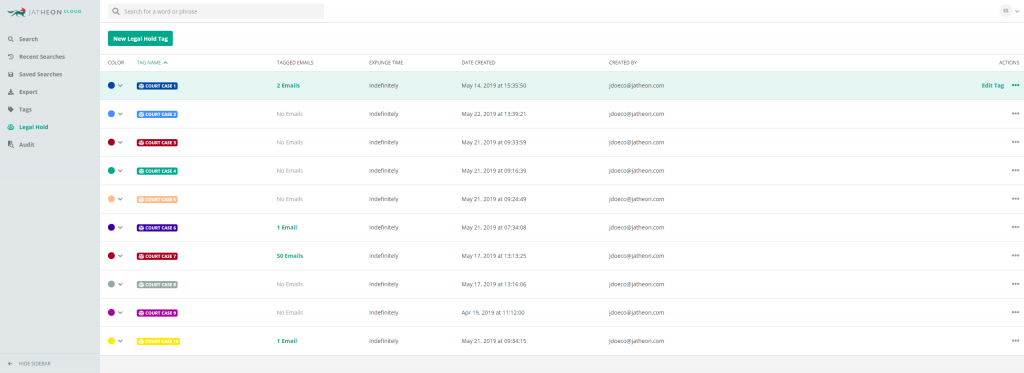
The biggest benefit is the cost-effective process of archiving emails on a cloud platform that retains them for as long as necessary and automatically deletes them after the retention period expires. This means no manual work for you after creating the policy.
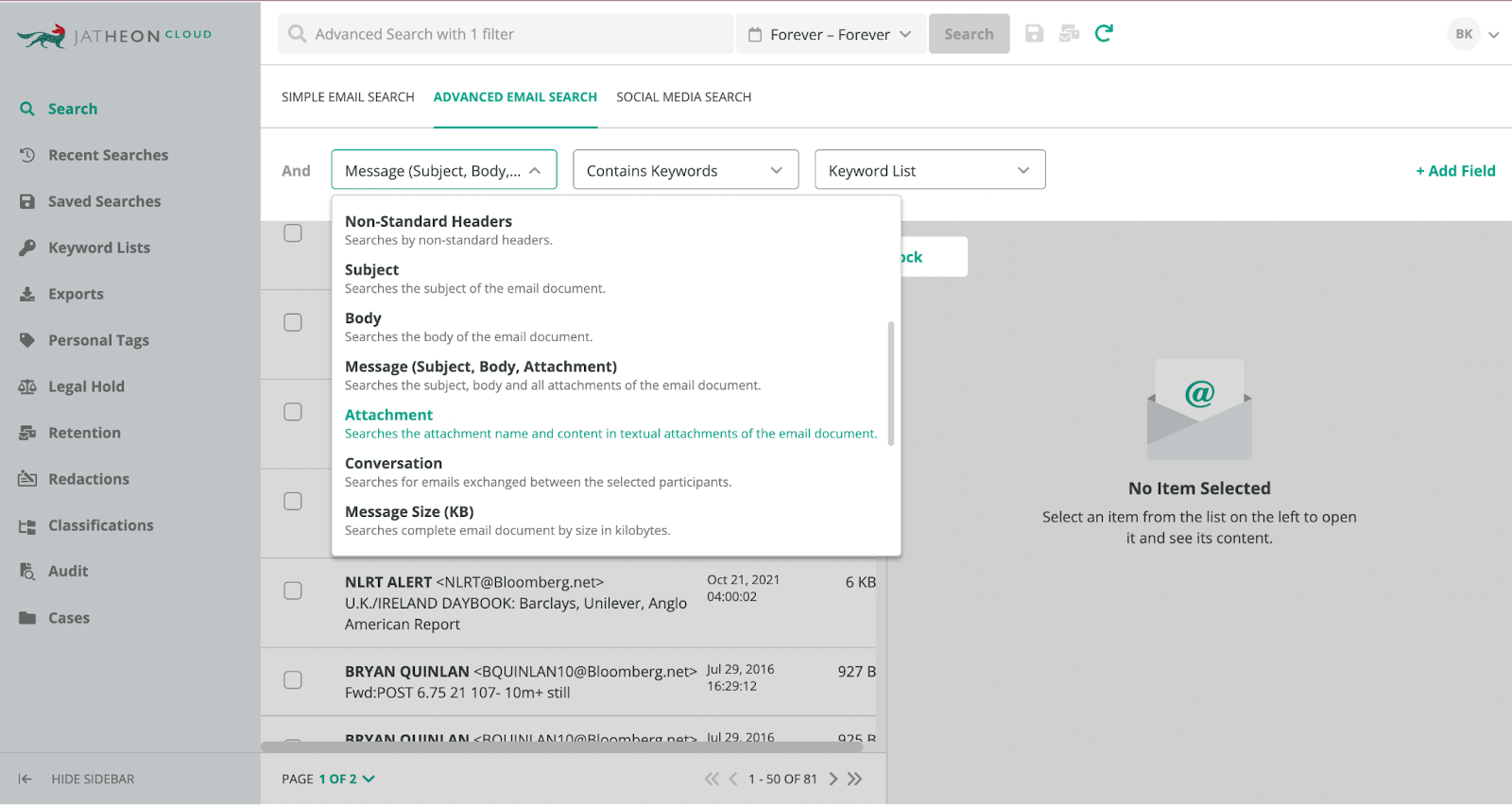
Going even further beyond, software like Jatheon automatically retains emails that match a certain policy and allows you to search for emails for that specific policy, which is easy with its advanced filters.
Use email retention policies to proactively monitor communication
Your email archiving software can also help your compliance and HR teams monitor communication for policy violations, data leakage, and other conduct risks.
Some common things these systems can flag:
- An employee shares personally identifiable information
- Sudden mass-downloads of documents or email attachments
- Messages that violate internal company rules
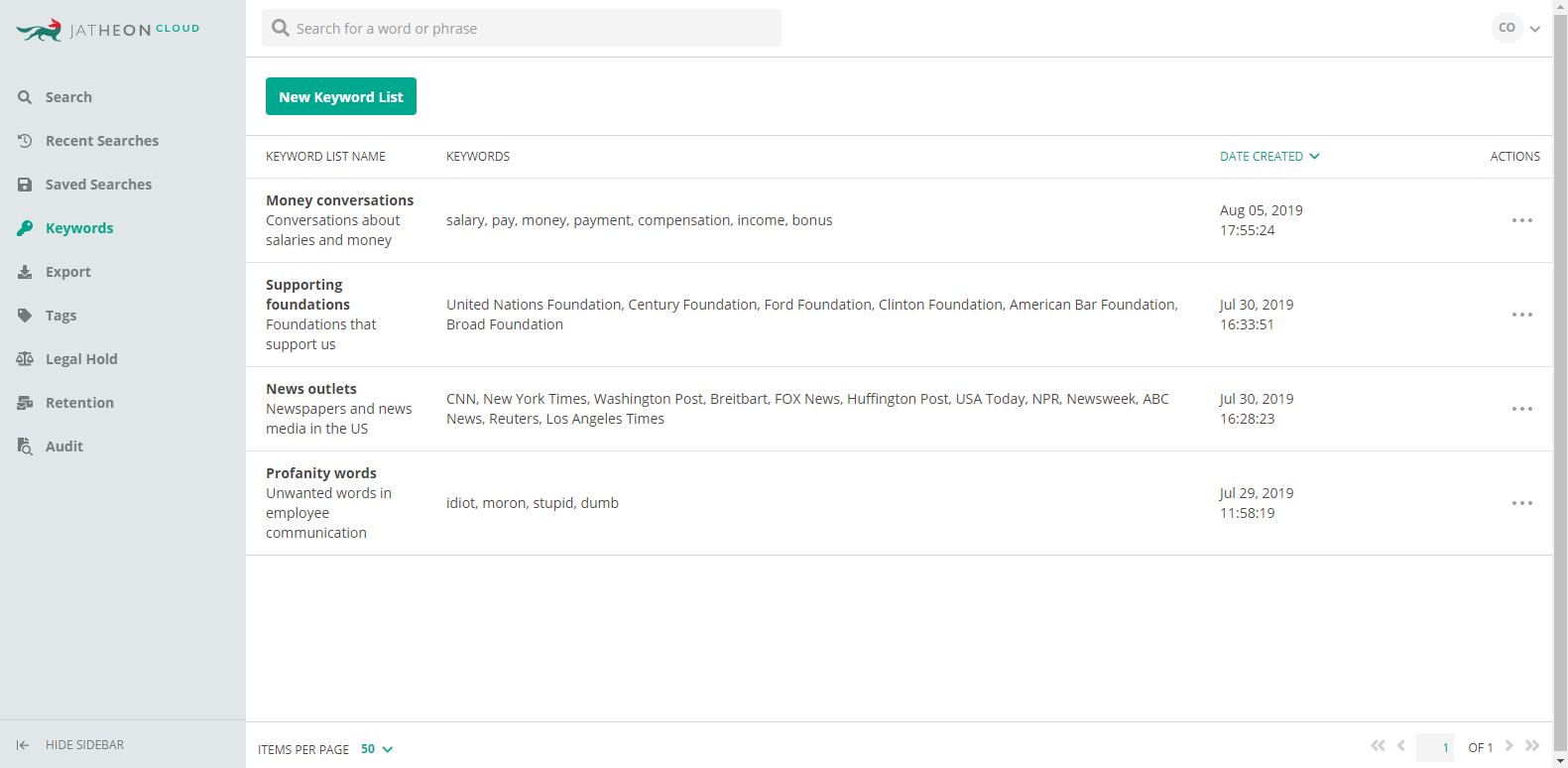
Instead of relying on manual review, archiving solutions with policy-based tagging, keyword lists, and automated alerts can surface relevant messages as they are captured.
In Jatheon, this can be configured by creating keyword or pattern-based rules and applying retention tags that preserve matching emails for review.
Think beyond email retention and archiving
Email is still the primary channel for business-critical communication, but it’s no longer the only one.
Teams, Slack, Zoom, WhatsApp, and SMS now carry conversations that are just as relevant to compliance and litigation. If your retention policy only covers email, you have a gap, and that gap is exactly where regulators and opposing counsel will look.
That’s why you need to apply your retention policies to all other communication channels your organization has approved for official use. Ideally, you’ll get an archiving platform that captures and retains communications across all channels in a single interface.
Get a list of all supported data sources Jatheon can capture and retain.
Regularly inform your staff, enforce, and update your policy
Once the policy is written, make sure people actually know it exists. Walk staff through the rules, add it to the employee handbook, and cover it in onboarding for new hires. A policy buried in a SharePoint folder no one opens is the same as no policy at all.
Regulations change. So do your tools and your business. Review the policy at least once a year, and update it when something shifts. What worked in 2022 might already be out of date.
The last piece is enforcement. Someone has to watch that the rules are being followed, so assign owners by department or team. Without that, you have a policy on paper and a different story in the inbox.

How Retention, Deletion, and Legal Holds Work Together
These processes should work in a clear hierarchy:
- Your retention policy is your starting point.
- Legal holds override all retention and deletion schedules from the policy.
- Retention policies define the minimum period before deletion is permitted.
- Deletion policies define when and how data is purged after retention expires.
Most Common Email Retention Policy Mistakes
Our support and compliance team helps customers set up email retention policies, and these are the mistakes we see derail them most often.
- Applying a single retention period across all departments, regardless of regulatory exposure
- No documented exception process for legal holds
- Relying on employees to manually classify or delete emails
- Failing to include non-email channels such as Teams, Slack, and SMS in the retention scope
- No annual policy review or audit trail of policy changes
- Over-retaining data without legal justification. In fact, while 80% of companies report having defined retention policies, only 33% consistently enforce data disposal timelines.
These challenges are avoidable. A strong, well-maintained email retention policy, paired with archiving software, ensures that only relevant data is retained, securely stored, and readily accessible when needed.