
Key Takeaways
- Data archiving moves inactive communications and records into secure, indexed, long-term storage, separate from production systems.
- Compliance with regulations like SOX, HIPAA, SEC Rule 17a-4, and FOIA is the primary driver for most organizations.
- A strong archiving strategy requires cross-department collaboration, automated retention policies, and defensible deletion workflows.
- The right archiving solution should support multi-channel capture, advanced search, legal hold, audit trails, and configurable retention.
- Cloud-based archiving reduces storage costs, improves disaster recovery, and centralizes ediscovery across all communication channels.
Introduction
Most organizations have years of communication data scattered across mailboxes, PST files, cloud platforms, and personal devices, with no single system that can search, hold, or produce it on demand.
The problem runs deeper than storage. The moment an audit, a litigation hold, or an open records request lands, that scattered data becomes a compliance exposure you can’t answer for in time.
The reality is simple. Your communications data is either an asset you can act on or a liability that puts you in breach of retention and privacy laws. There’s not much middle ground.
That’s why more companies are turning to data archiving, not just to store records, but to keep them searchable, defensible, and ready the moment someone asks.
Here’s what we’ll cover in this article:
- What is data archiving
- Major benefits of data archiving for your organization
- Data archiving best practices to follow
- The most important features to look for in data archiving solutions
What Is Data Archiving?
Data archiving is the process of identifying inactive data and moving it to a secure, long-term storage location, separate from active production data. This way, data can be easily accessed when needed without impacting system performance, cluttering active storage, or compromising compliance.
Data moves through a lifecycle: creation, active use, inactive retention, archiving, and defensible deletion. Archiving serves as the bridge between active data management and compliant disposal by preserving inactive records for long-term retention without burdening production systems.
In practice, archived data is captured at creation or ingestion, indexed with full metadata, stored in a tamper-proof format such as WORM, and made searchable so it can be retrieved quickly for audits, investigations, and legal matters.
This practice is essential for:
- Compliance requirements
- Cost-effective data management
- Freeing up space in primary storage systems
- Fast and efficient ediscovery
- Strategic analysis
- Historical reference
- Lawsuit management
- Business intelligence
- Information governance
Sometimes referred to as Enterprise Information Archiving (EIA), data archiving extends beyond mere data retention and encompasses a whole strategy for managing an organization’s data lifecycle.
Types of archived data
Business-critical data takes many forms and travels through many communication channels, and all of it matters, both for compliance and for running the business well.
Email was the first electronic communication channel to fall under formal U.S. retention rules. The SEC’s 1997 amendments to Rule 17a-4 brought broker-dealer email into the recordkeeping regime, and the Sarbanes-Oxley Act of 2002 broadened the scope further after Enron, pulling audit-related electronic records into long-term retention and putting recordkeeping squarely on the radar of public companies.
Since then, the picture has grown more complex. As businesses adopted new channels, archiving evolved to keep pace, and today’s solutions can capture and retain a far wider range of data types than email alone.
The most common data types archived are:
- Email (with attachments and all relevant metadata)
- Social media (Meta/Facebook, X, Instagram, LinkedIn, etc.)
- Internal and external collaboration platforms (Teams, Zoom, Slack, Meet, etc.)
- Instant messaging platforms (e.g., WhatsApp, Signal, WeChat)
- Mobile calls, voicemail, and text messages
- Websites
Data Archiving vs. Data Backup
Data archiving and data backup are often mentioned together, but they serve different purposes. Archiving is designed for long-term retention, search, compliance, and item-level retrieval of inactive data.
Backup is designed to restore systems and files after data loss, corruption, or disaster.
Here’s a comparison table to help you better understand the difference between the two:
| Criteria | Data Archiving | Data Backup |
| Purpose | Long-term retention, compliance, ediscovery, and historical reference | System and file recovery after loss, corruption, or outage |
| Data State | Inactive or less frequently accessed data | Active system data copied at a point in time |
| Retention Period | Typically years, based on legal, regulatory, or business requirements | Usually shorter-term and based on recovery objectives |
| Retrieval Method | Searchable, item-level retrieval of specific records | Restore-based recovery of files, servers, or full environments |
| Indexing & Search | Indexed with metadata and built for fast search | Limited search compared to archive platforms |
| Granularity | Individual emails, messages, files, or records | Entire systems, folders, or backup sets |
| Compliance Use | Well-suited for retention mandates, legal hold, and auditability | Not designed as a primary compliance retention system |
| Storage Format | Often immutable or tamper-proof, including WORM options | Designed for recoverability rather than evidentiary preservation |
6 Major Benefits of Data Archiving
Data archiving is a crucial aspect of any business operation that wants to take care of its data and stay compliant.
But most don’t realize that there’s more to archiving than just storing data.
Here are the key benefits of your organization implementing data archiving solutions into your workflow.
Meet compliance requirements
Whether you run a school, a government agency, or a business in a regulated industry, compliance is the first thing to think about when it comes to your data. It’s always been the number one reason to archive, and that won’t change. Get it right, and you can operate without worrying about fines or penalties for failing to retain communications.
Retention laws leave little room for interpretation. Most require you to keep data for extended periods, typically five to seven years, in a secure, protected environment.
Archiving everything your organization communicates through, from email to social media to text messages, keeps you on the right side of those laws. Just as important, it means you can actually produce the records a regulator asks for when they ask for them.
Common U.S. retention requirements include:
- SOX — Seven years for audit-related records and working papers under Section 802 and 17 CFR 210.2-06.
- SEC Rule 17a-4 — Six years for many broker-dealer records, with the first two years held in an easily accessible location.
- HIPAA — Six years for compliance documentation, policies, and procedures, measured from creation or the date last in effect (medical records themselves are governed separately by state law).
- FINRA — Three to six years, depending on record type.
- FOIA and state open records laws — Retention requirements vary by jurisdiction and agency.
GDPR and other international privacy laws cut the other way, requiring lawful deletion once the retention purpose has expired. Archiving policies have to handle both sides, preserving what regulators require, and disposing of what privacy law says you shouldn’t keep.
Centralize ediscovery
Your communications records are filled with business-critical information and insights into your projects and employees.
This means that your data can serve as evidence whenever there is a dispute at hand. Think employee disputes, harassment cases, discrimination claims, fraud, or embezzlement.
Data archiving does real work in electronic discovery, particularly in Early Case Assessment. At the start of a case, legal teams need to search and review large volumes of records quickly, often before deciding whether to litigate, settle, or move to dismiss.
Not archiving your data leaves you without evidence, which might cost you the case or require significant resources to find.
- Rising costs — Organizations are bringing ediscovery in-house to reduce reliance on outside counsel.
- Channel complexity — Discoverable data now spans email, mobile, social media, video, and audio.
- Dark data volume — Unstructured data from non-traditional sources accounts for 80-90% of all data.
How legal holds work in a data archive
A legal hold suspends automatic deletion for specific custodians or data sets when litigation is anticipated or pending. Without archive-based legal hold capability, organizations risk spoliation sanctions if relevant records are deleted under a normal retention policy. Jatheon supports legal hold functionality that preserves records regardless of retention policy expiration.
Without a comprehensive data archiving solution, this information is spread throughout your entire organization, which makes it difficult to control and use proactively.
In addition to that, employees increasingly create, access, and manage business information from personal devices. And even the most compliance- or ediscovery-conscious people make mistakes when generating or deleting data on BYOD devices.
Reduce storage load and costs
A large share of any organization’s institutional knowledge, client communications, and contractual discussions lives inside email and messaging platforms. That data is critical to protect, but the more of it you keep on your production servers, the slower they get and the more they cost to maintain.
Deleting isn’t an option. Some of it is too valuable to lose, and the rest is under mandatory retention.
Here, data archiving is the answer that allows you to offload your server and store all important data in the cloud, which is far more cost-efficient than increasing the storage capacity and power of your server.
Additional options include auto-removal of duplicate messages as well as advanced compression techniques that further reduce the strain on servers.
The operational gains compound from there. Lighter servers mean faster performance for everyone: quicker access to mailboxes, faster searches, smoother day-to-day work. IT teams see it too, with fewer mailbox management tickets, shorter backup windows, and lower maintenance overhead.
Improve disaster recovery
Data archiving plays a key role in enhancing disaster recovery strategies.
When you store your critical data in a stable, accessible format, you ensure that the information is protected against unexpected events like system failures, cyber-attacks, or natural disasters.
Every organization needs a second layer of data protection and security. Typical data backups aren’t always the best solution.
Backups take snapshots of your current system without taking into account individual items. It’s all or nothing.
On the other hand, data archives store each new piece of data at the time of its creation while still allowing you to have uninterrupted access to information.
Data archiving also simplifies the recovery process.
Since archives are typically well-organized and indexed, retrieving specific data in the aftermath of a disaster becomes much more manageable.
Archived data can also degrade over time through bit rot or media failure, especially on tape or aging disk systems. Compliance-grade archives address this through immutability controls, redundant storage, and periodic integrity validation to confirm that records remain complete and defensible.
By enabling faster restoration of data, archiving not only supports operational resilience but also helps maintain regulatory compliance during and after a disaster, ensuring that businesses can continue to operate within legal frameworks.
Manage company knowledge
When a senior employee leaves, their email and messaging history go with them, unless it’s archived.
A properly maintained archive preserves client communication history, project decisions, and vendor agreements that would otherwise disappear. It also gives compliance and HR teams the ability to reconstruct decision-making timelines during audits or internal investigations.
Turn the archive into a business asset with AI
For most of its history, the archive sat quietly in the background, a compliance obligation that paid for itself by keeping the auditors and lawyers off your back.
That’s changing. The same archive that holds years of email, chat, and mobile communications is now one of the richest sources of internal data in the organization, and AI is what makes it usable.
Modern archiving platforms layer AI on top of the underlying storage to do work that used to require either manual review or a dedicated analytics team. A few of the patterns showing up across regulated industries:
- Proactive surveillance. Instead of waiting for an incident to trigger a review, AI-driven classifiers continuously scan archived communications for policy violations, harassment language, insider trading signals, and other risk patterns. Compliance teams get flagged items to triage rather than a haystack to search.
- False positive reduction. Traditional keyword-based supervision tools generate enormous review queues full of irrelevant hits. AI models trained on regulated communications can cut review volume significantly while improving the quality of what does get flagged.
- Decision and sentiment context. Beyond individual messages, AI can surface decision-making timelines, sentiment shifts across teams, and unusual communication patterns, useful for HR investigations, internal audits, and reconstructing the chain of events leading up to an issue.
- Faster ediscovery. Concept search, document clustering, and summarization tools turn what used to be a weeks-long review process into something a small team can run in days, without sacrificing defensibility.
The shift matters for budget conversations, too.
Archiving has historically been positioned as a cost center, necessary but not strategic. AI changes that calculus by turning the archive into a source of business intelligence and risk insight that the rest of the organization can draw on, which is starting to show up in how procurement teams write their requirements.
For organizations evaluating archiving solutions, AI capability is becoming part of the buying criteria. Not as a checkbox, but as a question of whether the platform you choose now will still serve the supervision, governance, and intelligence needs of the next five years.
Data Archiving Requirements by Industry
Retention rules don’t apply evenly.
What counts as compliant in one industry can fall well short in another, because the laws were written for different risks, like financial misconduct, patient privacy, public accountability, or student records. The result is a patchwork of overlapping obligations, each with its own retention periods, scope, and consequences for getting it wrong.
The sections below guide you through what that looks like in four of the most heavily regulated sectors, and what archiving needs to cover in each.
Financial services
Financial services organizations typically face some of the strictest archiving rules. SEC Rule 17a-4 requires many broker-dealer records to be retained for six years, while FINRA rules commonly require retention for three to six years, depending on the record type.
Public companies also need to account for SOX requirements for audit-related records, including certain electronic communications, for at least five years.
In practice, that means archiving email, chat, mobile messages, and other business communications in a format that supports supervision, auditability, and retrieval.
The cost of getting this wrong has stopped being theoretical. Since 2021, the SEC and CFTC have collected more than $3 billion in penalties from broker-dealers, investment advisers, and swap dealers for failing to preserve off-channel communications, mostly business conversations happening on personal phones over WhatsApp, iMessage, and personal email.
The list of firms affected reads like a roster of the largest banks and asset managers in the world: JPMorgan, Morgan Stanley, Goldman Sachs, Bank of America, Citigroup, Wells Fargo, and dozens of smaller firms have all settled.
What regulators have made clear is that the firm is on the hook regardless of where the conversation happens. If business is being discussed, it needs to be captured, retained, and produced on request, and “we don’t allow employees to use WhatsApp” isn’t a defense if employees are using it anyway.
That’s pushed financial services firms toward archiving solutions that capture mobile, messaging, and collaboration platforms alongside email, rather than treating them as out-of-scope.
Healthcare
Healthcare providers and related organizations often need to align archiving practices with HIPAA.
HIPAA generally requires policies, procedures, and related documentation to be retained for six years from the date of creation or the date when the document was last in effect, whichever is later.
Archived data may include patient-related communications, internal email, messages, and compliance documentation.
Retention schedules also need to account for state-level healthcare recordkeeping rules where they apply.
Government and public sector
Government agencies need archiving policies that account for FOIA, state open records laws, and formal records schedules.
Retention periods vary based on jurisdiction, agency type, and record category, and many agencies also follow NARA schedules for federal records.
Email, text messages, collaboration data, and public-facing website content can all fall within records retention and disclosure obligations. Fast search and defensible production matter because open records and public records requests often have short response timelines.
Education
Educational institutions need to consider FERPA, state records retention schedules, and internal governance requirements.
Archived data may include student-related communications, staff email, administrative records, and disciplinary or HR documentation.
Retention periods vary by state and by record type, which means schools and universities need clear policies for both preservation and deletion. For regulated or publicly funded institutions, archiving also supports investigations, audits, and public records requests.
Choosing a Deployment Model
Where your archive lives matters as much as what it captures. Regulatory expectations, data residency rules, internal security postures, and budget structure all push organizations toward different deployment models, and the right choice often comes down to which trade-offs you’re willing to make on control, scalability, and operational overhead.
There are three options most regulated organizations evaluate.
Cloud archiving
Cloud archiving runs on third-party infrastructure, in Jatheon’s case, AWS, with the vendor handling provisioning, scaling, redundancy, and uptime. It’s the path of least resistance for organizations that want to move fast, avoid hardware refresh cycles, and shift archiving from a capital expense to a predictable operating cost.
Cloud is a strong fit for organizations that:
- Need to scale storage and ingest capacity without forecasting hardware budgets years out
- Want multi-zone redundancy and disaster recovery built in rather than engineered separately
- Have data residency requirements that can be met through regional cloud zones and geofencing
- Don’t have the IT headcount to run an on-premises archive
The trade-off is that your data sits in the vendor’s environment, which means due diligence on certifications (SOC 2, ISO 27001, HIPAA, GDPR readiness), encryption, and contract terms matters more than it would with on-prem.
On-premises archiving
On-prem keeps the archive inside your own data center, on hardware you own and control. For organizations with strict data residency rules, classified or air-gapped environments, or internal security policies that prohibit third-party data custody, this is often the only viable option.
On-prem is a strong fit for organizations that:
- Operate under data sovereignty rules that prohibit storing records outside their own infrastructure
- Need to integrate the archive with internal security tooling that can’t reach into a vendor cloud
- Prefer a one-time capital investment over a recurring subscription
- Have the IT capacity to manage hardware lifecycle, backups, and uptime
The trade-off is operational ownership. Hardware refreshes, capacity planning, and disaster recovery all sit with your team, though a strong vendor relationship and a well-engineered appliance can take much of that off the IT roadmap.
Hybrid archiving
Hybrid deployments combine on-premises and cloud components to balance control, resilience, and flexibility.
Organizations may keep some records on local infrastructure while using cloud capacity for scale, redundancy, or secondary retention needs. This approach can work well when compliance requirements vary by department, data type, or geography.
How to choose
The deployment decision usually comes down to four questions: Where does the law say your data can live? What does your security team accept? How predictable is your data growth? And what’s your IT team’s appetite for managing infrastructure?
There’s no single right answer: a federal agency with classified workloads and a fintech scaling internationally will land in very different places.
What matters is that the deployment model fits the regulatory and operational reality of your organization, not the other way around.
Data Archiving Best Practices and Strategy
Like any business process, data archiving needs to be approached strategically by examining all relevant data retention regulations in your industry and creating the right data retention policy.
Audit your data sources and volumes
Before selecting a platform, inventory the communication channels your organization uses, the volume of data each system generates, and where that data currently lives.
That includes email, PST files, collaboration tools, social media, mobile data, cloud storage, and any legacy archive systems.
This gives you a clear picture of what needs to be captured and migrated.
Map the regulations that apply to your organization
Analyze the regulations that apply to your industry and the location(s) of your business, then map those requirements to specific data types.
The goal is to make sure your archiving policy follows the retention periods outlined in the laws that govern your organization.
This step is especially important for regulated sectors that must account for overlapping rules.
Define roles and responsibilities across departments
Include multiple departments in the creation of your data archiving strategy.
Legal and compliance teams should define retention and legal hold requirements, IT should own infrastructure and system administration, and HR should help govern employee-related data policies.
Clear ownership reduces policy gaps and makes day-to-day administration easier.
Set retention schedules and avoid keeping everything forever
Create retention schedules that reflect the value and regulatory status of each record type.
Avoid retaining all your data indefinitely, because over-retention creates liability and increases the time required to locate information during searches or investigations.
Some records, however, may need to be archived for longer periods or permanently.
Automate deletion for defensible deletion
Automate the data deletion process when the retention period expires.
Defensible deletion means data is removed according to documented policy, with audit trails that show the deletion was lawful, intentional, and consistent. This helps reduce both over-retention risk under privacy laws and under-retention risk under compliance rules.
Prioritize security, privacy, and uptime
Pay attention to the security of your data archiving solution.
Storage doesn’t equal security by default when it comes to data, so look for strong access controls, encryption, data privacy certifications, reliable uptime, and a clear service level agreement.
These controls matter just as much as storage capacity.
Preserve integrity and prevent unauthorized changes
Ensure the integrity of your data by employing validation methods like integrity checks that allow for your data to be valid in the name of the law.
Archived data should be stored in a tamper-proof format so individual users can’t alter records after capture. That is what gives archives evidentiary value in audits, investigations, and legal matters.
Test the solution before rollout
Explore different types of data archiving software solutions and make sure to have a demo or do a POC to test the solution.
The platform needs to be equipped with the features your industry and organization require, and testing gives you a chance to evaluate usability, search performance, retention controls, and migration readiness before full deployment.
Let’s take a look at the must-have features of any great data archiving solution that you should consider.
Data Archiving Solutions: Features To Look For
A quick recap: your data archiving solution needs to help you meet regulatory compliance requirements, perform ediscovery, and manage your data.
Here’s a list of the must-have features and some bonus ones that an archiving solution needs to have for you to consider it:
- Automatic data capture — A proper data archive needs to be able to capture the data at the moment of its creation and store it individually, instead of periodically taking snapshots of your data.
- Centralized archiving — Data isn’t only in your email messages. Your social media, text messages, Zoom calls, and even AI conversations should also be captured. Running separate systems for each source only makes the problem harder. Jatheon brings every channel into a single archive, so you can search, hold, and produce data the same way, no matter where it originated.
- Configurable retention policies — Granular retention policies and the ability to schedule automatic deletion allow for easy policy management and minimize human error. While examining different data archiving tools, be sure to ask if there is a limit to the number of retention policies that can be applied to avoid additional costs down the road.

- Ediscovery capabilities — For an archive to hold up as an ediscovery tool, it needs tamper-proof storage that preserves the evidentiary quality of every record. SEC Rule 17a-4 has historically required WORM storage, and after the 2022 amendments, broker-dealers can now choose between WORM and an audit-trail-based alternative that delivers equivalent protections. Either way, the archive should support strong, unified search across large data volumes, including Boolean, wildcard, proximity, fuzzy, and a wide range of metadata-based criteria, so you can pinpoint the exact records you need across terabytes of communications.

- Access controls — Your archive needs to allow administrators to assign different roles to your team members. Each role should get access to different features depending on their needs and employee status. Some archiving solutions offer only pre-set user roles, while others allow more flexibility. Jatheon has 3 default roles, but also offers fully customizable user roles with 60+ different permissions.

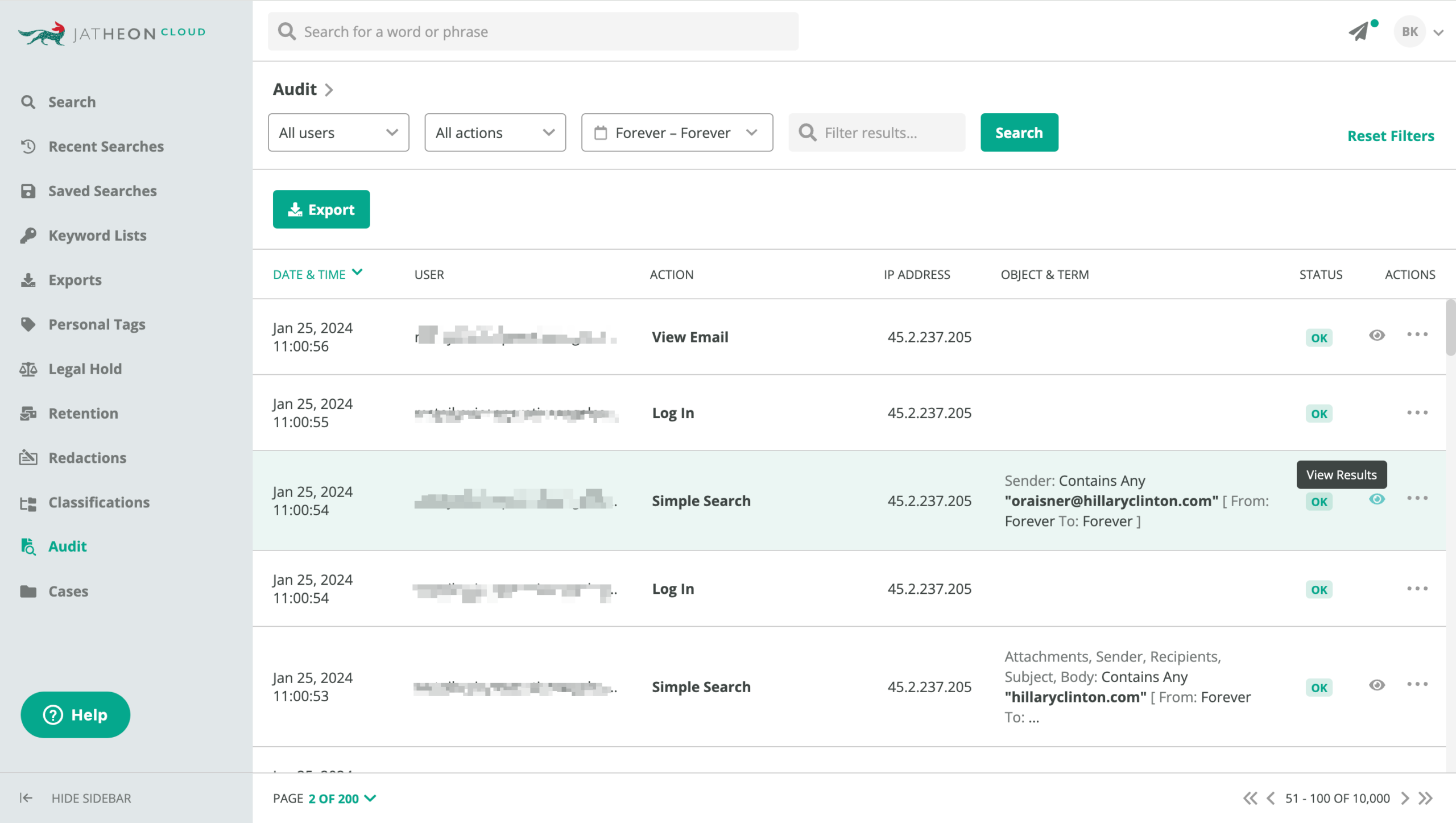
- Audit trail — The system should offer a full audit log so that the responsible teams can control user activity on the platform and check if anyone tried to misuse the system.
- Integration of historical data — Most organizations already have volumes of historical data that need to be preserved, but might be housed in another system or disparate systems. An efficient data archiving software will allow you to migrate your existing data from a legacy or competitor system without major issues and preserve data integrity.
- Technical support — You need a reputable archiving vendor whose technical expertise isn’t the only thing they can offer. When you need to retrieve data fast and something goes wrong, you need a trusted partner whose technical support team can assist you 24/7.
Conclusion
Archiving isn’t the most visible system in your stack, and it shouldn’t be. It does its best work quietly in the background, right up until an audit lands or a records request arrives with a tight deadline and the whole organization is suddenly leaning on it.
The organizations that get this right treat archiving as infrastructure rather than insurance, a foundation that carries compliance today while supporting the ediscovery, supervision, and AI-driven intelligence work that’s quickly becoming part of how regulated industries operate. The cost of getting it wrong keeps climbing, and the upside of getting it right has never been larger.