Key Takeaways
- Data management tools span eight categories, from governance and archiving to warehousing, security and beyond, and most organizations need a combination of them.
- Regulated industries face retention, supervision and legal readiness requirements that generic data management guides routinely overlook.
- Data archiving is a distinct data management category focused on long-term, searchable, tamper-proof storage for compliance and ediscovery.
- Tool selection for compliance-driven organizations should weight regulatory features, audit trails and retrieval speed alongside scalability and cost.
- AI-powered classification and search capabilities are transforming how organizations manage, supervise and retrieve archived data at scale.
Introduction
Seventy-three percent of companies now operate under at least one data privacy or retention regulation, according to the International Association of Privacy Professionals (IAPP). For organizations in healthcare, financial services, government and education, that number climbs closer to 100%. The result: selecting the right data management tools isn’t a technology decision alone. It’s a compliance and legal risk decision.
Most guides on data management tools cover the same four or five categories and move on. They talk about integration, warehousing, governance and analytics. What they miss is the category that matters most to organizations facing audits, FOIA requests, SEC examinations or HIPAA investigations: data archiving and retention.
IDC projects that the global datasphere will reach 291 zettabytes by 2027, with enterprise data growing at roughly 28% per year. That growth rate makes manual data management unsustainable and makes tool selection a strategic decision with direct compliance implications.
In this article, you’ll learn:
- What data management tools are and how they differ from platforms and strategies
- The eight categories of data management tools every organization should evaluate
- How to choose tools based on compliance requirements, not just technical specs
- Why regulated industries need archiving and retention tools most guides ignore
- Where AI-powered archiving fits into a modern data management strategy
What Is Data Management?
Data management is the practice of collecting, storing, organizing, protecting, and governing data across its full lifecycle, from ingestion and transformation through long-term retention and eventual deletion. It spans software tools, organizational policies, and operational processes that together determine how reliably an organization can use its data and prove compliance with the regulations that govern it.
Types of data management tools
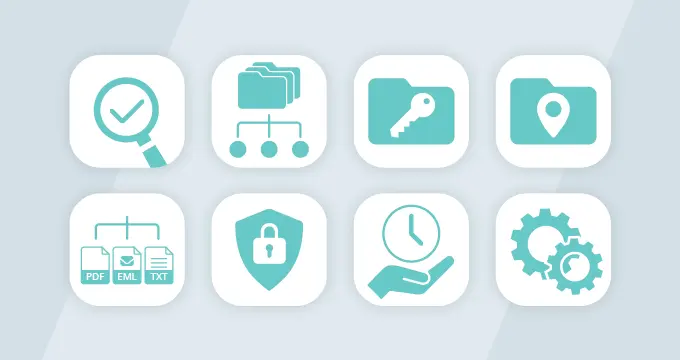
Whether you’re evaluating a single tool or a full data management platform, the landscape includes eight distinct categories, each serving a different function in the data lifecycle. Understanding all eight helps you build a strategy that covers not just analytics and efficiency but also retention, legal readiness and regulatory compliance.
Data Governance Tools
Data governance tools enforce the policies, standards, and accountability structures that determine how your organization handles its data, including who can access it, where it flows, and what happens when policies are violated. For compliance-driven organizations, a governance layer is what allows you to prove compliance, not just achieve it. Without documented policies, lineage tracking, and stewardship workflows, even well-managed data can’t satisfy an auditor.
Collibra

Collibra is an enterprise data and AI governance platform that centralizes policies, automates stewardship workflows, and enforces compliance across complex data environments. Recognized as a Leader in both the Gartner Magic Quadrant for Data and Analytics Governance Platforms and the Forrester Wave for Data Governance Solutions (Q3 2025), it is widely deployed by Global 2000 organizations in financial services, healthcare, and the public sector. Collibra expanded its platform to cover AI governance through ISO 42001 certification and the acquisition of Deasy Labs, extending governance capabilities to unstructured data including documents, transcripts, and presentations.
Key features:
- Centralized policy management and stewardship workflows that automate compliance checks, flag violations in real time, and maintain a full audit trail for regulatory adherence
- Data and AI governance covering structured data, unstructured assets (documents, transcripts), machine learning models, and AI agents across AWS, Azure, Google, and Databricks environments
- Native connectivity to 100+ data sources with FedRAMP authorization for federal agencies and public sector organizations with strict security requirements
- Automated compliance support for GDPR, HIPAA, CCPA, SOX, BCBS 239, and the EU AI Act, with lineage tracking from source datasets through model training and deployment
- Business glossary and data catalog integration that connects technical metadata with business definitions, making governance accessible to non-technical stakeholders
- ISO 42001 certification for AI management systems, alongside signing of the European Commission’s AI Pact, positioning the platform for emerging AI regulatory requirements
Best for: Chief Data Officers, data governance teams, and compliance functions at large enterprises in regulated industries that need to operationalize governance at scale across a complex, multi-source data environment and demonstrate regulatory readiness to auditors and regulators.
Not the right fit if: you’re a small or mid-size organization. It’s priced and architected for large enterprises with dedicated data governance teams and multi-year implementation timelines.
Microsoft Purview

Microsoft Purview is a unified data governance, compliance, and security platform that consolidates capabilities previously split across Azure Purview and Microsoft Compliance into a single system. It covers three interconnected areas: data governance (discovering, classifying, and cataloging data across on-premises, cloud, and SaaS environments), data security (sensitivity labels, DLP policies, insider risk management, and encryption), and data compliance (ediscovery, audit, records management, and data lifecycle management). For organizations already running Microsoft 365 and Azure, Purview provides a native compliance layer that reaches across the entire Microsoft estate without requiring separate tooling.
Key features:
- Automated data discovery and classification across Azure, Microsoft 365, AWS S3, Google Cloud Storage, and on-premises sources using AI-powered scanning and sensitivity labeling
- Data Loss Prevention (DLP) policies that detect and block the movement of sensitive data across email, Teams, SharePoint, endpoints, and cloud apps
- Communication compliance for monitoring Microsoft Teams, Exchange, and Yammer communications for policy violations, regulatory language, and insider risk indicators
- ediscovery and audit capabilities covering content search, legal hold, case management, and audit log review across Microsoft 365 workloads (relevant for FOIA, FINRA, and litigation response)
- Records management and data lifecycle policies for automated retention and defensible deletion of regulated content, with support for GDPR, HIPAA, CCPA, SOX, and SEC requirements
- Microsoft Copilot integration for AI governance, including visibility into what data AI models access and classification-based controls on what Copilot can surface to users
Best for: Compliance, legal, and IT teams at organizations with significant Microsoft 365 and Azure footprints that need a unified platform for governance, regulatory compliance, and communication supervision without deploying separate point solutions for each function.
Not the right fit if: you’re not heavily invested in the Microsoft ecosystem. Purview’s deepest capabilities are in M365 and Azure environments, with more limited coverage and integration outside them.
Data Archiving and Retention Tools
Data archiving is the category most data management guides skip or conflate with backup. They’re different: backup creates recovery copies of active data; archiving moves inactive data into long-term, searchable, tamper-proof storage built for compliance, legal readiness, and retention policy enforcement.
Your organization generates communications data every day — email, SMS, instant messages, social media, collaboration platform conversations, and regulations require you to retain most of it. HIPAA mandates six-year retention for certain records. FINRA requires broker-dealers to preserve communications for at least three years. FOIA compels agencies to make public records producible on request. When litigation begins, legal hold capabilities prevent deletion of relevant records. Without them, organizations face sanctions, adverse inferences, and significant outside counsel costs. The Ponemon Institute found the average cost of non-compliance reached $14.82 million in 2024.
Jatheon
Jatheon is a compliance archiving platform that captures, retains and makes searchable email, mobile communications (SMS/MMS/voice), social media, instant messaging and collaboration platform data and websites in a tamper-proof format. Built for regulated industries that must meet long-term retention mandates and produce records during audits, open data, ediscovery or regulatory examinations, Jatheon supports both cloud and on-premises deployment, giving organizations with strict data residency or sovereignty requirements full control over where their archived data lives. Its AI-powered search and classification capabilities allow compliance and legal teams to retrieve specific records across millions of archived items in seconds rather than days.
Key features:
- Wide channel coverage spanning email, SMS, voice, social media, WhatsApp, iMessage, Microsoft Teams, Slack and other collaboration platforms, all housed in a single platform
- AI-Powered Search & Classification: Uses AI to rapidly search and classify data across large communication archives, enabling faster, more accurate retrieval for legal, compliance, and regulatory requests. Delivers automated sentiment analysis, risk detection, and non-compliance identification while reducing the time and cost of investigations and ediscovery
- Legal hold and ediscovery workflows that automatically lock relevant records and prevent deletion when litigation or investigations begin
- Automated retention policy enforcement with defensible deletion, protecting organizations from both under-retention violations and the litigation risk of over-retention
- Supervision and compliance review workflows with keyword alerting, flagging and audit trails for monitoring regulated communications
- Tamper-evident storage with comprehensive audit logs for use during regulatory examinations, internal investigations and audits
- Open Data Request Automation (FOIA): Automates the processing of FOIA requests by converting uploaded request documents (PDF/TXT) into structured search criteria and date ranges, reducing manual effort, accelerating response times, and helping organizations meet statutory deadlines with greater accuracy and consistency
Best for: Compliance officers, legal teams and IT administrators at financial services firms, government agencies, healthcare organizations and public sector organizations subject to FINRA, SEC Rule 17a-4, HIPAA, FOIA, FERPA or similar retention and supervision mandates.
Not the right fit if: you only need to archive structured operational or transactional data. Jatheon is purpose-built for communications data (email, mobile, social, chat) and unstructured records.
Data Quality Tools
Data quality tools profile, cleanse, validate, and monitor data to ensure it remains accurate, complete, and consistent as it moves through your systems. While data governance defines the policies, data quality tools enforce them at the data layer by catching errors, schema drift, and contract violations before they reach production systems or downstream reports. For compliance-driven organizations, poor data quality isn’t just an operational problem; it produces inaccurate regulatory reporting and failed audits.
Gable
Gable is a data quality and governance platform that applies static analysis to source code to enforce data quality before issues reach production. It works by detecting changes in data-producing code, automatically generating data contracts, and flagging potential violations during development rather than after deployment. Teams get full visibility into how data flows from application code through backend systems, without deploying runtime agents or adding production overhead.
Key features:
- Automated data contract generation that analyzes existing code to draft data contracts automatically, reducing the manual effort typically involved in formalizing agreements between data producers and consumers
- Pre-deployment violation detection that flags breaking changes during development, preventing schema drift and data quality incidents from reaching downstream systems before they cause outages or audit failures
- Field-level data lineage from code, tracing individual data elements from consumer-facing applications through backend transformations to storage, with exportable lineage reports for privacy reviews and regulatory requests
- Static analysis at build time that captures data flows and ties them to specific releases, so compliance evidence ships alongside the code rather than being reconstructed after the fact
- One-click lineage reports for compliance audits, privacy reviews, and procurement requests, with controls showing which fields were masked, filtered, or transformed before reaching AI models or downstream consumers
- CI/CD integration that enforces data contracts as part of the existing development pipeline, making data quality checks a standard part of code review rather than a separate governance process
Best for: Data engineering and platform teams at mid-to-large enterprises in regulated industries, financial services, and healthcare, and organizations subject to data privacy regulations like GDPR or frameworks like BCBS 239. Also well-suited for teams managing AI/ML pipelines where documenting what data reaches models is becoming a compliance requirement.
Not the right fit if: your data pipelines are built outside your application codebase or managed by third-party tools. Gable requires source code access to analyze and enforce contracts.
Master Data Management (MDM) Tools
MDM tools create a single authoritative “golden record” for your organization’s core data domains: customers, products, employees, vendors, and assets. Without MDM, the same customer can exist in slightly different forms across your CRM, billing system, and support platform, creating reconciliation problems for finance, sales, and compliance teams. MDM tools solve this by matching, merging, and deduplicating records across systems and pushing updates back to connected applications. Customer data management is where MDM delivers the most immediate compliance value, particularly for financial services and healthcare organizations that must maintain accurate client records across multiple systems.
Informatica Intelligent Data Management Cloud (IDMC)
Informatica’s Intelligent Data Management Cloud (IDMC) is an AI-powered, multi-domain master data management platform that consolidates customer, product, supplier, and financial records into single authoritative golden records across the enterprise. Its proprietary CLAIRE AI engine powers the platform’s matching, deduplication, data quality, and lineage capabilities, with CLAIRE Copilot allowing users to interact with master data through natural language queries. Recognized as a Leader in the Forrester Wave for Master Data Management Solutions (Q2 2025) and the Gartner Magic Quadrant for Metadata Management, Informatica serves organizations that need to unify data across complex, multi-system environments while maintaining compliance and auditability.
Key features:
- Multi-domain MDM covering Customer 360, Product 360 (PIM), Supplier 360, and Finance 360, consolidating records across CRM, ERP, and operational systems into a single golden record
- CLAIRE AI-powered match analysis with field-level contribution scores and explainability, logging evidence for audit trails and enabling self-service threshold tuning without IT involvement
- Data Catalog Scanner for MDM that automatically harvests metadata, maps record-level lineage, and integrates with Cloud Data Governance and Catalog (CDGC) for compliance tracking during regulatory audits
- AI-powered CLAIRE Agents for autonomous data exploration, pipeline creation, data quality rule generation, and enterprise discovery using natural language
- Compliance reporting support for healthcare, financial services, and public sector with role-based access controls, data masking, and privacy policy enforcement
- Cloud-native SaaS deployment with high availability, scalability, and resilience for operational MDM workloads, alongside integration with Snowflake, Salesforce, Microsoft Dynamics, and Jira
Best for: Enterprise data teams and compliance functions at large organizations in healthcare, financial services, retail, and manufacturing that need to create a trusted, unified record for customers, products, or suppliers across a complex, multi-system landscape.
Not the right fit if: you need a fast time-to-value. Implementations typically run months, not weeks, and require significant internal resourcing and change management.
Data Warehousing and Data Lake Tools
Data warehouses store structured data optimized for fast queries and BI reporting, enforcing schema on write. Data lakes take the opposite approach by accepting raw data in any format and applying structure at read time, making them better suited for big data management use cases where organizations need to store everything first and decide how to analyze it later. Most enterprises now run a hybrid “lakehouse” architecture that combines the flexibility of a lake with warehouse-level query performance.
Snowflake

Snowflake is a cloud-native data platform that separates compute and storage, allowing organizations to scale query performance independently of how much data they store. Originally a data warehouse, it has expanded into a broader AI Data Cloud supporting data lakes, data sharing, machine learning, and application development — all within a multi-cloud architecture that runs on AWS, Azure, and Google Cloud simultaneously. For regulated industries, Snowflake’s compliance posture is one of its key differentiators: its Business Critical and Virtual Private Snowflake editions add customer-managed encryption keys, dedicated infrastructure, and enhanced network isolation on top of the platform’s baseline certifications.
Key features:
- Separated compute and storage architecture, enabling independent scaling of query resources and data storage without downtime or manual resizing
- Multi-cloud deployment across AWS, Azure, and Google Cloud, with data residency controls that restrict where data physically resides
- SOC 1 Type II, SOC 2 Type II, PCI DSS, HITRUST, CSA STAR, and FedRAMP authorizations, with HIPAA support available on Business Critical and higher editions
- Dynamic data masking and row-level security that control what individual users see based on roles, without maintaining separate copies of masked datasets
- Time Travel and Fail-safe capabilities allowing organizations to query, clone, or restore data at any point within a defined retention window — useful for audit and recovery scenarios
- Native data sharing that allows organizations to exchange live data with regulators, auditors, or partners without copying or moving the underlying datasets
Best for: Enterprises and regulated organizations that need a scalable, multi-cloud analytics environment with strong compliance certifications and the ability to share data securely across organizational boundaries.
Not the right fit if: you need on-premises deployment or have low, predictable workloads. Per-second compute pricing can add up quickly for organizations without variable query patterns.
Databricks
Databricks is the Data Intelligence Platform built on the lakehouse architecture, combining the flexibility of a data lake with the performance and governance of a data warehouse in a single, unified environment. Its Unity Catalog provides a centralized governance layer for structured data, unstructured files, machine learning models, dashboards, and AI agents — covering the full data and AI lifecycle within one policy framework. For regulated industries, Databricks offers FedRAMP High, DoD IL5, HIPAA, PCI DSS, and HITRUST certifications, with ITAR compliance available through its GovCloud deployment.
Key features:
- Lakehouse architecture on open data formats (Delta Lake, Apache Iceberg) that eliminates the need to maintain separate data lakes and warehouses under different governance policies
- Unity Catalog providing unified, cross-cloud governance for data, models, dashboards, and AI agents, with fine-grained access controls, lineage tracking, and policy enforcement in one layer
- Lakeflow for building batch and streaming ETL pipelines natively within the platform, with orchestration and transformation handled without external tooling
- FedRAMP High, DoD IL5, HIPAA, HITRUST, and PCI DSS compliance certifications, with GovCloud deployment for government agencies with ITAR and sovereignty requirements
- Databricks SQL for high-performance analytics with serverless execution, cost monitoring, and ANSI-compliant SQL
- AI and ML development environments, model serving, and agent tooling built directly into the same governed data foundation used for analytics and reporting
Best for: Data engineering and data science teams at enterprises that need a unified platform for analytics, AI/ML development, and compliance governance without operating a separate data lake and warehouse. Particularly strong for organizations building AI pipelines where data lineage and governance of training data is becoming a regulatory requirement.
Not the right fit if: your team lacks data engineering or ML expertise. The platform rewards technical depth and has a steeper learning curve than traditional warehouses.
Amazon Redshift
 Amazon Redshift is AWS’s fully managed cloud data warehouse, designed to run fast analytical queries against datasets ranging from gigabytes to petabytes. Available in both provisioned cluster and serverless configurations, it integrates natively with the broader AWS ecosystem — S3 for data lake storage, Glue for ETL, Kinesis for streaming ingestion, and CloudTrail for audit logging — making it a natural fit for organizations already operating on AWS. Its compliance posture covers HIPAA, SOC, PCI DSS, and FedRAMP, with all security features included at no additional cost across editions.
Key features:
- Serverless and provisioned deployment options, with Redshift Serverless scaling compute automatically to match query demand without cluster management
- Native integration with Amazon S3, Glue, Kinesis, and Lake Formation, enabling both batch and near-real-time data pipelines within a unified AWS data stack
- AES-256 encryption at rest and TLS in transit, with VPC isolation, IAM-based access control, and multi-factor authentication supported across all configurations
- HIPAA, SOC (1 and 2), PCI DSS, and FedRAMP compliance, with AWS CloudTrail logging every API call and action taken against the Redshift environment for full audit traceability
- Federated permissions model supporting row-level, column-level, and dynamic masking controls that apply automatically across multi-warehouse architectures
- Amazon Redshift ML for building, training, and deploying machine learning models using standard SQL, without requiring data movement to a separate ML environment
Best for: Analytics and data engineering teams at AWS-native organizations that need a scalable, compliance-ready data warehouse tightly integrated with existing AWS infrastructure. Strong fit for financial services, healthcare, and government organizations already using AWS services for their data stack.
Not the right fit if: you’re not primarily on AWS. Moving data into Redshift from non-AWS environments adds meaningful friction and egress costs.
BigQuery

BigQuery is a fully managed, serverless data warehouse built on Google Cloud that runs SQL analytics at petabyte scale without requiring infrastructure management. It separates storage and compute, scales automatically to match query demand, and charges only for the data queried, making it a cost-efficient option for organizations with variable or unpredictable workloads. BigQuery Omni extends its reach to multi-cloud environments, allowing organizations to run queries against data stored in AWS S3 or Azure Blob Storage without moving the underlying datasets, which matters for regulated organizations with data residency constraints.
Key features:
- Fully serverless architecture with automatic scaling — no cluster provisioning, resizing, or maintenance required
- SOC 1/2/3, ISO 27001, HIPAA, PCI DSS, and FedRAMP compliance, with data residency controls that restrict where data is physically stored and processed
- Column-level security, row-level security, and dynamic data masking that enforce access policies without duplicating datasets for different user groups
- Cloud Audit Logs capturing all data access, query execution, and administrative actions for compliance reporting and forensic investigation
- BigQuery ML for building, evaluating, and running machine learning models directly in SQL, without exporting data to a separate ML environment
- BigQuery Omni for federated multi-cloud analytics across AWS and Azure, and native integration with Looker, Vertex AI, and Dataplex for governance
Best for: Data and analytics teams at organizations running a Google Cloud-native or multi-cloud data stack that need a scalable, compliance-ready warehouse with strong IAM integration and no infrastructure overhead.
Not the right fit if: you’re not primarily on Google Cloud. BigQuery’s ecosystem advantages diminish significantly when used as a standalone warehouse in a non-GCP environment.
Data Integration and ETL Tools
Data integration tools move data between systems so your organization can consolidate information into a single, queryable location. The dominant pattern is ETL, which extracts data from source systems, transforms it into a consistent format, and loads it into a target such as a data warehouse. Cloud-native environments increasingly favor ELT, which loads raw data first and performs transformations within the destination system. Common use cases include consolidating CRM and billing records, feeding real-time dashboards, and synchronizing data across departments.
Fivetran

Fivetran is a fully managed ELT platform that automates data movement from over 740 pre-built sources — SaaS applications, databases, files, and event streams — into cloud data warehouses like Snowflake, BigQuery, Databricks, and Amazon Redshift. Unlike traditional ETL tools that require custom scripts and ongoing maintenance, Fivetran handles extraction and loading automatically, applying schema changes as source systems evolve. In October 2025, Fivetran merged with dbt Labs, bringing post-load transformation capabilities directly into the platform alongside its core pipeline automation.
Key features:
- 740+ pre-built connectors covering SaaS applications, databases, files, and event streams, with automatic schema migration when source systems change
- Fully managed ELT architecture — no custom scripts, no manual maintenance, with transformations handled in-warehouse via dbt Core integration
- Hybrid deployment model for organizations that need pipelines to run within their own cloud environment while still leveraging centralized warehouse infrastructure
- Automated schema drift detection that adapts to upstream source changes without breaking downstream pipelines or requiring manual intervention
- SOC 2 Type II certification and audit log access covering pipeline activity, schema changes, and data movement events
- Sub-minute sync frequency on Enterprise and Business Critical plans, with standard connectors syncing on a 15-minute minimum interval
Best for: Data engineering teams at mid-to-large enterprises that need reliable, low-maintenance pipelines into cloud data warehouses and want to avoid building and managing custom connectors. Particularly strong for AWS, Snowflake, BigQuery, and Databricks environments.
Not the right fit if: you need on-premises pipelines or have tight budget constraints. Pricing scales with data volume and can grow expensive quickly at enterprise scale.
Talend Data Fabric
Talend Data Fabric, now part of Qlik following its 2023 acquisition, is an enterprise data integration platform that combines ETL/ELT pipeline development, data quality enforcement, and governance in a single environment. Powered by Apache Spark, the platform processes data across 1,000+ source connectors and supports hybrid deployments across cloud, on-premises, and self-managed infrastructure — making it a strong fit for organizations that can’t consolidate to a single cloud environment. Its built-in data quality engine profiles, cleanses, and validates data within the pipeline layer rather than downstream, catching issues before they reach production.
Key features:
- 1,000+ pre-built connectors for databases, SaaS applications, ERPs, cloud storage, and file formats, with real-time Change Data Capture (CDC) for sub-second latency
- Built-in data quality suite with profiling, cleansing, standardization, and the Talend Trust Score to assess and communicate data reliability across pipelines
- Apache Spark-powered processing architecture, with automatic JDBC batch size and connection pool tuning
- Low-code visual job designer with an AI-powered transformation assistant that converts natural language instructions into SQL
- Hybrid deployment across cloud-native, on-premises, Kubernetes, Spark, and serverless platforms under a single “build once, run anywhere” model
- SOC 2 Type II, ISO 27001, HIPAA, and PCI DSS certifications with enterprise governance policies, audit trails, and role-based access controls
Best for: Large enterprises with complex, multi-system data environments and compliance requirements who need a single platform for integration, quality, and governance rather than stitching together multiple point solutions. Strong in regulated industries including healthcare, financial services, and manufacturing.
Not the right fit if: you’re a small team or startup. The platform carries enterprise-level complexity and a learning curve that requires dedicated implementation resources.
Coupler.io

Coupler.io is a no-code data integration platform and AI analytics solution that connects data from 400+ business applications to spreadsheets, BI tools, data warehouses, and AI tools on a scheduled basis. It enables teams to automate data pipelines, prepare data for analysis with built-in transformations, and centralize reporting without requiring SQL or engineering resources. For organizations that need reliable, consolidated reporting across multiple business systems, Coupler.io creates a single, analysis-ready view of business data.
Key features:
- Automated data pipelines with configurable refresh schedules from every 15 minutes to custom intervals.
- 400+ pre-built connectors for CRMs, accounting platforms, marketing tools, databases, e-commerce platforms, and more.
- Built-in data transformation, filtering, formulas, and data blending to prepare clean, analysis-ready datasets without code.
- Support for Google Sheets, Microsoft Excel, BigQuery, PostgreSQL, Snowflake, Looker Studio, Power BI, and AI tools including ChatGPT, Claude, and Gemini.
- Team collaboration, workspace management, pipeline monitoring, and role-based access.
- SOC 2 Type II, GDPR, HIPAA, and DORA compliance to support secure data management.
Best for: Compliance, finance, operations, and business teams that need secure, automated data integration and reporting without engineering resources.
Not the right fit if: You need real-time streaming pipelines, reverse ETL, enterprise-scale data orchestration, or highly customized SQL-based transformations.
Data Security and Access Management Tools
Data security tools protect your organization’s information assets from breaches, unauthorized access, and data loss through encryption, access controls, DLP, and activity monitoring. For regulated industries, these tools must also produce audit trails, including access logs, permission changes, and export records, that serve as evidence during regulatory examinations. Evaluate your security stack alongside your governance strategy, as the two categories overlap significantly and redundant investments are common.
Internxt Drive
Internxt Drive is a secure cloud storage platform that encrypts files on-device before upload, so no one, including Internxt, can access your data. Among data management tools built for regulated industries, it is one of the few privacy-first alternatives to Google Drive and Dropbox that combines zero-knowledge architecture with enterprise-grade compliance out of the box. Plans go from a free 1 GB tier up to 5 TB lifetime, with desktop, mobile, WebDAV, Rclone, and NAS support.
Key features:
- Zero-knowledge + post-quantum encryption (AES-256 + Kyber-512), client-side before upload
- HIPAA, ISO 27001, SOC 2, GDPR, ENS, and EBA compliance, independently certified
- Encrypted file sharing with password-protected links, permission controls, and revocation
- Automated backups and file versioning, scheduled and encrypted with full version history
- S3-compatible object storage, scalable pay-as-you-go infrastructure for large-scale unstructured data
- Lifetime storage plans, one-time payment from 1 TB to 5 TB
Best for: Individuals, IT teams in healthcare, legal, finance, and organizations of any size who need to store and manage files without giving the storage provider access to their data.
Not the right fit if: you need real-time collaboration features like co-editing or document workflows. Internxt is a storage and privacy platform, not a productivity suite.
Varonis

Varonis is a data security platform that focuses on protecting data itself rather than the infrastructure around it — identifying sensitive data, remediating excessive access, and detecting threats across cloud, SaaS, and on-premises environments from a single platform. Named a Leader and Customer Favorite in the Forrester Wave for Data Security Platforms (Q1 2025), Varonis is particularly strong in Microsoft 365 environments, where it maps permissions, monitors activity, and automatically remediates overexposed data without requiring manual intervention from security teams. In 2025, it launched the first MCP (Model Context Protocol) server for data security, enabling security workflows to be executed through AI clients including Claude and ChatGPT.
Key features:
- Automated data discovery and classification across structured and unstructured data in cloud, SaaS, and on-premises environments, identifying sensitive content subject to GDPR, HIPAA, PCI DSS, and other regulatory frameworks
- Data Security Posture Management (DSPM) that continuously maps who has access to what data, surfaces over-permissioned accounts, and prioritizes remediation by blast radius
- User and entity behavior analytics (UEBA) that detects anomalous data access patterns, insider threats, and early-stage attack indicators without requiring manual alert triage
- Automated remediation that goes beyond surfacing issues to actually fixing them — revoking excessive permissions, quarantining exposed files, and notifying affected teams through automated workflows
- Managed Data Detection and Response (MDDR) service where Varonis analysts monitor customer environments 24/7, investigate incidents, and contain threats on behalf of security teams
- Full audit trail of all data access and permission changes, supporting regulatory examination, forensic investigation, and compliance reporting across the organization
Best for: Security and compliance teams at mid-to-large enterprises in financial services, healthcare, legal, and government that need to reduce their data exposure surface, demonstrate regulatory compliance, and detect insider threats without adding headcount to their security operations.
Not the right fit if: your environment is primarily Linux/Unix or non-Microsoft. Coverage depth outside the Microsoft 365 and Windows ecosystem is more limited.
Imperva Data Security Fabric

Imperva Data Security Fabric (DSF) is a hybrid, multi-cloud data security platform that discovers, classifies, and continuously monitors sensitive data across on-premises databases, cloud data warehouses, DBaaS environments, and SaaS applications from a centralized console. Named an Overall Leader in the 2025 KuppingerCole Leadership Compass for Data Security Platforms (under Thales, which acquired Imperva), DSF natively integrates with over 65 database services and is built specifically for organizations managing heterogeneous data environments where traditional agent-based monitoring tools can’t reach cloud-managed database services. Its compliance automation layer maps data activity to regulatory frameworks including SOX, HIPAA, PCI DSS, CCPA, and GDPR, reducing the manual effort involved in audit preparation.
Key features:
- Unified data discovery and classification across on-premises databases, cloud warehouses (Snowflake, BigQuery, Redshift), DBaaS services, and file systems, with out-of-the-box regular expressions mapped to regulatory data categories
- Continuous database activity monitoring (DAM) that captures all user access, query execution, and administrative actions across 65+ natively integrated database services, including cloud-managed environments where agent deployment isn’t possible
- Automated compliance reporting for SOX, HIPAA, PCI DSS, CCPA, and GDPR, with long-term audit data retention in a next-generation data warehouse using hybrid columnar compression
- Real-time risk analytics informed by MITRE ATT&CK frameworks, prioritizing alerts by severity and providing contextual investigation data for SOC analysts
- Automated remediation through data masking, tokenization, and encryption, with integration into existing SIEM and SOAR platforms via 260+ built-in connectors
- Multi-year audit data exploration through a single interactive interface, giving compliance teams and forensic investigators multi-year query access without separate archival systems
Best for: Security and compliance teams at enterprises managing large, heterogeneous database environments across on-premises and multi-cloud infrastructure that need to demonstrate regulatory compliance, monitor insider access, and investigate data incidents without maintaining separate tools for each database environment.
Not the right fit if: you’re a mid-market organization looking for quick deployment. The platform is complex to implement and enterprise-priced, with long rollout timelines.
Data Catalog and Metadata Management Tools
Data catalogs inventory, tag, and document your organization’s data assets so teams across departments can find, understand, and trust the data they work with. Metadata management extends this by tracking lineage (where data came from), transformations (how it changed), and usage patterns — the context that makes governance enforceable and self-service analytics safe. Gartner estimates poor data quality costs organizations an average of $12.9 million annually; a catalog is often the first step toward reducing that figure.
Alation

Alation is one of the original data catalog platforms, founded in 2012 and recognized five times as a Leader in the Gartner Magic Quadrant for its category. It provides data discovery, governance, lineage, and quality capabilities in a collaborative environment where both technical and non-technical users can find, understand, and trust data assets. Alation offers Agentic Platform, introducing AI agents that automate metadata curation, governance policy enforcement, and compliance management — alongside its Critical Data Elements (CDE) Manager, which uses purpose-built agents to govern data assets directly tied to regulatory reporting and risk management.
Key features:
- Centralized data asset inventory with automated metadata ingestion from connected databases, warehouses, BI tools, and cloud storage, kept current without manual cataloging effort
- ALLIE AI for intelligent metadata recommendations and automated curation, reducing the manual effort required to document and classify new data assets as they enter the environment
- End-to-end data lineage tracing the journey of data from source through transformation to consumption — including the ability to see what data feeds specific reports, dashboards, or regulatory submissions
- Critical Data Elements (CDE) Manager with AI agents that translate governance policies into measurable technical standards and monitor quality and compliance of priority data in real time
- Collaborative features including data stewardship workflows, crowdsourced metadata contributions, and query sharing that make governance a team activity rather than a bottleneck
- Open Data Quality Framework integrating with external data quality tools and aggregating results into a single system of record for unified visibility
Best for: Data governance, analytics, and compliance teams at large enterprises in financial services, healthcare, and highly regulated industries that need to make data discoverable across business units, enforce stewardship accountability, and produce audit evidence for regulatory examinations.
Not the right fit if: you need a lightweight, fast-start catalog. Full deployment requires significant time, dedicated stewardship resourcing, and organizational change management.
How to choose the right data management tool
For compliance-driven organizations, tool selection should weigh regulatory readiness alongside technical capability. Before comparing features, map your regulatory obligations: which data types fall under retention requirements, which departments generate compliance-relevant records, and how quickly you need to respond to legal or regulatory requests. That map is your requirements document. Any tool that doesn’t address it is the wrong tool, regardless of its technical merits.
Four criteria matter most when evaluating any data management platform for regulated use:
- Compliance and regulatory features. Retention policies, legal hold, audit trails, supervision workflows, and defensible deletion aren’t optional features — they’re the baseline for regulated environments.
- Data types supported. Many tools handle structured data well but struggle with unstructured communications data (email, SMS, chat, social media) — the content most likely to be requested in an audit or investigation.
- Search and retrieval speed. For ediscovery and FOIA responses, the difference between minutes and days directly affects legal costs and compliance outcomes.
- Total cost of ownership. Factor in the cost of non-compliance alongside licensing and implementation — fines, legal exposure, and operational disruption routinely dwarf the sticker price of the tool itself.
Data management tools for regulated industries
Generic tool selection guides treat all organizations the same. But healthcare providers, government agencies, financial firms and educational institutions face regulatory requirements that fundamentally change which tools matter and how they must be configured.
Healthcare. Healthcare data management goes beyond clinical systems and EHRs. HIPAA requires covered entities to retain medical records, access logs and communications involving protected health information (PHI) for a minimum of six years. It includes email between providers, text messages containing patient information and collaboration platform discussions about treatment plans. Healthcare organizations need archiving tools that capture these communications, enforce retention policies and produce records during audits or investigations.
Government. Federal, state and local agencies must comply with FOIA and state open records laws that require them to produce public records in response to citizen requests. This includes email, social media posts, text messages and instant messages sent or received by public employees. Agencies need email archiving and information governance tools that make these records searchable and producible on demand. FOIA request volume has grown steadily: the U.S. Department of Justice reported over 928,000 FOIA requests across federal agencies in fiscal year 2023. Employee data management software that captures and indexes government communications is a regulatory requirement, not an operational convenience.
Financial services. FINRA Rule 4511 and SEC Rule 17a-4 mandate that broker-dealers retain business communications, including email, instant messages, social media and text messages, for at least three years. Supervision requirements under FINRA Rule 3110 add another layer: firms must monitor communications for insider trading, market manipulation and unsuitable investment recommendations. Financial services firms need archiving tools with built-in supervision and keyword alerting, not just storage.
Education. FERPA protects student education records and limits how institutions can share student information. K-12 districts and universities must manage student data, internal communications and institutional records in ways that prevent unauthorized disclosure. As schools adopt more digital communication tools, the archiving burden grows alongside the compliance risk.
Across all four industries, the pattern is consistent. Traditional data management tools like warehouses, catalogs and governance platforms address part of the problem. But without a dedicated archiving and compliance layer, your organization can’t meet retention mandates, respond to legal requests or demonstrate regulatory compliance.