
Key Takeaways
- Data governance is the system of policies, roles and processes that determines how your organization manages, protects and uses data throughout its lifecycle.
- A data governance strategy is a compliance requirement for regulated organizations that need to pass audits, respond to records requests and reduce legal exposure under HIPAA, FOIA, FERPA, SEC 17a-4, FINRA and GDPR.
- The core components of data governance include data quality standards, classification, access controls, retention policies, audit trails and clear accountability.
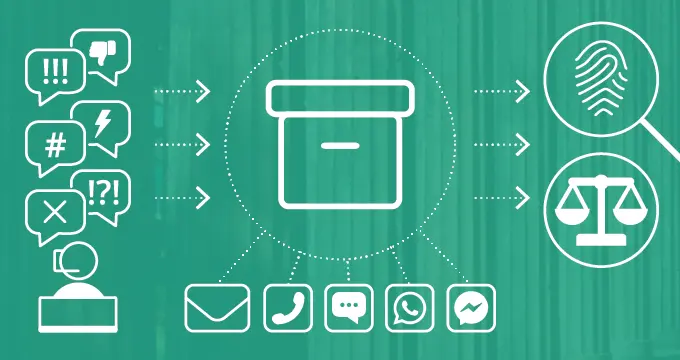
- Communication archiving (email, chat, text messages, social media) is a governance pillar that most frameworks overlook, even though regulators routinely request this data.
- Implementing data governance early and including all communication channels prevents gaps that lead to fines, failed audits and litigation risk.
Introduction
A state agency receives a FOIA request for all email and text message communications related to a procurement decision made 14 months ago. The IT team searches three different systems, finds partial email threads but no text messages and can’t confirm if records were deleted or never captured. The agency misses its statutory deadline and triggers an investigation.
This scenario plays out in government offices, school districts, hospitals and financial firms every week. For regulated organizations, a data governance strategy is the difference between passing an audit and facing enforcement action.
In this guide, you’ll learn:
- What is data governance and how it differs from data management
- Why a data governance strategy is a compliance requirement for regulated industries
- The key elements of data governance and how to build an implementation plan
- How data archiving fits into a governance framework
What Is Data Governance?
Data governance is the accountability system your organization uses to manage data across its entire lifecycle.
In practical terms, governance includes written policies, documented processes, assigned roles and supporting technology. These elements of data governance work together to keep your data accurate, secure and accessible to authorized users. They also ensure compliance with the laws and regulations that apply to your industry.
Governance is an ongoing process that adapts as your organization adds new data sources or faces new regulations. Without it, data decisions happen ad hoc, retention is inconsistent and your organization loses the ability to prove it handled records responsibly.
A strong data governance strategy defines what every team, from IT to legal, marketing and HR, must do with data. It also assigns accountability when something goes wrong.
Data governance vs data management
These two terms get used interchangeably, but they serve different functions.
Data governance sets the rules. It answers questions like: Who owns this data? How long do we keep it? Who can access it? What happens if someone violates the policy?
Data management executes those rules. It’s the day-to-day work of storing, organizing, backing up and retrieving data according to the governance framework.
You can manage data without governing it, but you’ll lack consistency and defensibility. A records manager who archives email based on personal judgment is managing data.
An organization that defines a retention schedule, assigns ownership and audits compliance is governing it.
Benefits of Data Governance for Regulated Organizations
Why is data governance important? Regulators, courts, and the public expect you to prove you control your data. For organizations in regulated verticals, governance determines whether you can meet retention mandates, respond to records requests on time, defend yourself in litigation, and limit the damage when something goes wrong.
Let’s break down the tangible benefits of data governance:
Helps meet compliance and regulatory requirements
Multiple federal and state regulations impose specific obligations on how you capture, retain and produce records:
- HIPAA requires healthcare organizations to safeguard protected health information and maintain audit trails showing who accessed what and when
- FERPA mandates that educational institutions protect student records and control access to personally identifiable information
- SEC 17a-4 and FINRA require broker-dealers and financial firms to retain electronic communications in non-rewritable, non-erasable formats for defined periods
- FOIA (and state-level open records laws) obligate government agencies to produce public records on request, often within tight statutory deadlines
- GDPR applies to any organization handling EU residents’ data, with requirements around consent, data minimization and the right to erasure.
Each regulation demands that you know where your data lives, who can access it and how long you retain it. Without governance, you can’t answer those questions consistently.
Improves litigation readiness and ediscovery
When a lawsuit or investigation begins, your organization must identify, hold, and produce relevant records. This process, known as ediscovery, depends entirely on how well you’ve governed your data.
Governance enables you to place legal holds on relevant records to prevent deletion during active litigation. It gives your legal team a defensible process for searching, reviewing and producing documents. It also supports defensible disposal.
In case records were deleted before a hold, you can prove they were destroyed under a documented retention policy, not to obstruct an investigation.
Organizations without governance often face sanctions for spoliation (destroying evidence), produce incomplete records or spend months manually searching through unorganized data stores. These are among the most tangible data governance risks for regulated entities.
Reduces risk across systems and departments
Ungoverned data creates measurable risk. According to IBM’s 2024 Cost of a Data Breach Report, the global average cost of a data breach reached $4.88 million, a 10% increase from the prior year. Organizations with strong governance and security practices consistently report lower breach costs.
Ungoverned data sprawl also increases the attack surface for unauthorized access. Employees store records in personal folders, local drives, unsanctioned cloud apps and email inboxes. Without a central governance framework, your organization loses visibility into what it holds.
The importance of data governance becomes clear when you calculate the combined cost of breach response, regulatory fines and litigation exposure.
Key Components of a Data Governance Framework
A governance framework gives your organization structure. Here are the components that make it work.
Data quality and data governance standards
Governance starts with defining what “good data” looks like. Data governance standards address accuracy, completeness, consistency and timeliness. Without them, your teams make decisions on unreliable information and your compliance reports contain errors.
Set quality benchmarks, assign responsibility for monitoring them and build validation checks into your data pipelines.
Data classification and cataloging
Not all data carries the same risk or regulatory obligation. Classification assigns sensitivity levels (public, internal, confidential, restricted) to your data so you can apply appropriate protections.
A data catalog gives your organization a searchable inventory of what data exists, where it’s stored and who owns it. This is the foundation for every other governance activity.
Access controls and security
Governance determines who can view, edit, export or delete data. Role-based data access governance controls (RBAC) enforce these policies at the system level.
Strong access controls also include multi-factor authentication, encryption at rest and in transit, and activity logging. These controls reduce the risk of unauthorized access and create the audit trail regulators expect.
Retention policies and lifecycle management
Every data type your organization handles should have a defined retention period based on legal, regulatory, and business requirements. Retention policies specify how long to keep records and when to dispose of them.
For regulated organizations, this is where governance connects directly to recordkeeping obligations. FINRA requires broker-dealers to retain certain communications for three to six years. HIPAA requires covered entities to retain documentation for six years. State FOIA laws may require indefinite retention of certain public records.
Without documented data retention policies, your organization either hoards data (increasing breach risk and storage costs) or deletes records it may still need for compliance or litigation.
Data lineage and audit trails
Regulators and legal teams need to trace where data came from and who interacted with it. Data lineage provides that chain of custody.
Audit trails record every action taken on a record: creation, access, modification, export, and deletion. In an investigation or audit, these logs are the evidence that proves your organization handled data according to its policies and that nobody overstepped their authority.
Data governance roles and responsibilities
Governance only works if someone owns it. Without assigned accountability, governance policies sit in a document no one follows. Ideally, you want to define clear data governance roles and responsibilities within your framework:
- Data owners are business leaders accountable for specific data domains.
- Data stewards manage day-to-day data quality and policy enforcement.
- Compliance officers monitor adherence to regulatory requirements.
- A governance council sets strategy, resolves conflicts and reviews policies.
Communication Archiving as a Governance Pillar
Most data governance guides focus on structured data: databases, CRM records, financial transactions. They tend to overlook the data regulators and attorneys frequently request: business communications.
The distinction between data governance vs. information governance matters here. Data governance sets rules for data assets; information governance extends those rules to all records, including unstructured communications. Effective information governance requires covering these channels with the same rigor.
Email, chat messages, text messages, social media posts, collaboration tool conversations, and transcripts make up a massive share of your organization’s records. They contain decisions, approvals, directives, complaints and evidence of intent. When a regulator asks for records or litigation begins, communications are almost always the first category in scope.
Yet many governance frameworks treat communications as an afterthought. Organizations archive email inconsistently, ignore chat and text messages entirely and have no capture mechanism for social media or collaboration platforms like Microsoft Teams or Slack.
This gap is a governance failure. If your retention policies don’t cover communications and your audit trails stop at the database layer, your governance framework has a blind spot. That blind spot is often where regulators are looking.
What communication archiving covers
A comprehensive data archiving solution captures, indexes and preserves data from:
- Email (Office 365, Gmail, Exchange and other platforms
- Instant messaging and chat (Microsoft Teams, Slack, Google Chat, WhatsApp, iMessage)
- Social media (Facebook, X/Twitter, Instagram, YouTube)
- Text messages and voice (SMS, MMS, calls, voicemail on mobile devices) and
- Files and collaboration tools (Google Drive, OneDrive, SharePoint)
- Website content
Archiving captures messages in their original format with complete metadata, threading and version history. This preserves the evidentiary quality regulators and legal teams require.
Why archiving belongs in your governance framework
Communication archiving directly supports these core governance components.
- Retention policies — Archiving enforces automated retention schedules across all communication channels, not just email.
- Access controls — Role-based permissions determine who can search, view, export or place legal holds on archived data;
- Audit trails — Every search, export and user action within the archive is logged;
- Ediscovery — Centralized, indexed archives let your team search across millions of messages and produce results in seconds rather than weeks; and
- Data quality — Deduplication, single-instance storage and full metadata keep your archived records clean and complete.
If your governance framework doesn’t include data archiving, you’re governing only part of your data and likely missing the part that matters most in an audit or legal proceeding.
Data Governance Best Practices and Implementation
Building an effective governance program takes deliberate planning. A strong data governance implementation plan breaks the work into stages: assess, define, implement, monitor and refine.
These six data governance phases will help you avoid the most common pitfalls at each phase.
- Start with a clear business case — Tie governance to specific data governance use cases your leadership cares about, such as reducing audit preparation time, lowering breach risk and accelerating ediscovery response. A data governance strategy example: a healthcare system that frames its program around HIPAA audit readiness will get funded faster than one that pitches “data maturity”.
- Get executive interest early — Governance crosses every single department. Without a C-level advocate (CIO, CISO, General Counsel or CCO), initiatives stall at departmental boundaries.
- Include communication data in your governance scope from day one — Don’t limit governance to databases and file shares. Email, chat, text messages and social media contain some of your most sensitive records.
- Define retention policies before you start archiving — Know the regulatory landscape, what you need to keep and for how long before you select tools or configure systems. Retention policy drives technology decisions, not the other way around.
- Assign data owners and stewards for every data domain — Accountability prevents the “someone else’s problem” dynamic that causes governance to fail. Make ownership part of job descriptions, not an informal expectation.
- Use data governance automation wherever possible — Automate retention schedules, classification tagging and access reviews. AI data governance tools can flag policy violations, classify sensitive records and surface anomalies faster than manual processes.
Common Data Governance Challenges
A data governance program is not easy to implement. Recognizing these challenges early helps you plan around them. Here’s a list of typical issues and how to fix them:
- Data silos — When departments store data in isolated systems, governance policies can’t be applied consistently.
Fix: Address silos by centralizing data or creating cross-system visibility through integration. - Balancing access and security — Too much restriction slows operations. Too little increases breach risk.
Fix: Use role-based access controls to give each team the minimum level of access they need. - Changing regulations — New rules emerge frequently, especially around data privacy, AI data governance and digital communications.
Fix: Build regulatory monitoring into your governance program so you can adapt policies before enforcement actions begin. - Legacy systems — Older systems often lack the APIs, logging or retention controls modern governance requires.
Fix: Plan phased migrations or implement archiving solutions that can ingest data from legacy platforms.
How Jatheon Can Support Your Data Governance Strategy
Data governance works only when your archiving infrastructure can enforce retention, restrict access and produce records on demand. Jatheon’s platform is built to do exactly that, with deployment options that fit both cloud-first and on-premise environments.
Policy-based retention and records integrity
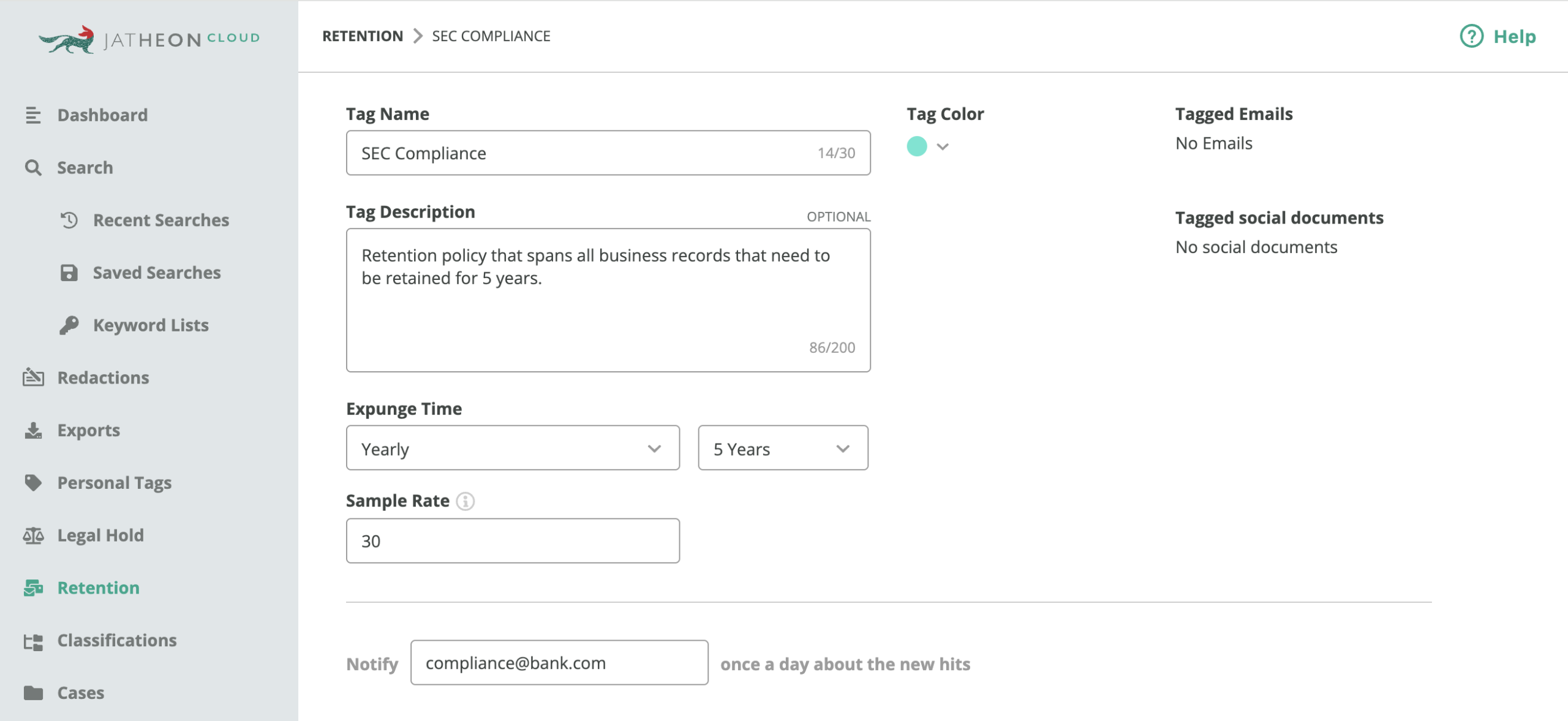
Jatheon lets you define retention policies at a granular level, set automated deletion schedules and apply legal holds to prevent premature data destruction. Jatheon stores archived records in write-once, read-many (WORM) format, which protects message integrity and supports defensibility during audits or litigation.
For organizations subject to SEC 17a-4, HIPAA or FERPA, this means you can demonstrate that records were preserved in their original form, with metadata intact. Retention policies can be tailored by department, content type or regulation, so your governance framework reflects actual operational requirements rather than a one-size-fits-all schedule.
Centralized capture across 25+ communication channels
Governance gaps often start with data you don’t capture. Jatheon pulls communications from email, text messages, social media, Teams, Slack, WhatsApp, voice calls, transcripts, Claude, Google Drive, SharePoint and other apps into a single, searchable archive.
This matters because regulators don’t limit their requests to email.
A FOIA officer processing a public records request, a compliance team responding to a FINRA audit or a healthcare organization handling a HIPAA inquiry all need access to the full picture. Jatheon normalizes data across channels so you can search, review and export from one interface.
Here’s a full list of Jatheon data connectors for a deeper look.
Access controls, audit trails and ediscovery
Role-based access ensures that only authorized personnel can view, search, modify, or export archived data. The platform logs every action, creating an unbroken audit trail that supports governance accountability.
When ediscovery requests arrive, Jatheon’s natural language search returns results in seconds across billions of archived messages. You can apply redactions, manage cases and export in formats like PST, PDF and EML.
Conclusion
A data governance strategy gives your organization structured, documented control over its most sensitive records. For regulated organizations, proper data governance helps you pass audits, respond to records requests on time, and avoid the fines that come with gaps.