Key Takeaways
- PII compliance is a set of rules that govern how organizations collect, store, use, and dispose of personally identifiable information.
- There’s no single law that defines it. Depending on your industry and location, GDPR, HIPAA, CCPA, FERPA, FINRA rules, or several of these may apply.
- Organizations are expected to know what personal data they hold, protect it appropriately, and be able to prove that they’re doing so.
- Effective PII compliance starts with knowing where private information lives in your systems, through a structured data discovery and data mapping process.
- PII redaction is a legal requirement in many disclosure scenarios, including FOIA responses and ediscovery productions.
Introduction
Data privacy is no longer just an IT concern. If your organization collects, stores, or processes information about individuals, it has legal obligations around how this data is handled, and the consequences of getting it wrong can be severe.
In short, that’s what PII compliance is about: a set of rules, controls, and requirements that govern how personally identifiable information must be managed throughout its lifecycle.
The challenge is that there’s no single law that covers it. Depending on your industry and where you operate, you could be subject to GDPR, HIPAA, CCPA, FERPA, or several of these at once, each with its own requirements and penalties.
In this guide, you’ll learn:
- What PII compliance is and which regulations apply
- How to identify and safeguard PII across your systems
- What PII data discovery and redaction involve in practice
- How to build a PII compliance checklist
What Is PII?
Personally identifiable information (PII) is any data that can be used to identify an individual, either on its own or in combination with other information.
Some examples are obvious: a person’s full name, SSN, email address, phone number, or home address. Others are less straightforward, like IP addresses, device identifiers, or location data.
PII is typically split into two categories:
- Sensitive PII — Information that poses a higher risk if exposed. This can be financial account numbers, medical records, passport details, biometric data, and government-issued ID numbers. This type of data is subject to stricter handling requirements under most privacy regulations.
- Non-sensitive PII — Information that’s generally available in public records, a business phone number, a job title, or a general location. On its own, it’s lower risk. But combined with sensitive PII, it can still be used to identify or target an individual.
That last point matters more than most companies realize. A dataset that looks harmless, like ZIP code, date of birth, and gender, can be enough to re-identify a specific person when cross-referenced with other sources.
This is why PII compliance can’t stop at protecting the obvious identifiers.
What Is PII Compliance?
PII compliance refers to the policies, controls, and practices an organization puts in place to collect, store, use, and dispose of personally identifiable information in line with applicable laws and regulations.
There’s no single, universal standard. PII compliance is shaped by a patchwork of regulations, some industry-specific, some geography-specific, and some both.
Here’s a quick overview of the major PII laws and regulations:
- GDPR — Applies to any organization that processes the personal data of EU residents, regardless of where the organization is based. Sets strict rules around consent, data minimization, breach notification, and individual rights.
- HIPAA — Governs how healthcare organizations and their business associates handle protected health information (PHI) in the United States.
- CCPA — Gives California residents rights over their personal data and imposes obligations on businesses that collect it.
- FERPA — Protects the privacy of student education records. Relevant for K-12 schools, colleges, and any vendor handling student data.
- FINRA and SEC rules — Financial services firms face additional obligations around recordkeeping, supervision, and data protection under FINRA and SEC regulations.
- PIPEDA (Personal Information Protection and Electronic Documents Act) — Canada’s federal privacy law governing how private-sector organizations collect, use, and disclose personal information.
This list isn’t exhaustive. In the US alone, eight new state privacy laws took effect in 2025, and more are in progress. Organizations that operate across multiple jurisdictions often find themselves subject to several of these frameworks simultaneously, with overlapping requirements and different penalty structures.
The common thread across all of them is this: organizations are expected to know what personal data they hold, protect it appropriately, and be able to prove that they’re doing so.
What Can Happen If You Don’t Protect PII?
Non-compliance isn’t just a legal problem, but also a business risk. The consequences range from financial penalties to long-term reputational damage that’s much harder to quantify.
Regulatory fines
The financial exposure varies by regulation, but the numbers are significant across the board:
- GDPR: Up to €20 million or 4% of global annual revenue, whichever is higher. Cumulative GDPR fines surpassed €5.88 billion by January 2025.
- HIPAA: Up to $2.2 million per violation category per year. The OCR collected over $9.9 million in HIPAA penalties in 2024 alone, largely driven by enforcement actions tied to website tracking technologies.
- CCPA/CPRA: Up to $2,663 per unintentional violation and $7,988 per intentional violation. With millions of California residents potentially affected in a single incident, these figures add up fast.
- PIPEDA: Up to CAD $100,000 per violation for individuals, CAD $500,000 for organizations.
Civil litigation
Regulatory fines are only part of the picture. In many jurisdictions, affected individuals have the right to sue organizations directly.
Class action lawsuits following data breaches have resulted in multi-million dollar settlements. Meta’s $1.4 billion settlement with the Texas Attorney General in 2024 over unlawful biometric data collection is one of the most prominent recent examples.
Operational disruption
A breach or compliance failure doesn’t just cost money upfront.
Organizations typically face mandatory audits, corrective action plans, and years of increased regulatory scrutiny.
The 2024 IBM Cost of a Data Breach Report put the average total cost of a breach at $4.88 million, the highest figure ever recorded, factoring in detection, response, lost business, and remediation.
Reputational damage
This one is harder to measure but is often more lasting.
Customers, partners, and regulators all take note when a company mishandles personal data. In regulated industries, like government, healthcare, financial services, and education, that loss of trust can affect procurement decisions, contract renewals, and public perception for years.
Identifying and Safeguarding PII: Where to Start
Effective PII compliance starts with a simple principle: you can’t protect what you don’t know you have.
Most organizations collect personal data across dozens of systems, including email, HR platforms, CRM tools, cloud storage, archiving solutions, and legacy databases. Over time, PII accumulates in places that aren’t always obvious or well-documented.
So, before you can protect it, you need to find it.
PII data discovery
PII data discovery is the process of locating, classifying, and cataloging personally identifiable information across all of your systems and storage environments.
This means going beyond the obvious repositories. Structured databases are a starting point, but a significant volume of PII lives in unstructured data, like email archives, scanned documents, chat apps, spreadsheets, and files.
In regulated industries, email alone can contain years’ worth of sensitive information: names, account numbers, medical details, legal correspondence, and more.
A thorough discovery process typically involves:
- Inventorying all systems that collect, store, or transmit personal data, including third-party vendors and cloud services,
- Classifying data as sensitive or non-sensitive to prioritize protection efforts,
- Mapping data flows to understand how PII moves between systems, departments, and external parties, and
- Identifying gaps where PII exists without adequate controls or documentation
Most organizations rely on automated tools to scan and classify data across structured and unstructured sources, and repeat the process regularly, since data environments change constantly.
The output of a discovery audit goes beyond just a compliance checkbox. It becomes the foundation for everything else: retention policies, access controls, redaction workflows, and breach response.
Without it, none of those programs can operate reliably.
PII Redaction: Removing Sensitive Data When Disclosure Is Required
Identifying and protecting PII within your own systems is one challenge. Knowing what to do when you’re required to share documents externally is another.
PII redaction is the process of permanently removing or masking personally identifiable information from documents before they are disclosed to an outside party. It’s a legal requirement in a number of common scenarios:
- FOIA requests — Government agencies responding to Freedom of Information Act requests must produce records with third-party PII removed before release.
- Ediscovery and litigation — Organizations producing documents in legal proceedings are required to redact information that falls outside the scope of the request or is otherwise protected.
- Public records releases — Any situation where internal records become part of the public domain requires a review for sensitive personal information.
It’s important to distinguish redaction from related terms that are sometimes used interchangeably:
- Redaction permanently removes or obscures specific information from a document while preserving the rest of it. The document remains usable, just with sensitive fields removed.
- Anonymization strips all identifying information from a dataset so that individuals can no longer be identified at all. It’s typically used for research or analytics purposes rather than document disclosure.
- Pseudonymization replaces identifying information with a placeholder or code. The original data still exists and can be re-linked with the right key, which means pseudonymized data is still considered personal data under GDPR.
Why manual redaction doesn’t scale
For organizations that handle a high volume of records requests, like public agencies, healthcare providers, and financial firms, manual redaction is a significant operational burden.
Reviewing documents line by line is time-consuming, inconsistent, and prone to human error. A single missed identifier in a FOIA response can constitute a compliance failure.
Automated redaction tools address this by scanning documents for predefined PII patterns — names, ID numbers, account details, dates of birth — and applying redactions consistently across large document sets.
PII Protection Best Practices
Once you know where your PII lives, the next step is making sure it’s adequately protected.
No single control is sufficient on its own. Effective PII protection relies on a combination of technical measures, organizational policies, and ongoing oversight.
Encryption
PII should be encrypted both at rest and in transit.
If data is intercepted or a storage device is compromised, encryption ensures the information is unreadable without the appropriate key. This is a baseline requirement under most privacy regulations and one of the most straightforward controls to implement.
Centralized data management
It’s harder to protect PII when data is scattered across disconnected systems.
When there’s a single platform where all the data flows, it’s much easier for compliance and legal teams to search, manage, and act on data. It also reduces the risk of PII sitting in unmonitored locations without adequate controls in place.
Access controls
Not everyone in your organization needs access to every piece of personal data.
Apply the principle of least privilege, that is, grant access only to the individuals who need it to do their job, and review those permissions regularly. Role-based access controls (RBAC) make this easier to manage at scale.
Data minimization
Only collect the PII you actually need.
The more personal data you hold, the larger your attack surface and the greater your compliance burden. If data no longer serves a legitimate purpose, it should be deleted or anonymized in line with your retention policy.
Retention and deletion schedules
PII shouldn’t be kept indefinitely.
Most regulations require organizations to define how long different categories of data are retained and to dispose of it securely when that period ends. Automated retention policies built into your archiving or data management platform remove the reliance on manual processes that are easy to overlook.
Employee training
A significant proportion of data breaches involve human error, like a misdirected email, a weak password, or a response to a phishing attempt.
Regular training ensures that employees understand what PII looks like, how to handle it correctly, and what to do if something goes wrong.
Breach response planning
Even well-protected organizations can experience incidents.
Having a documented breach response plan in place with clear roles, notification timelines, and escalation procedures determines how quickly and effectively you can contain the damage.
Under GDPR, for example, organizations have 72 hours to notify regulators after becoming aware of a breach.
Regular audits
PII compliance isn’t a one-time project.
Data environments change, regulations evolve, and new risks emerge. Scheduling regular audits, at least annually, ensures your controls remain effective and your documentation stays current.
PII Compliance Checklist
Here’s a quick 10-step PII compliance checklist you can use as a starting point (but make your own):
- Conduct a PII data discovery audit — Inventory all systems, databases, applications, and third-party services that collect, store, or transmit personal data. Include unstructured sources like email archives, file shares, and chat logs.
- Classify your data — Separate sensitive PII from non-sensitive PII. Identify which regulatory frameworks apply to each category based on your industry and the jurisdictions you operate in.
- Map your data flows — Document how PII moves through your organization, where it enters, how it’s processed, who has access, and where it exits. This is essential for identifying gaps and demonstrating compliance to regulators.
- Establish a data governance policy —Define roles and responsibilities for data protection, set handling procedures for each data category, and document the entire data lifecycle from collection to disposal. Make this accessible to all relevant staff.
- Implement encryption and access controls — Encrypt PII at rest and in transit. Apply role-based access controls so that personal data is only accessible to those with a legitimate need.
- Set retention and deletion schedules — Define how long each category of PII is retained and put automated processes in place to delete or anonymize it when that period ends.
- Deploy automated monitoring — Manual oversight can’t keep pace with the volume and complexity of modern data environments. Automated tools that continuously scan for PII, flag anomalies, and generate audit trails are increasingly a baseline expectation under most frameworks.
- Train your staff — Ensure that anyone who handles personal data understands your policies, knows how to recognize PII, and is aware of their obligations under applicable regulations. Repeat this training regularly, not just during onboarding.
- Document a breach response plan — Define who is responsible for breach detection, containment, and notification. Know your reporting timelines, 72 hours under GDPR, for example, and test your plan before you need it.
- Schedule regular compliance audits — Review your controls, update your data inventory, and assess whether your practices still align with current regulatory requirements. Annual audits are a minimum, while higher-risk environments may demand more frequent reviews.
How Jatheon Supports PII Compliance
PII compliance requires more than policy documents and good intentions.
It depends on having the right infrastructure in place, including systems that enforce retention schedules automatically, preserve records in a tamper-proof format, and make it possible to locate and produce specific data quickly when required.
That’s where Jatheon fits in.
Our archiving platform is built for organizations in regulated industries, where the stakes around data handling are highest and the compliance requirements most demanding. It acts as a centralized location where you can store and actively search all company communications, from over 25 data sources like email, chat apps, social media, or collaboration platforms.
Here’s how it supports a PII compliance program in practice:
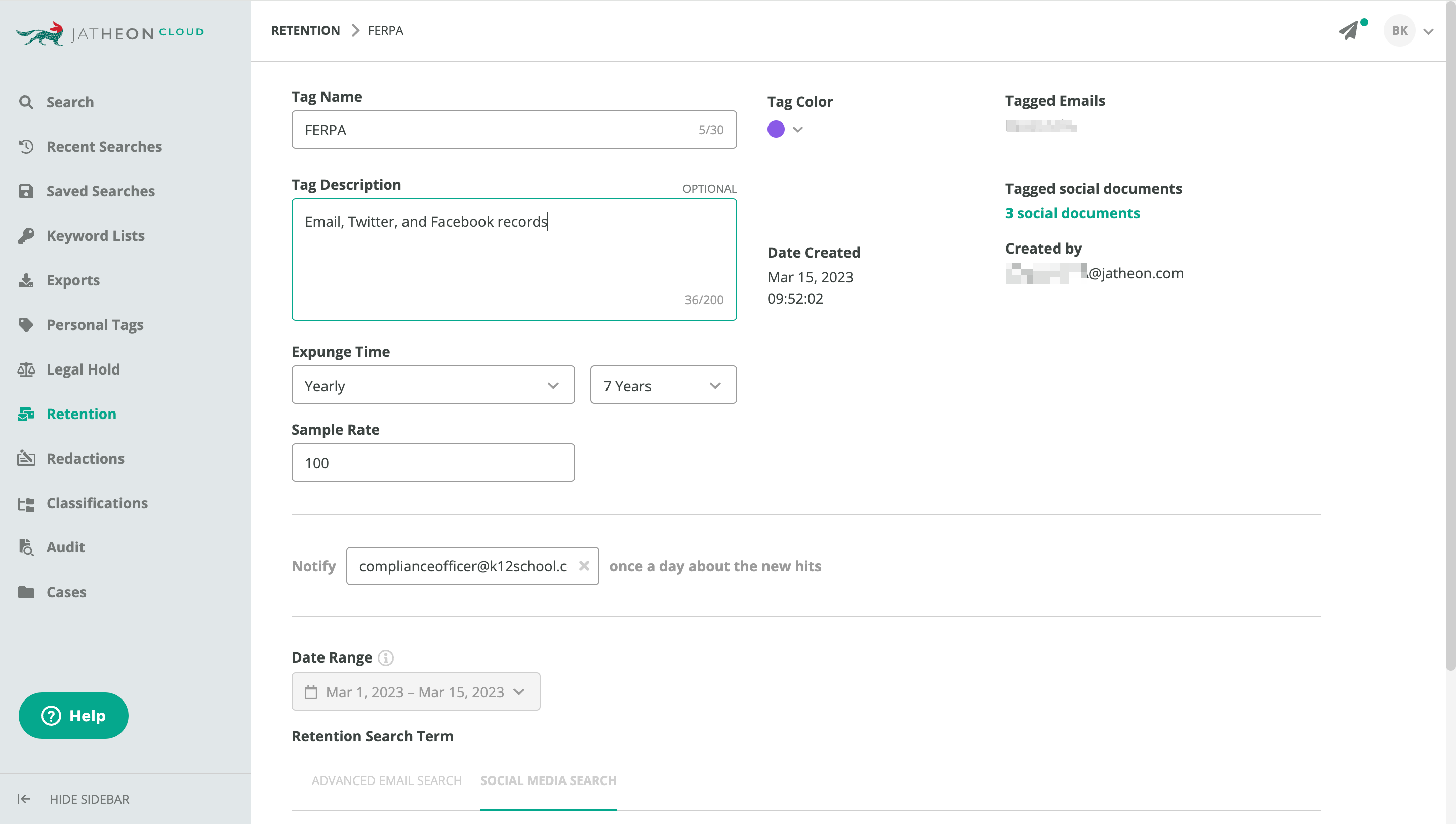
- Automated retention policy enforcement — Define retention schedules by data type, regulation, or department, and let the platform apply them consistently across entire data sets.
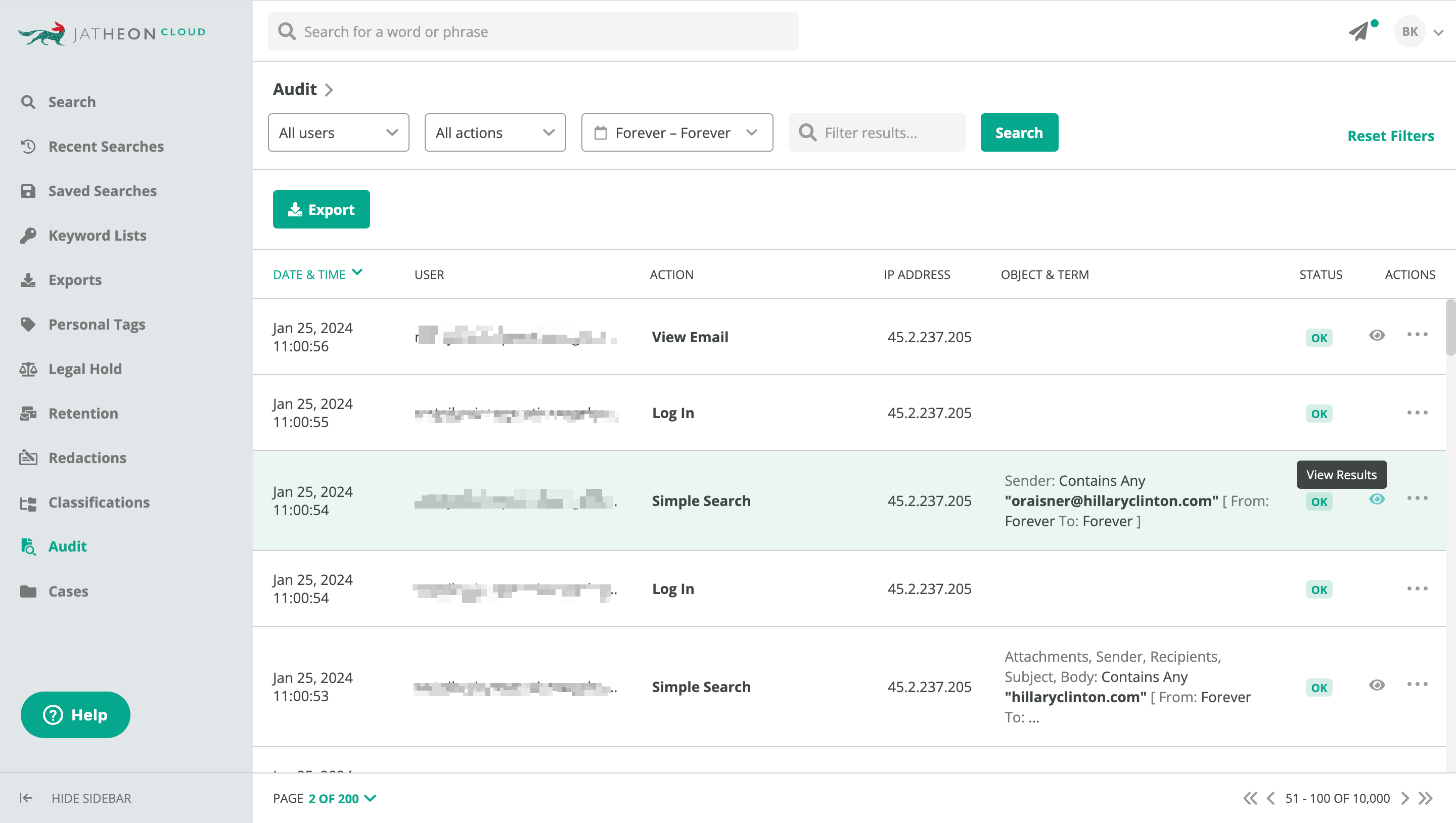
- Immutable audit trails — Every archived record is stored in a tamper-proof format with a complete chain of custody. This gives legal and compliance teams the documentation they need to demonstrate compliance during audits or litigation.
- Legal holds — When litigation or an investigation is anticipated, legal holds prevent relevant records from being altered or deleted to protect the organization and ensure it can meet its discovery obligations.
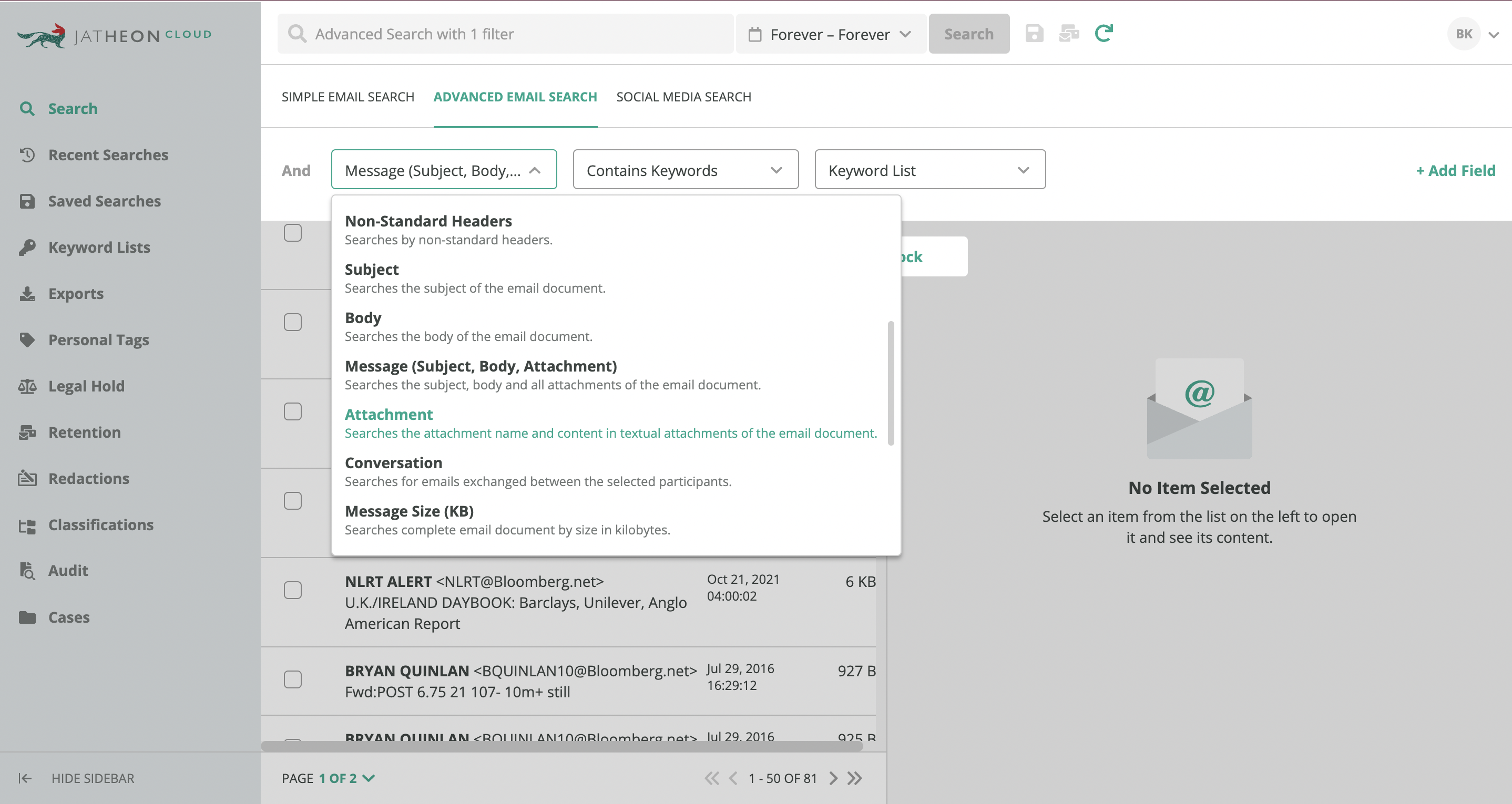
- Powerful search and ediscovery — You can pinpoint specific records quickly across massive data sets and present them in standard formats like PST or PDF.
- Bulk PII redaction — Jatheon Cloud includes a built-in redaction capability that allows compliance and legal teams to process FOIA requests and public records releases at scale, stripping PII from documents automatically before disclosure, without exporting to separate tools.
For organizations managing high volumes of records and complex compliance obligations, having archiving and compliance functions in a single platform reduces operational overhead and eliminates the gaps that tend to appear when multiple disconnected tools are involved.
If your organization handles personal data, having the right archiving infrastructure in place is a core part of staying compliant. Book a demo or reach out at sales@jatheon.com to see how Jatheon helps organizations manage data retention, meet privacy requirements, and handle PII redaction across GDPR, CCPA, and HIPAA.
Summary of the Main Points
- PII (personally identifiable information) is any data that can identify an individual, either on its own or in combination with other information.
- PII compliance is not defined by a single law. Depending on your industry and where you operate, you may be subject to GDPR, HIPAA, CCPA, FERPA, FINRA rules, or several of these laws at once.
- You can’t protect PII you don’t know you have. A thorough data discovery audit is the starting point for any compliance program, covering structured databases, email archives, file shares, and every other system that touches personal data.
- PII redaction is a legal requirement in many disclosure scenarios, including FOIA responses and ediscovery productions. At scale, manual redaction is impractical — automated tools are essential.
- Effective PII protection requires layered controls: encryption, access management, data minimization, retention schedules, staff training, and a documented breach response plan.
- Compliance is an ongoing program, not a one-time project. Regular audits, updated data inventories, and automated monitoring are what keep it functional as regulations and data environments evolve.
FAQ
What is the difference between PII and PHI?
PII is a broad category covering any data that can identify an individual. PHI (Protected Health Information) is a subset of PII that specifically relates to an individual’s health status, healthcare provision, or payment for healthcare. PHI is governed by HIPAA in the United States, while PII more broadly falls under a range of regulations depending on industry and jurisdiction.
Who is responsible for PII compliance in an organization?
Responsibility is typically shared across the CISO, Data Protection Officer (DPO), compliance teams, and IT security. All employees who handle personal data have an obligation to follow the organization’s data protection policies, but accountability for the program as a whole sits with senior leadership.
How long should organizations retain PII?
Retention periods vary by regulation and data type. HIPAA requires most medical records to be retained for six years from creation or last use. GDPR mandates that data be kept no longer than necessary for its original purpose. Organizations should define retention schedules by data category and automate enforcement wherever possible.
Does PII compliance apply to employee data as well as customer data?
Yes. Most privacy regulations cover any personal data an organization holds, including employee records, payroll information, and HR files. Organizations often focus on customer-facing data but face equal obligations around the personal information of their own staff.
What is the difference between a data breach and a privacy breach?
A data breach involves unauthorized access to data, typically through hacking, malware, or a misconfigured system. A privacy breach is broader: it includes any situation where personal data is collected, used, or disclosed in a way that violates applicable privacy rules, even without unauthorized access. Every data breach is a privacy breach, but not every privacy breach involves a data breach.
Is PII compliance a one-time project or an ongoing obligation?
It’s an ongoing obligation. Data environments change, new systems are introduced, regulations evolve, and staff turn over. A compliance program that isn’t actively maintained quickly develops gaps. Regular audits, updated data inventories, and continuous monitoring are what keep it functional over time.
Read Next:FOIA Deadlines by State: Time Limits for Open Records Requests Cloud Archiving Solution vs. On-Premise Archive Storage Digital Evidence Examples — Insights from Recent Legal Cases |