Key Takeaways
- Enterprise archiving is evolving from passive storage into an intelligence layer powered by AI.
- AI helps compliance teams review communications faster by automatically classifying, summarizing, and prioritizing records.
- Conversational AI assistants allow users to interact with archived communications using natural language queries.
- AI-powered transcription, OCR, and sentiment analysis make multimedia communications fully searchable and easier to investigate.
- Trust and transparency are critical. AI used in compliance archives must be secure, explainable, and auditable.
Introduction
Enterprise archives now contain millions of emails, chats, files, and meeting recordings. For compliance and legal teams, reviewing this data manually has become a major operational bottleneck.
Adding an AI layer to enterprise archives transforms them into intelligent platforms that automatically surface risks, speed up regulatory responses, and extract business insights from millions of conversations.
Enterprise archiving was originally built to solve a simple problem: keep communications for compliance, retention, and legal discovery.
But as organizations generate more communication across email, messaging platforms, meetings, and social channels, archives are no longer just storage systems. They are becoming intelligence platforms.
Artificial intelligence is the key driver behind this shift. Instead of treating archived data as static records, organizations can use AI for enterprise platforms to analyze, classify, and surface insights from their communications in real time.
In this article, we’ll look at how AI is changing enterprise archiving and why modern archives are evolving from passive storage systems into active compliance and intelligence tools.
Why Enterprise Archives Need AI Intelligence
Most enterprise archives were originally designed to meet regulatory retention and legal discovery requirements.
They capture communications from:
- Messaging apps (Teams, Slack, WhatsApp)
- Social media
- Files and attachments
- Meeting recordings
- Voice messages
- Images and scanned documents
Over time, the amount of data inside these archives has grown dramatically.
A single compliance review or an HR request case may involve searching through thousands or even millions of communications. Investigations and audit requests can require teams to manually sift through massive datasets just to find a handful of relevant records.
Keyword search works well when you know exactly what you’re looking for. But compliance and legal teams often start investigations without a clear query.
That’s where AI changes the playbook.
Instead of relying solely on static searches, AI adds an intelligent layer on top of passively stored data. It can analyze patterns across communications, surface related conversations, and highlight potentially relevant information that a simple keyword search might miss.
The Hidden Bottleneck in Enterprise Archives
For most organizations, the challenge isn’t storing communications. Modern enterprise archives can capture and retain enormous volumes of data across email, messaging apps, meeting recordings, social platforms, and file systems.
The real challenge begins after the data is archived.
Compliance and legal teams are often responsible for reviewing large volumes of communications to identify risk, respond to regulatory inquiries, or produce evidence during investigations. But most archiving platforms simply return raw search results.
A keyword query might return thousands of messages. Someone still has to read them.
For compliance officers, legal teams, IT administrators, and records managers, identifying risk across millions of communications requires substantial effort. Important signals are buried in massive datasets of structured and unstructured data.
At enterprise scale, this problem becomes impossible to ignore.
Platforms like Jatheon already process hundreds of millions of communication records per month across enterprise customers. At that volume, manual review alone is no longer viable.
Organizations need systems that can do more than store records. They need systems that can analyze them intelligently.
Why This Problem Matters Now
Enterprise archiving is entering a new phase driven by two major forces: regulatory pressure and AI-driven software innovation.
Regulators are increasingly focused on proactive monitoring of communications, not just long-term retention.
Financial services organizations must meet strict oversight requirements from regulators such as the SEC and FINRA. Healthcare organizations face extensive documentation and monitoring obligations under HIPAA. Government agencies must respond quickly to FOIA requests.
Across these sectors, expectations are changing.
Regulators increasingly expect organizations to demonstrate active supervision and monitoring of communications, not simply store messages and retrieve them later when requested.
At the same time, enterprise software companies are rapidly adopting AI.
“Compliance requirements such as SEC Rule 17a-4, FINRA regulations, HIPAA, and state privacy laws are evolving alongside the explosion of digital communications. Regulators now expect firms not only to retain records but to actively supervise and assess risk across those communications. Our AI layer is designed to meet that expectation — helping organizations analyze communications at scale, detect potential compliance issues earlier, and do so while protecting the privacy and integrity of sensitive information.” explains Marko Dinic, Jatheon’s CEO.
Next-generation archiving and ediscovery platforms are beginning to introduce AI-assisted review tools that help organizations identify risks and prioritize relevant communications more efficiently.
For organizations managing large communication datasets, the shift is inevitable. Archives are no longer just record repositories. They are becoming intelligent compliance platforms.
How AI Is Transforming Enterprise Archiving
AI does not replace the core purpose of an archive — retaining records securely and defensibly. Instead, it adds an intelligence layer on top of the archive.
This layer helps organizations understand and work with their archived data more efficiently.
Here are some of the most important ways AI is reshaping enterprise archiving.
Conversational AI and AI enterprise search for archives
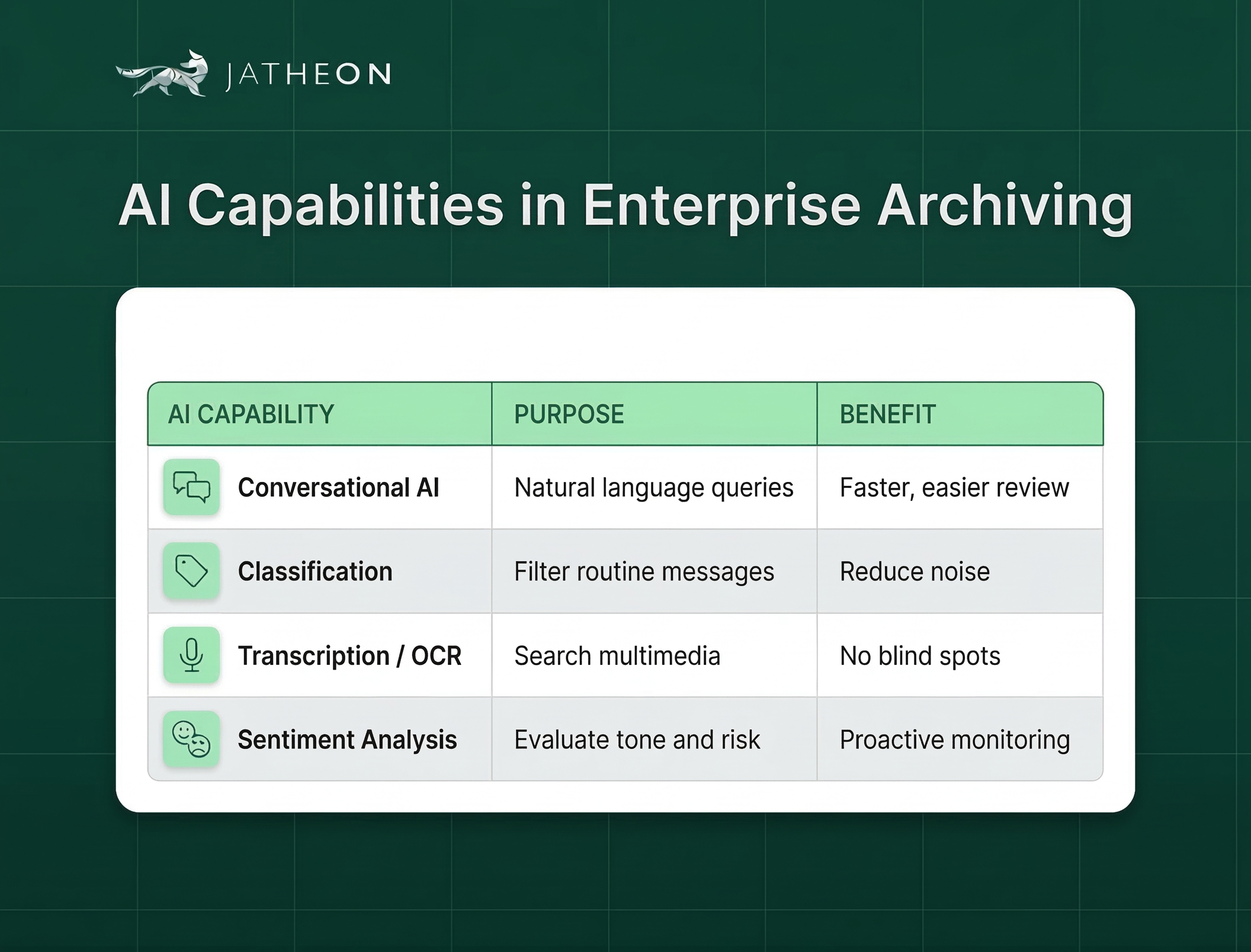
One of the most significant changes is the introduction of conversational AI assistants inside archive platforms.
Instead of navigating complex filters or building advanced search queries, users can ask questions in natural language.
For example:
- “Summarize this email thread.”
- “Who attended this meeting?”
- “What actions were agreed on during this discussion?”
AI assistants can analyze archived emails, attachments, chat conversations, and files to provide contextual answers.
In Jatheon’s platform, this capability is delivered through Liya, a conversational AI copilot that allows users to chat directly with their archived communications. Compliance officers can generate summaries, ask follow-up questions, and clarify the meaning of conversations without leaving the archive, reducing the time required for ad hoc reviews and investigations.
AI classification and content filtering
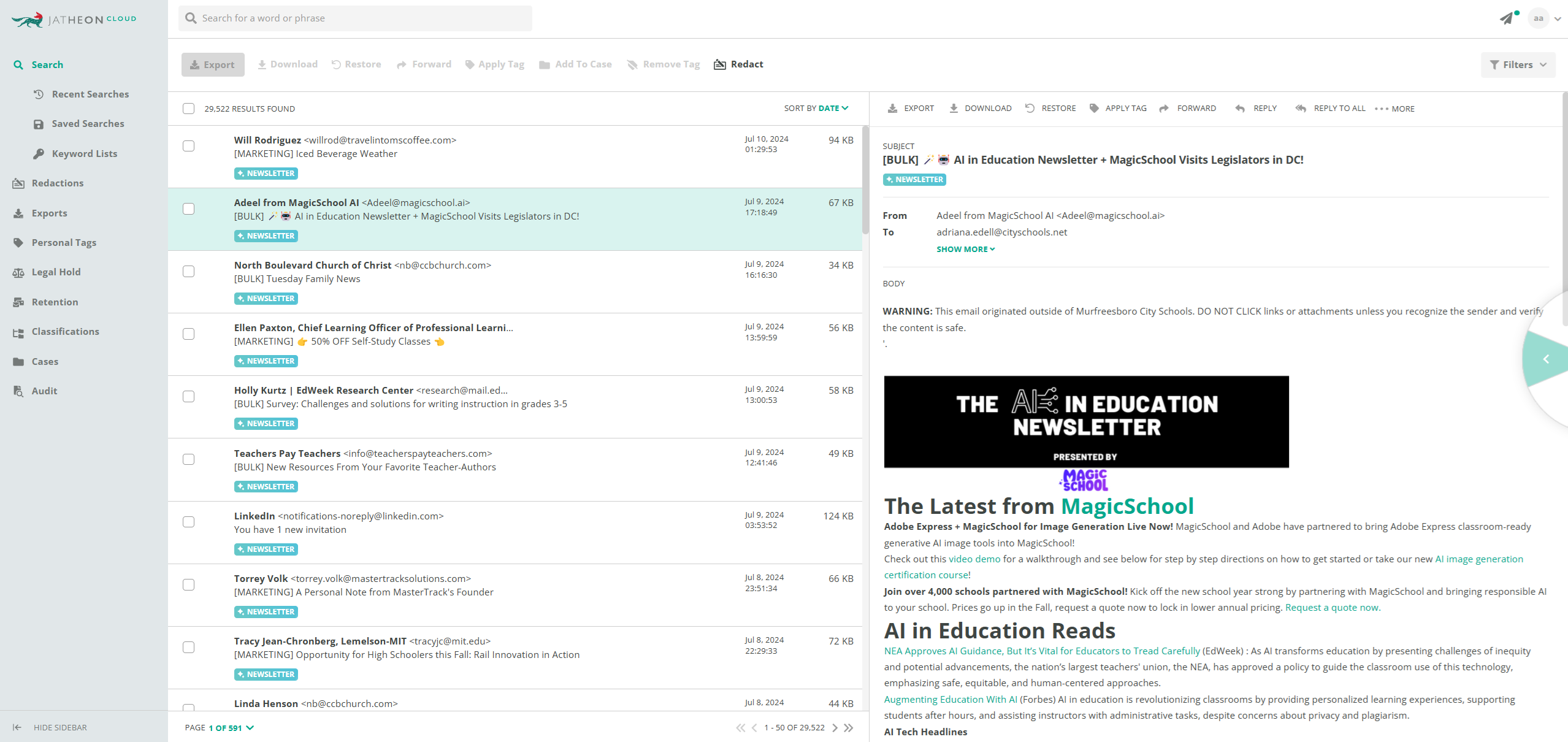
Another major challenge in enterprise archiving is noise.
Archives often contain large volumes of routine messages that are irrelevant during compliance reviews or investigations, such as:
- Newsletters
- Promotions
- Out-of-office replies
- Bounced messages
AI classification helps automatically identify and tag this type of content.
Instead of appearing in every search result, routine communications can be filtered out of review sets, allowing compliance teams to focus on the messages that actually matter.
This approach reduces false positives and makes audits, FOIA requests, and ediscovery reviews significantly faster.
Making multimedia communications searchable
Modern workplace communications extend far beyond text-based messages.
Organizations now rely heavily on:
- Video meetings
- Voice messages
- Recorded calls
- Shared images and scanned documents
Without AI, much of this data remains difficult to search.
AI transcription and optical character recognition (OCR) change that.
Audio and video recordings can be converted into searchable text, while scanned documents and images become searchable through OCR. Once indexed, these communications appear alongside emails and chats in AI enterprise search results, allowing investigators to analyze conversations across multiple communication channels.
This capability helps eliminate what many compliance teams call “communication blind spots.”
Sentiment analysis and risk detection
AI can also help organizations understand the tone and intent behind communications.
Sentiment analysis evaluates the emotional context of messages and classifies them across categories such as:
- Very positive
- Positive
- Neutral
- Negative
- Very negative
Combined with contextual tagging, this allows compliance and HR teams to identify potentially problematic interactions earlier.
For example, organizations may use sentiment analysis to detect:
- Hostile or inappropriate communication
- Potential harassment or workplace conflict
- Suspicious language related to compliance violations
By surfacing risky communications sooner, AI enables organizations to take proactive action before issues escalate.
What Makes AI in Archiving Different
Not all AI tools are suited for compliance and governance environments.
Many enterprise platforms have started adding generic AI features by integrating external models or third-party AI services. While these tools can provide basic summarization or text analysis, they often lack the transparency and precision required for regulated communications data.
Compliance workflows demand more than general-purpose AI.
Organizations need systems that can operate within strict constraints, including:
- Auditable decision-making
- Extremely low error tolerance in classification tasks
- Strict data isolation across customers
- The ability to process hundreds of millions of records efficiently
For enterprise archiving platforms, AI must be designed with these requirements in mind from the beginning.
Building an AI Intelligence Layer for the Archive
Rather than attaching generic AI tools to the archive, modern platforms are beginning to build purpose-built AI intelligence layers.
These layers combine several different capabilities to analyze archived communications at scale.
First, deterministic processing handles structured parsing and data preparation. Routine tasks such as message extraction, metadata parsing, and file processing are performed through deterministic systems that ensure accuracy and consistency.
Second, AI reasoning is applied only where it provides the most value. Tasks such as contextual interpretation, classification, or risk identification can benefit from machine learning and language models.
Finally, intelligent orchestration ensures the right models are used for the right tasks.
Some operations require high-throughput classification across large datasets. Others require deeper reasoning to interpret context or identify compliance risks. By dynamically routing tasks to different models based on complexity, the system can maintain both accuracy and performance.
This hybrid approach allows enterprise archives to operate at scale while maintaining the reliability required for compliance workflows.
From manual searches to intelligent triage
Traditional archive search presents users with lists of messages matching specific keywords.
As AI for enterprise data analysis continues to evolve, AI-enabled archives move a step further.
Instead of simply returning results, they help teams triage communications based on risk, urgency, and relevance.
This allows compliance teams to focus their attention where it matters most.
For example, an AI-powered archive can:
- Surface communications that indicate potential compliance risks
- Highlight conversations that require immediate review
- Identify clusters of related communications across multiple channels
Rather than manually scanning thousands of records, reviewers can focus on the communications that actually require investigation and are relevant to the case at hand.
The result is faster reviews, reduced compliance workloads, and more proactive oversight of organizational communications.
From passive storage to intelligent archives
The role of enterprise archiving is expanding.
Instead of acting as a passive storage repository, the archive is becoming a system that actively supports compliance, investigations, and governance.
AI enables archives to:
- Surface high-risk communications earlier
- Reduce manual review workloads
- Make complex data easier to search and understand
- Accelerate legal and regulatory response times
For compliance officers, this means less time spent searching through noise and more time focusing on meaningful analysis.
For organizations, it means turning a growing volume of archived communications into a valuable source of operational insight.
Trust and Transparency in AI Archives
For regulated industries, introducing AI into compliance workflows raises an important question: Can the AI be trusted?
Compliance teams need systems that are transparent, explainable, and secure.
AI used in enterprise archiving must provide:
- Clear audit trails
- Documented reasoning behind automated actions
- Full visibility into how decisions were made
Equally important is data privacy.
Organizations can’t risk sensitive communications being sent to external AI providers or used for training third-party models.
For this reason, some enterprise archiving platforms run AI entirely within their own secure infrastructure. This approach keeps communications private and ensures that customer data is never used to train external models.
In regulated environments, this level of control is critical for maintaining compliance and trust.
Summary of the Main Points
- Enterprise archiving has traditionally focused on storing communications for compliance, legal discovery, and retention. As communication volumes grow, manual review processes are becoming a major operational bottleneck for compliance and legal teams.
- Most archiving platforms still rely on keyword search, which returns raw search results and requires reviewers to manually sift through large datasets to identify relevant communications.
- At enterprise scale, this approach is no longer practical. Organizations processing hundreds of millions of communication records per month need more efficient ways to identify risk, urgency, and sensitive content.
- AI provides a new intelligence layer for enterprise archives, enabling automated classification, contextual analysis, and intelligent triage of communications.
- As regulatory expectations increase and enterprise software continues adopting AI, modern archiving platforms are evolving from passive storage systems into intelligent compliance and governance tools.
Frequently Asked Questions About AI in Enterprise Archiving
What is AI-powered enterprise archiving?
AI-powered enterprise archiving combines traditional data archiving with artificial intelligence technologies that analyze and organize archived communications. As part of the broader shift toward AI for the enterprise, these systems help organizations automatically classify content, detect patterns, and surface high-risk or relevant communications. Instead of simply storing messages and files, AI-enabled archives provide contextual insights that allow compliance, legal, and IT teams to review large volumes of data more efficiently.
How does AI improve compliance monitoring in archived communications?
Enterprise AI can automatically analyze archived communications to identify potential compliance risks, policy violations, or sensitive content. AI techniques such as classification, sentiment analysis, transcription, and contextual tagging help compliance teams prioritize messages that require attention instead of manually reviewing thousands of records.
Why is traditional keyword search no longer enough for enterprise archives?
Keyword search works well for simple retrieval, but it often produces large numbers of irrelevant results that then need to be tweaked or filtered further. It also requires manual review to determine context. In organizations managing millions of communications, this creates a massive challenge. Modern AI enterprise search capabilities add contextual analysis and intelligent triage, helping teams quickly identify the most relevant records.
Can AI help with ediscovery and regulatory requests?
Yes. AI can significantly accelerate ediscovery workflows by organizing and analyzing large communication datasets. Capabilities like automated classification, transcription of audio and video files, bulk AI redaction, and intelligent search help legal teams locate and collect relevant evidence faster and respond more efficiently to regulatory or legal requests.
Is AI in enterprise archiving secure?
Security and data governance are critical in regulated environments. Many enterprise archiving platforms deploy AI within secure infrastructure environments so that sensitive communications remain protected. Systems designed for compliance also provide audit trails, explainable AI actions, and strict data isolation to ensure transparency and regulatory accountability.
What industries benefit most from AI-driven archiving?
AI-powered archiving is particularly valuable in industries that generate large volumes of regulated communications, including financial services, healthcare, government, and education. These organizations must maintain detailed communication records while also demonstrating proactive monitoring and governance.
How is AI transforming the role of the enterprise archive?
Traditionally, enterprise archives served as passive repositories for storing communications. With the addition of AI, archives are evolving into active intelligence systems that help organizations identify risk, support investigations, and generate insights from historical communications data. This shift reflects the growing role of AI for the enterprise in transforming traditional business systems into intelligent platforms.
Read Next:AI in Compliance: Use Cases and Considerations How AI Is Reshaping the Ediscovery Lifecycle in 2025 AI Classification and AI Categorization in Data Archiving and Risk Management |