Government social media accounts are no longer just outreach tools. Every post, comment, reply, and moderation decision on an official account can become a public record, and agencies have to produce it in full when a request comes in. Many still depend on screenshots, manual logs, or the platforms themselves. None of these keep deleted comments, edit histories, or the metadata needed to show a record is authentic.
When a records request arrives with a statutory deadline, those gaps become a compliance problem. In this guide, we explain why the stakes have risen, what a complete government social media archive has to capture, and how to answer a records request without gaps.
Why Government Social Media Records Carry More Legal Risk Now
The legal ground shifted with the Supreme Court’s 2024 Lindke v. Freed decision. The Court looked at officials who use social accounts to speak for the government. On those accounts, blocking users or deleting comments can count as government action.
That falls under Section 1983, a federal civil rights law. The content is a public record, and erasing it can create First Amendment liability.
Demand is climbing too. Under FOIA, the Freedom of Information Act, the public has a right to request government records, and federal agencies received a record 1.5 million FOIA requests in FY 2024, up 25.15% over the prior year. That count comes from the DOJ Office of Information Policy.
Strong government social media archiving is now the difference between a fast, complete answer and a missed deadline.
What Social Media Archiving for Government Must Do
Those two pressures point to the same fix. A government archive has to capture posts and comments automatically and without gaps, the moment they go live. It has to preserve the federal complete-record standard of content, context, structure, and metadata, so a record holds up later.
It also has to catch edits and deletions, not just what’s visible today. And it has to cover every channel an agency runs, since federal agencies use as many as 18 social platforms. Jatheon designed its archiving built for public sector agencies around exactly these needs.

What Jatheon Captures
Jatheon ties each capability back to those requirements. Its data connectors for social platforms pull in Facebook, X, Instagram, and YouTube on a continuous basis. The platform can capture Facebook posts and comments with their full thread. A conversation stays intact instead of arriving as loose screenshots.
Coverage doesn’t stop at social. Agencies also answer for staff texts and calls, and Jatheon captures those under the same roof. You can review the text and mobile records rules for agencies that make cross-channel capture part of the records duty.
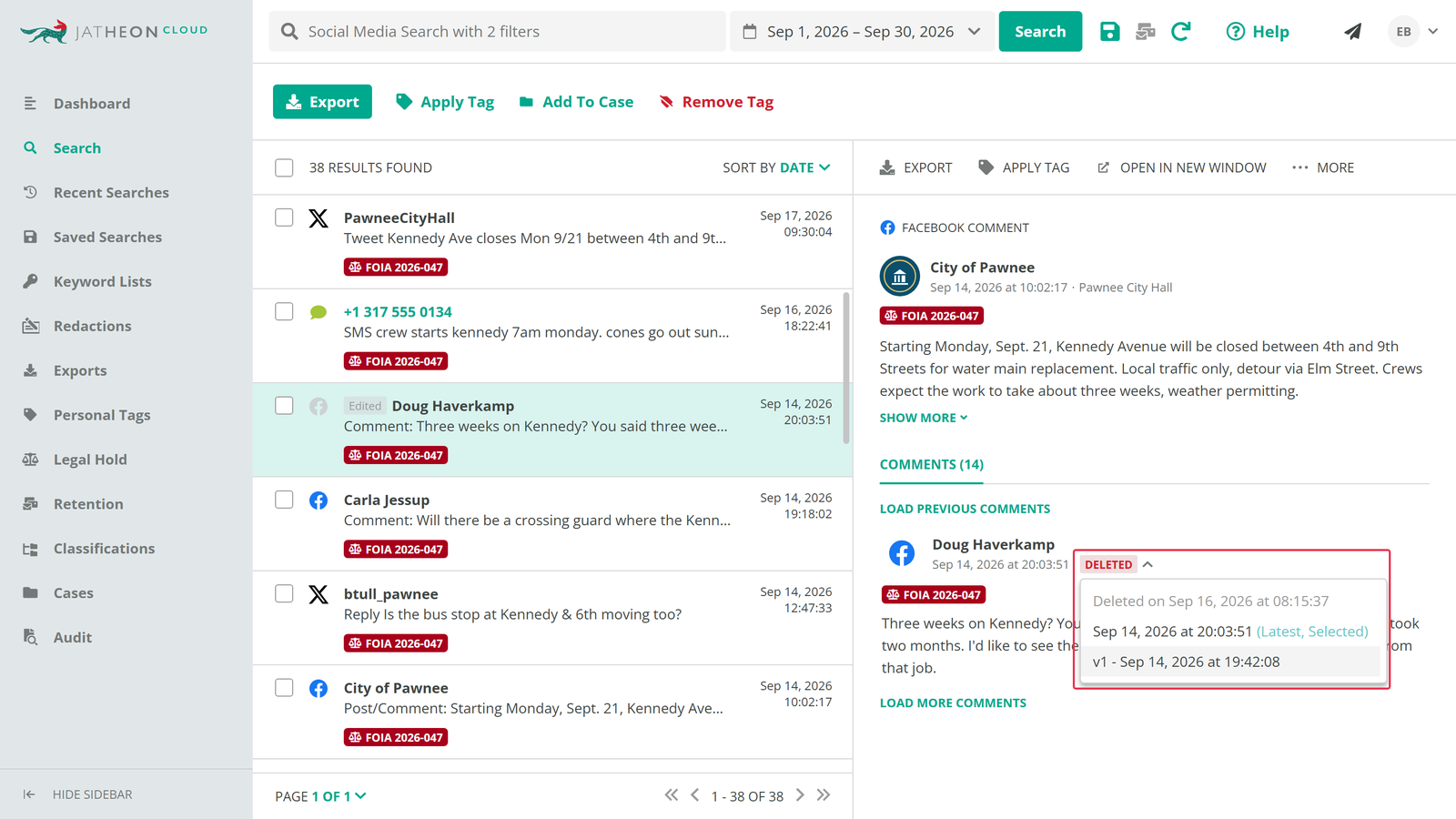
The system records everything in evidentiary quality with full context, including edits and the messages someone later deleted. That’s the exact gap screenshots and the native platforms leave open, because a deleted comment simply disappears from public view.
Point solutions usually cover one channel or a few. A unified archive keeps every channel in one searchable place. That matters when a single request spans Facebook, X, and text messages.
For teams ready to close the gap, Jatheon offers automated social media archiving that runs in the background.
How to Answer Records Requests and Meet Retention Rules with Jatheon
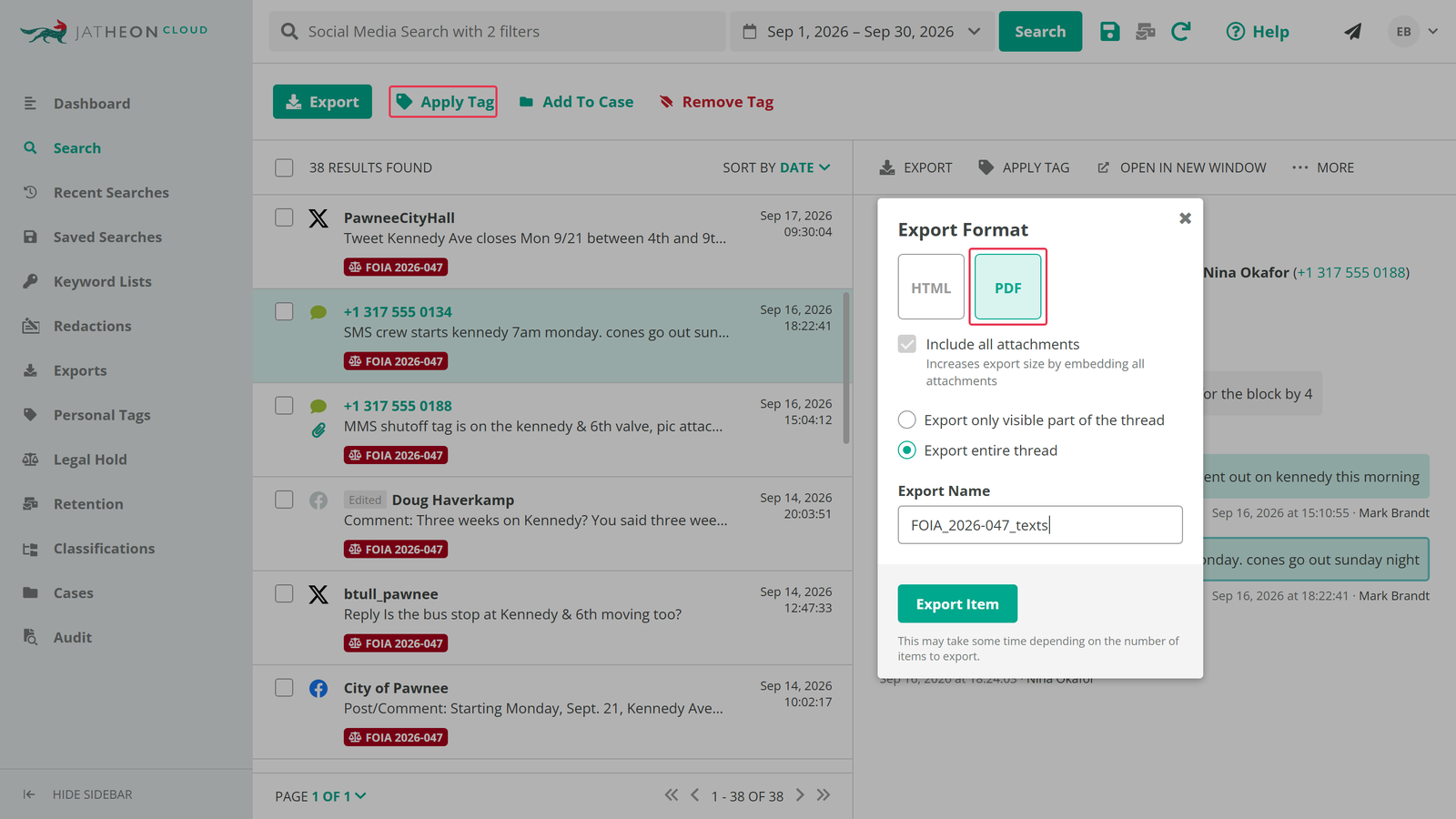
Answering a records request is the first payoff. When a request arrives, you run an advanced search across every channel at once. You filter by date, account, or keyword, then pull a complete, defensible export before the deadline. You can search, hold, and export from one archive instead of piecing files together by hand.
Litigation is the next one. When a case looks likely, you apply a legal hold, which locks relevant records so no one can change or delete them.
Jatheon keeps those records in WORM storage, short for write once, read many. That means data gets written a single time and never altered. Paired with detailed audit trails, that gives you tamper-proof evidence.
Retention is the ongoing job. You set retention schedules and deletion rules once. The archive then keeps each record only as long as the schedule requires. It disposes of the record on time. That protects you from holding data longer than the law allows.
Evaluating vendors is the last step before you buy. If you’re comparing options, our guide on how to evaluate social media archiving software walks through the criteria that matter in social media archiving for government, like capture completeness and export formats.
Jatheon has archived communications for more than 500 organizations and stores over 21 billion messages. It has a track record in regulated sectors since 2004, and The Radicati Group named Jatheon a 2025 Top Player in information archiving.