
Key Takeaways
- In the public sector, Slack messages in channels and DMs are considered public records under FOIA and state open records laws.
- The content of a message determines its record status, not the platform, device, type of Slack channel.
- Native Slack features like channel archiving and data export were not built for compliance. They lack retention enforcement, legal hold, and defensible search.
- Regulators have issued a combined $2.6 billion in fines tied to recordkeeping failures, and government agencies face a parallel risk through FOIA litigation and spoliation claims.
- A defensible Slack archive has to capture channels, direct messages, group messages, edits, deletions, and attachments, with tamper-proof retention and a complete audit trail.
- Gartner projects that by 2030, 70% of organizations using digital communications governance and archiving tools will rely on AI-driven features, up from 40% in 2025.
- Jatheon captures Slack messages for compliance and is a good choice for government agencies
Introduction
In June 2025, Baltimore’s Office of the Inspector General found that two city agencies, including the Mayor’s Office of Neighborhood Safety and Engagement (MONSE), were conducting significant daily business over Slack. In just one week, MONSE sent more than 2,500 messages and shared over 250 files, yet its Slack plan lacked the security and compliance capabilities needed to reliably produce records requested under Maryland’s Public Information Act.
Baltimore is one example of a broader shift: government agencies are moving daily coordination from email to Slack, Teams, and other chat platforms faster than their records policies can keep up. The same public records and litigation obligations that apply to email now extend to these platforms, but many agencies haven’t updated their archiving programs accordingly.
In this guide, you’ll learn:
- Why Slack messages tied to government business can constitute public records, and where the legal picture gets complicated
- Why Slack can create greater compliance risks than email, including private channels and deleted messages
- What a complete Slack archiving solution needs to capture—and how Jatheon’s new Slack connector addresses these requirements
Why Slack Messages Count as Public Records Now
Public records law was written for paper, then stretched to cover email, and now it’s being stretched again to cover chat. The consistent thread across all three is that the format of a communication has never been the test for whether it’s a record.
What matters is content and purpose: was the message created or received while conducting government business?
If so, it’s presumptively a public record, no matter if it traveled through a government server or a free Slack workspace someone on staff set up.
Exactly how that plays out varies by level of government.
Federal agencies answer to their own archival requirements, while states and localities each enforce their own version of public records law, with real differences from one place to the next.
The federal framework: NARA and the Capstone approach
Federal agencies have been under formal guidance on this since 2013, when NARA introduced the Capstone approach.
Capstone assigns retention rules to email based on the sender’s or recipient’s role, so a message from an agency head gets treated differently than one from a junior staffer.
In January 2023, NARA expanded Capstone to cover chat and instant messaging. The update backs the Electronic Message Preservation Act of 2021, and it’s specific: texts, chats, and instant messages used for agency business are likely federal records, and even emoji and GIFs count as content agencies may need to retain.
Depending on the sender’s role, Capstone retention runs anywhere from 3 to 30 years.
FOIA, state and local rules
The Freedom of Information Act (FOIA) works alongside these retention rules by giving the public a right to request federal records.
Courts have been consistent on one point: using a personal phone or an app outside official channels doesn’t get an agency out of that obligation, as long as the message concerns agency business. NARA made that point directly in April 2025, when it reminded newly appointed federal officials that messages sent through apps like Signal carry the same retention duties as email.
The reminder followed public scrutiny over a senior national security group chat and a court order to preserve the messages involved.
Every state has its own public records or open records law, and most define a record the same way federal law does. What matters is content and purpose, not the device or app that created it.
Washington, Florida, Texas, and California all treat text messages and chat records related to public business as public records, even when they’re stored on personal devices. Courts in other states have largely followed that approach, though the law is still evolving.
A 2026 Kentucky Supreme Court ruling took a different position, showing that agencies can’t rely on courts to provide a consistent answer.
The safest approach is to capture public-business communications consistently across official and personal channels, regardless of where they’re stored or how courts may interpret the law in the future.
What Makes Slack Riskier Than Email for Compliance
Email compliance programs have had two decades to mature. Slack compliance programs, in most agencies, are much newer, and the platform’s design creates a few specific problems.
The first is losing visibility into private conversations an agency didn’t even know were happening. The second is assuming a native feature or a backup process already has this covered, when neither one does. The third is losing the context that turns a plain message into a usable, defensible record.
Private channels, direct messages, and the shadow IT problem
Slack workspaces are easy to create, which makes them easy for agencies to adopt without IT or records staff involvement. Once in use, private channels and direct messages can contain public records just like public channels.
Without a capture plan in place from day one, records staff may have no visibility into these conversations and no reliable way to know they exist when responding to a records request.
Where native Slack tools and generic backups fall short
Agencies may assume Slack’s “Archive Channel” feature or standard IT backups provide sufficient records protection, but neither is designed for compliance.
Archiving a channel inside Slack removes it from the sidebar, but the messages themselves stay inside Slack. Anyone with the right permissions can edit and delete them. Backups are designed for disaster recovery, not searchable records retrieval, retention management, legal holds, or defensible responses to records requests.
Slack’s compliance features also generally require an Enterprise-tier plan and export data rather than serving as a dedicated system of record.
A dedicated archiving layer fills that gap by preserving, indexing, retaining, and making communications accessible for compliance and records management.
What Agencies Risk by Failing to Archive Slack Messages
For agencies, the costs of an incomplete Slack archive tend to show up in different ways. A few examples come up again and again:
- A judge granting an adverse inference instruction because relevant messages weren’t preserved
- A public records lawsuit that drags on for months because a request can’t be fully answered
- An inspector general report, like Baltimore’s, that turns into a local news story
- A legal team spending days manually collecting screenshots instead of running a single search
None of these show up as a line item on a balance sheet, but each one costs real time, money, and public trust.
What to Look for in a Government Slack Message Archiving Solution
Before evaluating vendors, it helps to work from a clear checklist of what “complete” actually means for a government deployment.
A government-ready Slack archiving solution should:
- Capture public channels, private channels, direct messages, and group messages, since public records law doesn’t distinguish between them.
- Keep replies attached to the thread they belong to, in a readable threaded view, rather than flattening everything into a single stream.
- Preserve message metadata alongside the text itself, including sender, timestamp, mentions, channel references, and link previews.
- Retain both the original and edited versions of a message, with timestamps for each, rather than silently overwriting history.
- Show clearly, with a timestamp, when a message has been deleted, instead of leaving a gap that looks the same as a message that never existed.
- Capture attachments, images, documents, and Slack clips (including auto-generated transcripts) in a way that keeps them associated with the right message.
- Support historical import, so records created before the archiving tool was deployed aren’t a permanent gap.
- Apply the same retention schedules, legal holds, and audit trails used for email and other channels, in one unified search.
- Offer flexible deployment options, cloud or on-prem, so the agency can meet its own data residency and IT requirements.
- Include AI-assisted search or classification to help records and legal teams manage rising message volume without adding headcount
How Jatheon Slack Archiving Can Help
Jatheon’s new Slack connector was built against that same checklist, extending the completeness Jatheon already provides for email, social media, mobile, iMessage, WhatsApp, collaboration tools, website content, and other channels to Slack workspaces specifically.

Every Slack conversation captured completely
The connector captures public Slack channels, private channels, 1:1 direct messages, and group direct messages.
Message content that stays usable, not just stored
Beyond plain text, sender, and timestamp, the connector keeps replies attached to their original thread in a readable, threaded view rather than flattening every reply into the main channel feed.
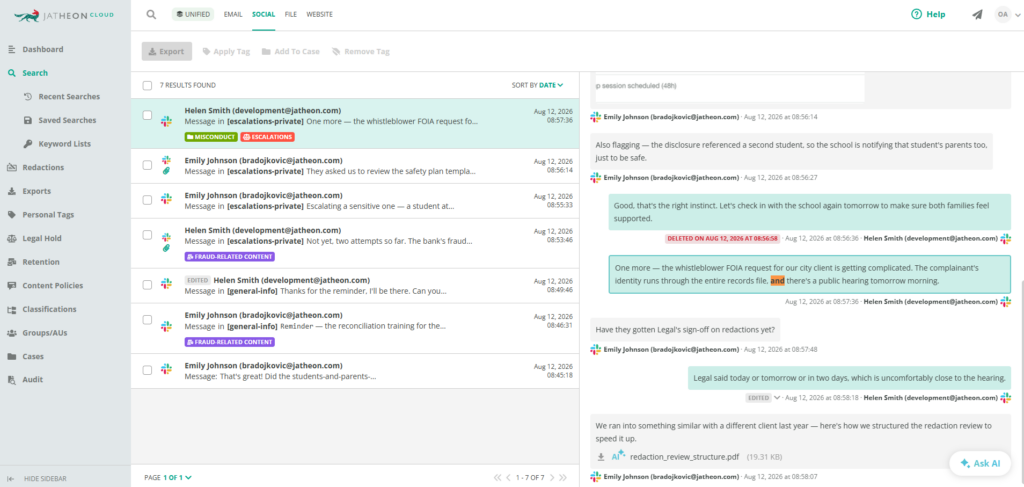
It resolves @user mentions to an identifiable user reference rather than leaving them as unreadable text, and it distinguishes broadcast notifications like @here and @channel from an ordinary mention. Channel references (#channel-name) are captured with the correct channel ID and link intact.
URLs are retained both as the raw link and the unfurled preview, including title, image, and description, so reviewers see what a recipient actually saw.
Unicode emoji, markdown formatting (bold, italic, strikethrough, code blocks), and GIFs are preserved rather than stripped out, with GIFs archived and viewable or, at minimum, kept as a static frame with a link back to the source.
Long, multi-line messages are archived without truncation, and non-Latin scripts and special characters are correctly UTF-8 encoded.
Attachments and rich media handled properly
Images, video, and audio, including audio messages with an accompanying caption, are captured along with documents like PDFs, Word files, and spreadsheets.
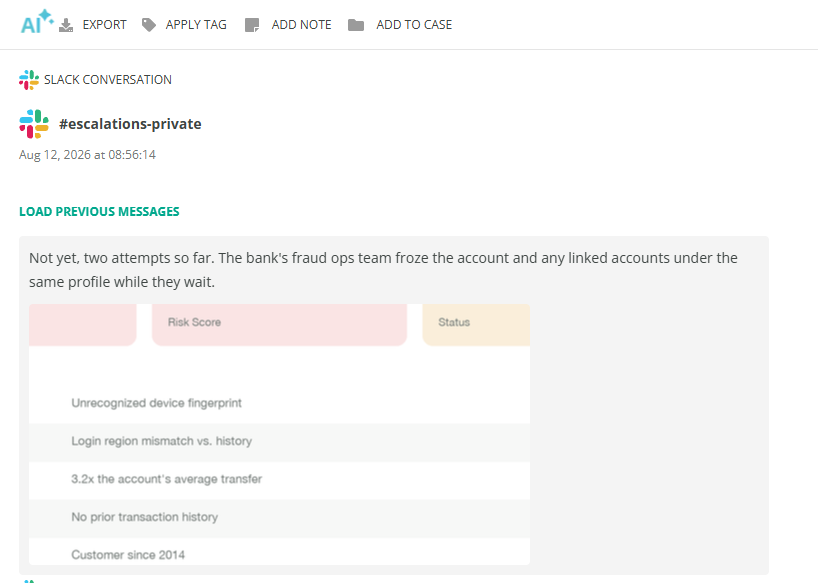
When a single message includes multiple attachments, they stay correctly associated with one another and with the original message. Slack clips, the platform’s video and audio recordings, are archived along with their auto-generated transcripts.
A defensible record of edits and deletions
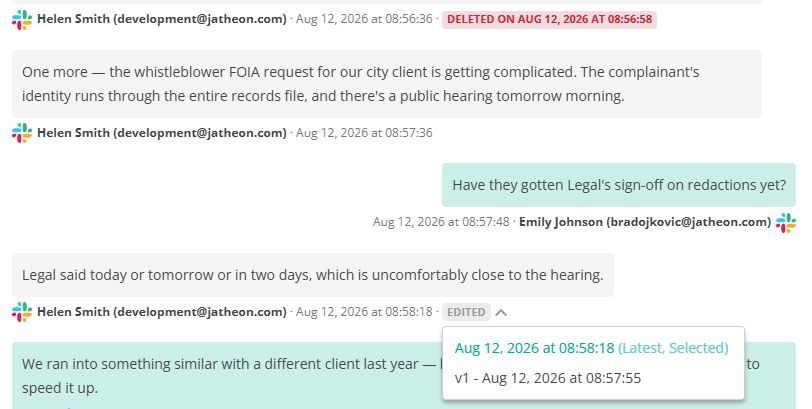
When a message is edited, the connector retains both the original and the edited text, each with its own timestamp, preserving a full edit history rather than only the latest version.
When a message is deleted, the archive retains it as a compliance record and marks explicitly, with a timestamp, where the content was removed, so a reviewer can see exactly when a deletion happened rather than encountering a silent, unexplained gap in the conversation.
Optional historical import
The connector supports historical import of existing Slack conversations, not only messages sent after deployment, which matters for agencies that have been using Slack for months or years before formalizing an archiving plan.
That backfill is optional. Agencies can import existing history when they connect a workspace, or start capture from the deployment date and leave prior conversations out of the archive. Historical import requires an enterprise-tier Slack plan.
One archive and one search across every record type
Slack messages land in the same searchable archive as email, social media, files, and website data, all searchable together through Jatheon’s Unified Search.
Retention policies, legal holds, tags, and audit trails apply to Slack records exactly as they do to every other channel Jatheon archives.
When an investigation or a public records request comes in, reviewers can search by content, title, author, recipient, origin, attachment, tag, or note.
The relevant Slack results can then be pulled into a case file alongside every other record type, using the same FOIA request automation already available across Jatheon’s other channels. There’s no need to run a separate search in a separate tool.
Liya, when you need answers fast
Liya, Jatheon’s AI copilot, can be used to ask questions about archived Slack data and generate summaries, which helps records officers and legal teams work through large result sets faster.
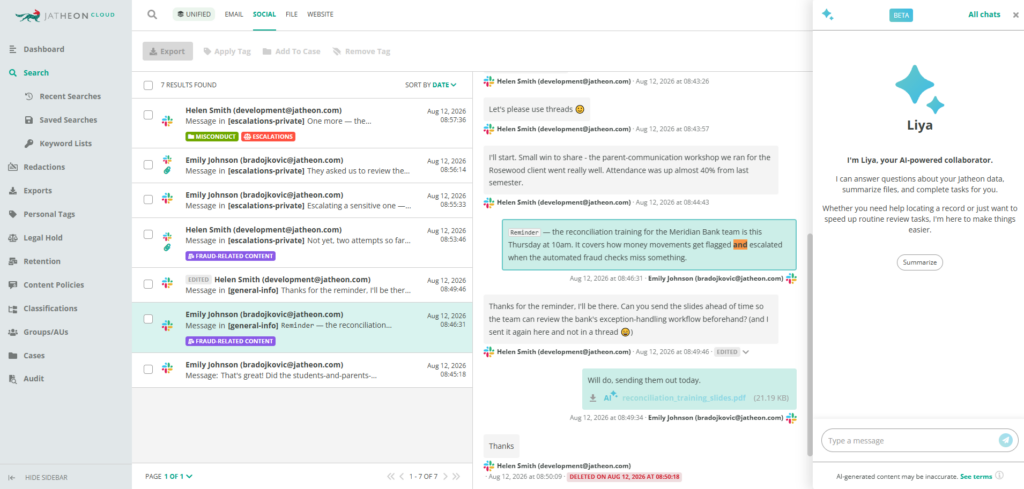
AI-based classification filters out noise, like newsletters or out-of-office replies, and OCR extracts searchable text from images and documents shared in Slack, so a screenshot or a scanned form doesn’t become a blind spot in a search.
Risk scoring can also flag messages that need attention first, with a short explanation of why each one was flagged, which helps records and HR teams catch potential policy violations or security concerns while they’re still small.
Sentiment analysis adds another layer of context by surfacing tone across a larger set of messages.
Like every other channel Jatheon archives, Slack data can be deployed through Jatheon Cloud or Jatheon On-Prem, depending on an agency’s data residency and infrastructure requirements.
Agencies that already archive elsewhere can also use the connector for capture only and route Slack data into their existing system.
Conclusion
Slack is now central to government operations, just like email, and the same recordkeeping obligations apply. Waiting for a records request, lawsuit, or audit to expose gaps can be costly.
The safest approach is to treat Slack as a records system from day one, with capture, retention, and search built in.