
Slack ediscovery is the process of preserving, collecting, reviewing, and producing Slack messages and files for litigation, internal investigations, and regulatory requests.
On most Slack plans, the platform keeps the messages but doesn’t give you the tools to defend how they were preserved or produced. The Slack Discovery API closes part of that gap on Enterprise plans, but it returns raw JSON that still needs a capture, review, and production layer around it.
This guide covers what courts and regulators expect from Slack data, why it’s harder to produce than email, and which Slack plans support ediscovery at all. You’ll also find a five-step workflow and a buyer’s checklist for comparing Slack ediscovery tools.
What Slack Ediscovery Covers and Why Courts Treat Slack Like Email
Slack messages, files, and channel metadata are electronically stored information (ESI), so they fall under the same discovery rules as email. At least one federal court has already rejected the argument that Slack is too burdensome to search.
Under the Federal Rules of Civil Procedure, Rule 34 covers ESI, and Rule 26(b)(1) makes any nonprivileged material discoverable if it’s relevant to a claim or defense and proportional to the needs of the case. Once litigation is reasonably anticipated, the duty to preserve applies to Slack the same way it applies to a mailbox.
If Slack data is lost because a party didn’t take reasonable steps to preserve it, FRCP Rule 37(e) allows measures to cure the prejudice. Where the court finds intent to deprive, it can go further and order an adverse inference or dismissal.
A frequently cited example is Benebone LLC v. Pet Qwerks, Inc. (C.D. Cal. Feb. 18, 2021). The plaintiff estimated that reviewing about 30,000 Slack messages would cost $110,000 to $255,000, while the defendants’ ediscovery vendor put the cost at roughly $22,000. The court compelled production and found that searching and producing Slack messages “is generally comparable to requiring search and production of emails and is not unduly burdensome.”
Regulators take the same view. On Jan. 26, 2024, the FTC and DOJ updated their preservation guidance and made clear that their preservation letters, second requests, and subpoenas cover collaboration tools and ephemeral messaging.
Broker-dealers also have to retain business communications under SEC Rule 17a-4 and FINRA Rule 4511, and public agencies answer FOIA and state open records requests that treat Slack messages as public records.
Why Slack Data Is Harder to Produce Than Email
An email is a self-contained record with a sender, recipients, a timestamp, and a body.
A Slack message often depends on a thread, a channel’s membership, and edits made after it was sent, so producing it accurately takes more work than exporting a mailbox.
Context lives in threads and reactions
Meaning in Slack is spread across replies, reactions, and shared files.
A reply posted three days after the original message, or a thumbs-up on a proposal, can change what a conversation means.
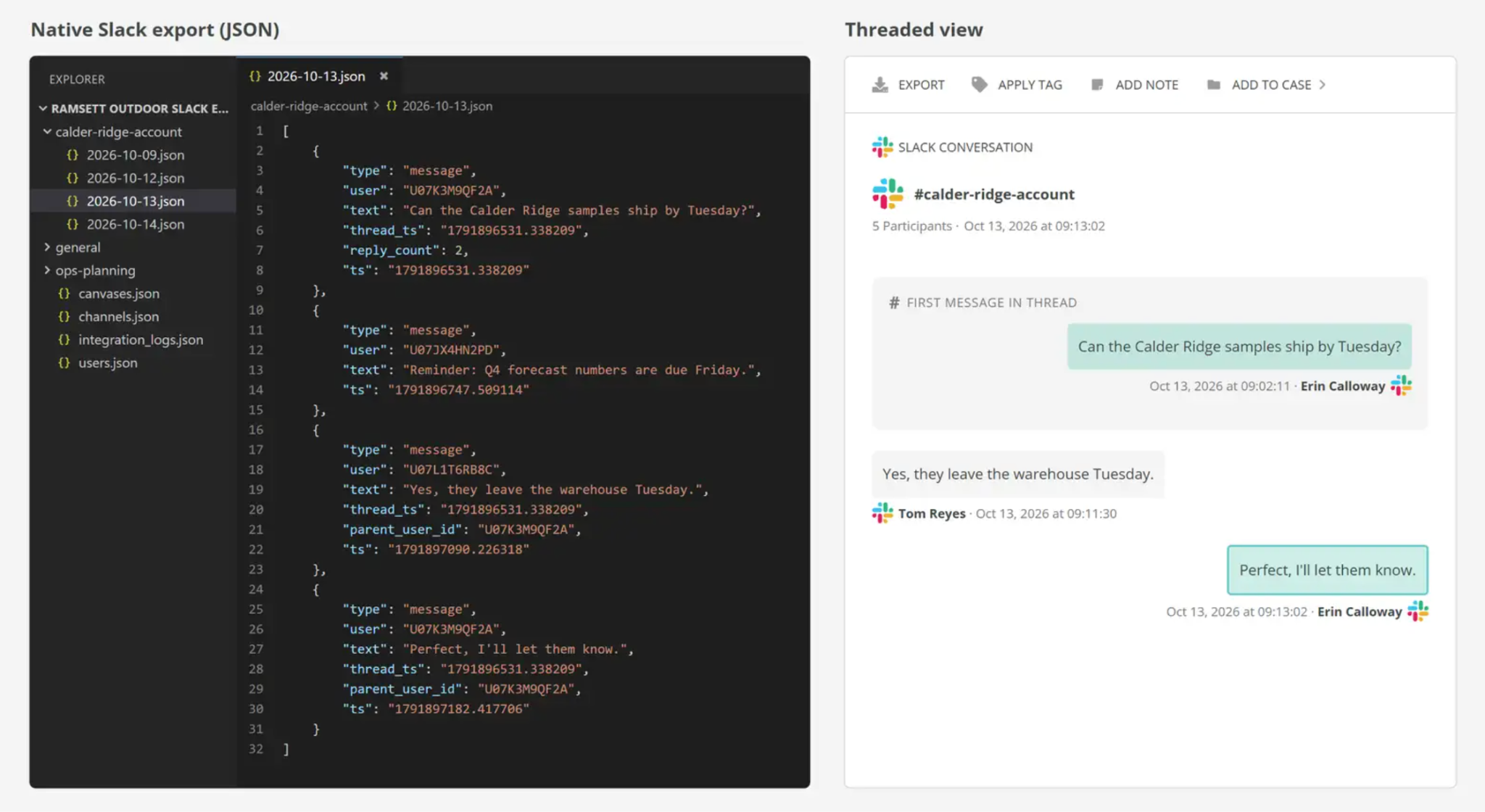
Slack’s native export stores each conversation as a folder with one JSON file per day, and Slack’s own documentation notes that the export doesn’t separate thread replies from regular channel messages. Reviewers have to rebuild threads from timestamps and metadata before they can read them.
Messages can be edited or deleted after the fact
Slack users can edit or delete their own messages unless an admin restricts it.
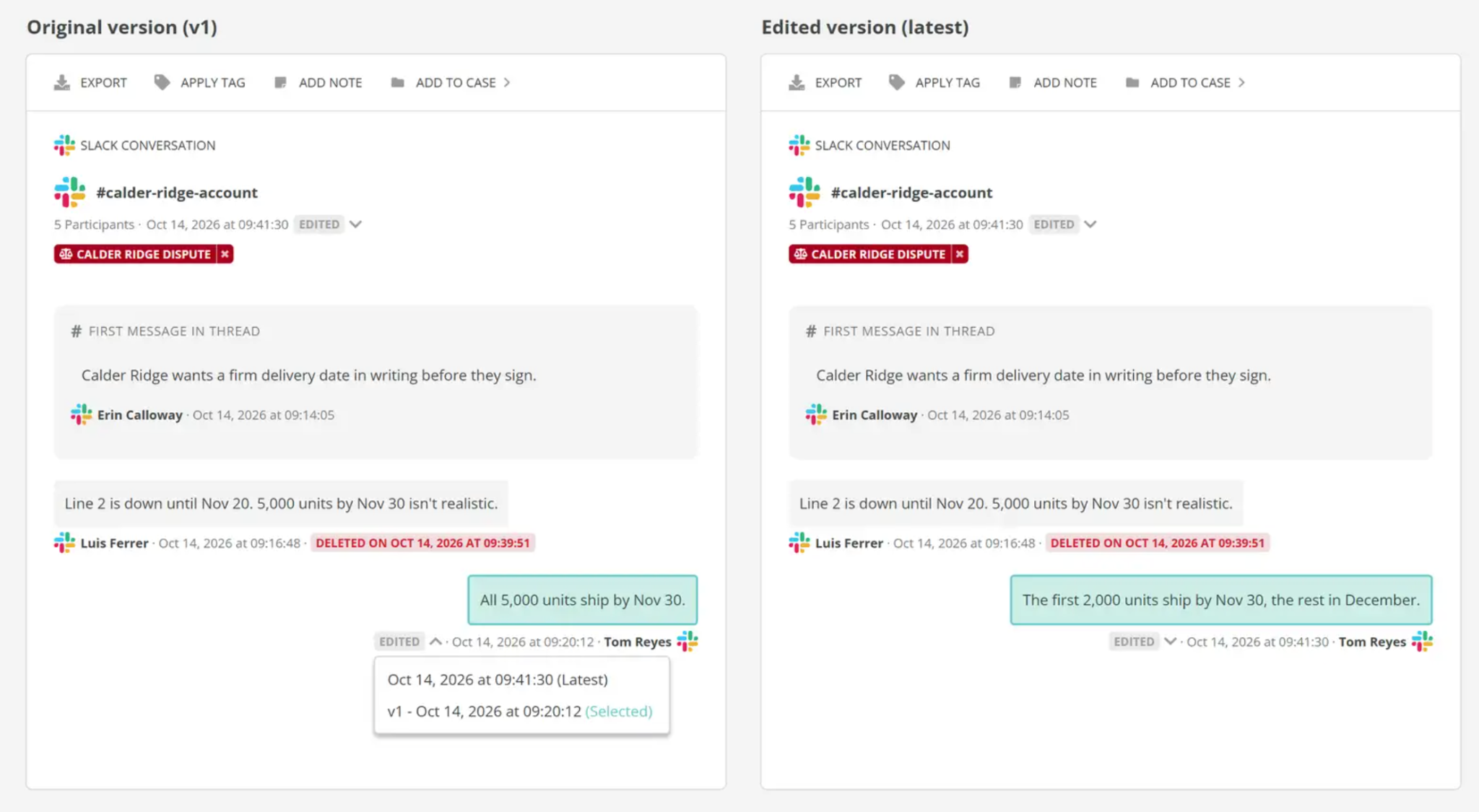
An edited message shows an “(edited)” label, but other readers can’t see the original wording, and a deleted message usually disappears from the channel. Edited and deleted messages only survive if a retention policy or legal hold kept them, so a hold placed after the edit can’t bring it back.

Channel membership widens the custodian list
Email custodians are usually the people who sent or received a message. In Slack, everyone in a channel had access to every message posted there, so a dispute between two employees in a 200-person channel can raise questions about 200 potential custodians. Shared channels with other companies, guests, and former employees make it longer still.
Which Slack Plans Support Ediscovery?
Only Enterprise plans include the tools most ediscovery work depends on, namely legal holds and the Slack Discovery API. Lower plans can export some data, but the scope is narrow and the files arrive as JSON.
The table below reflects Slack’s current plan names and features as listed on its plans and features page.
| Plan | Message history | Custom retention | Data exports | Legal holds | Discovery API |
| Free | 90 days of access; content older than one year is deleted | No | Public channels only | No | No |
| Pro | Full history | Yes | Public channels only | No | No |
| Business+ | Full history | Yes | All messages, including private channels and DMs, after an approved application | No | No |
| Enterprise+ | Full history | Yes | All messages, plus exports by member, conversation type, or workspace | Yes | Yes |
Slack data export options for discovery
A Slack data export comes in two forms.
Standard exports, available on every plan, include messages and file links from public channels only. On the Free plan, file links cover just the last 90 days.
Exports of all messages, including private channels and DMs, are available on Business+ and Enterprise plans.
On Business+, a Workspace Owner has to apply for the export tool, and Slack describes it as intended for legal and regulatory compliance.
Enterprise plans add exports for a single member or a specific conversation type, which helps when a request names specific custodians.
Both export types share the same limits for review. They contain links to files instead of the files themselves, they split conversations into daily JSON files, and they only include edits and deletions if retention settings kept them. A review platform can’t read them without processing, and anything that changed before the export ran is gone.
How the Slack Discovery API Works
The Slack Discovery API is Slack’s interface for approved ediscovery, archiving, and data loss prevention (DLP) applications. It’s available only on Enterprise plans, and a Primary Org Owner or Org Owner has to request access before any third-party tool can use it.
According to Slack’s guide to its Discovery APIs, the API can collect messages, files, canvases, and lists from the start of an organization’s history. That includes edits and deletions, as long as retention policies or legal holds preserved them. Data comes out as JSON, so you still need a tool to index, review, and produce it.
Jatheon’s Slack connector uses the Discovery API to capture public and private channels, DMs, and group messages with attachments, metadata, and threading, and it requires an Enterprise-level Slack subscription.
A Defensible Slack Ediscovery Workflow, Step by Step
A defensible Slack ediscovery process follows the same arc as email discovery, with extra steps for channel scope, edits, and threads. These five steps assume you’re on an Enterprise plan or have Slack captured in an archive.
1. Map workspaces, channels, and custodians
Start with an inventory of every workspace, channel, DM, and group message that might hold relevant content. For each custodian, list the public and private channels they belong to. Then add the accounts that are easy to miss, such as guests, departed employees whose accounts were deactivated, and members of Slack Connect channels shared with outside organizations. Slack Connect needs separate attention.
Slack’s legal holds don’t include messages and files from Slack Connect conversations, and the outside organization’s retention settings control their copy of those messages. If a shared channel matters to the case, document how you’re preserving it and raise it with opposing counsel early.
2. Set retention and place a Slack legal hold
A Slack legal hold preserves a custodian’s messages and files regardless of retention settings, including content they later edit or delete. Slack’s native holds are available on Enterprise plans, are placed by members with the Legal Holds Admin role, and cover up to 1,000 custodians per hold.
Native holds have limits worth documenting. According to Slack’s legal holds documentation, they’re scoped to people instead of channels, can’t be edited to change the date range, don’t save data from a channel that gets deleted, and exclude emoji reactions.
An archive gives you a second layer that doesn’t depend on Slack’s settings. In Jatheon, legal hold tags override retention policies, and the archive keeps every edit and deletion side by side with timestamps, so the hold covers content captured before anyone knew a dispute was coming.
The rest of the legal hold process, from the hold notice to the release, works the same way for Slack as it does for email.
3. Collect through the Discovery API
Collect Slack data through the Discovery API or from an archive that captures through it. Screenshots and copied text drop the metadata that proves who said what and when, and exports made by individual users only cover what that user can see.
Log every collection with the date range, custodians, channels, and tool used. That record is what you’ll rely on if opposing counsel challenges completeness.
4. Review threads in context
Reviewers need to see a thread the way participants saw it, with replies grouped under the parent message and edits shown next to the original wording. They also need Slack alongside the custodian’s email, Teams chats, and text messages, since a conversation often starts in one channel and ends in another.
Jatheon puts Slack in the same cases as email, Teams, mobile, and social media, so reviewers can search all of a custodian’s communications through Jatheon’s Unified Search instead of reconciling separate exports.
5. Produce in a usable, authenticated format
Agree on the production format before you collect.
Add Slack to the ESI topics on your FRCP 26(f) meet-and-confer checklist, including whether you’ll produce threads as single documents, how you’ll handle reactions and attachments, and which date ranges apply.
Review platforms often take load files or the Relativity Short Message Format (RSMF), and regulators and opposing counsel commonly accept PDFs with threads rendered in order. Federal Rules of Evidence 902(13) and 902(14) let you authenticate electronic records and copied data through a certification, and 902(14) relies on hash values to show the copy matches the original. Keep hash values and an audit trail in ediscovery for every export, so you can show the chain of custody from capture to production.
Jatheon exports Slack data to PDF and HTML. Redaction is non-destructive and applied only on export with a PDF redaction log, and every export is recorded in WORM-protected audit logs with checksums.
How to Choose Slack Ediscovery Tools: A Buyer’s Checklist
The right Slack ediscovery tools capture Slack continuously, keep edits and threads intact, and produce data in formats your counsel and regulators accept. Use these criteria and questions when you compare vendors.
| Criterion | Why it matters | Question to ask the vendor |
| Discovery API integration | It’s Slack’s supported route for continuous, programmatic collection on Enterprise plans | Do you collect through the Discovery API, and which data types do you support? |
| Capture frequency | Content edited or deleted between captures may never reach the archive | How often do you capture Slack data, and can you import historical data? |
| Edit and deletion history | Original wording is often the evidence | Do you keep every version of an edited message and show deleted messages to reviewers? |
| Threaded rendering | Reviewers need replies grouped with the parent message | How do threads, reactions, and attachments appear in review and in exports? |
| Legal hold and retention | Native holds are custodian-based and exclude Slack Connect | Can holds override retention across channels, and how do you handle shared channels? |
| Cross-channel search | Conversations move between Slack, email, Teams, and mobile | Can one search cover Slack and every other channel for the same custodian? |
| Export formats | Courts and regulators expect different formats | Which formats do you support for Slack, and do exports keep threads, timestamps, and attachments intact? |
| Chain of custody | Authentication depends on proving nothing changed | Do you generate hash values and immutable audit logs for every export? |
| Security certifications | Slack data often includes privileged and personal information | Which certifications do you hold, and when was your last audit? |
| Data residency | Some regulations restrict where data is stored | Can you keep our data in a specific region? |
| Fees | Ingestion and export fees can exceed the subscription | Do you charge for ingestion, migration, storage overages, or exports? |
Fees deserve extra scrutiny, since processing and hosting charges grow with data volume and make up a large share of ediscovery costs. Ask for a written quote that covers a full matter, from ingestion through production.
How Jatheon Supports Slack Ediscovery
Jatheon treats Slack as one more channel in the same archive as the rest of your communications.
The connector captures Slack through the Discovery API, and from there the same retention policies, legal holds, and ediscovery and legal hold tools apply to every source. Slack data reaches the archive in near real time, typically within 15 minutes, and you can import historical conversations when you connect a workspace.
Beyond capture and holds, three things set the platform apart for Slack ediscovery.
- Searchable content in every format. OCR makes text inside shared images and screenshots searchable, and Jatheon’s AI assistant, Liya, available with the AI module, can summarize long Slack threads and search results in plain language.
- Security your legal team can document. Jatheon Cloud runs on single-tenant AWS infrastructure with region geofencing, holds SOC 2 Type II and ISO/IEC 27001:2022 certifications, and comes with a 99.9% uptime SLA.
- Predictable costs. Ingestion, storage, and the migration of historical data are scoped and priced up front, so the cost of adding Slack is clear before you sign. You can deploy in the cloud or on-premises.
Conclusion
Slack ediscovery gets easier once Slack is treated as a business record from the day a message is sent. Native exports and holds help, but they depend on your plan, exclude shared channels, and only cover what Slack still holds when you act. Continuous capture into an archive gives legal and compliance teams the original wording, the edits, and the threads before anyone asks for them, and lets them produce Slack alongside email in one case.