
FRCP Rule 34 lets a party in a federal civil case serve a request for production on another party, asking it to produce, or allow inspection, copying, testing or sampling of, documents, electronically stored information (ESI) and tangible things. The items must be in the responding party’s “possession, custody, or control” and within the scope of Rule 26(b). The rule also covers requests to enter land.
The responding party must answer in writing within 30 days of service. Objections must be specific and say whether anything is being withheld, and ESI must come in the requested form or a form ordinarily maintained or reasonably usable. Rule 34 binds only parties; requesting parties reach nonparties through Rule 45 subpoenas.
What it costs to get FRCP Rule 34 wrong
In October 2022, the U.S. District Court for the Northern District of Illinois awarded $2,526,744.76 in monetary sanctions in DR Distributors, LLC v. 21 Century Smoking, Inc. Judge Iain D. Johnston’s order broke the total into $2,401,042.21 in fees plus $125,702.55 for litigating the fee petition.
On June 5, 2024, the court dismissed the defendants’ counterclaims and entered default judgment, citing unpaid sanctions and the “failure to produce tens of thousands of relevant, responsive documents.” It said that failure violated several federal rules, including Rule 34 (Justia docket).
This was an extreme case, and the money sanction also rested on Rules 26(g) and 37, so it isn’t a typical outcome. The failure pattern is ordinary, though: ESI nobody knew existed, sources nobody searched and responses signed before anyone located the data. The 30-day clock starts at service, whether or not IT can find the data.
In Fischer v. Forrest (S.D.N.Y. 2017), Magistrate Judge Andrew Peck issued no sanction but warned that non-specific objections would be “deemed a waiver of all objections (except as to privilege)” (the opinion).
What FRCP Rule 34 covers
Rule 34(a) lets any party ask another party to produce items in its “possession, custody, or control” and permit the requester to inspect, copy, test or sample them. The rule covers documents and ESI, “including writings, drawings, graphs, charts, photographs, sound recordings, images, and other data or data compilations,” when “stored in any medium.” It also reaches tangible things and entry onto land.
The 2006 Committee Note says ESI discovery “stands on equal footing with discovery of paper documents.” In practice, that covers email, chat, text messages, collaboration tools and file shares. (For platform-specific guidance, see how to preserve and produce Slack data and archive text messages for ediscovery.)
Rule 26(b)(1) limits discovery to matter “relevant to any party’s claim or defense and proportional to the needs of the case.” Rule 34 binds only parties, and Rule 34(c) routes nonparties to Rule 45 subpoenas.
How a Rule 34 request for production and response work
What the request must include
Under Rule 34(b)(1), a request:
- Must describe each item or category of items with “reasonable particularity”;
- Must specify a reasonable time, place and manner for inspection; and
- May specify the form or forms for producing ESI.
“Reasonable particularity” means a reasonable person could tell what’s being asked for. Courts often reject catch-all requests for “all documents relating to the case,” while requests that name a subject, date range, custodians or document types usually pass.
The 30-day response clock
Rule 34(b)(2)(A) gives you 30 days after service to respond in writing. If the other side delivered the request early under Rule 26(d)(2), the rule treats it as served at the parties’ first Rule 26(f) conference. A Rule 29 stipulation or a court order can change that deadline.
Objections after the 2015 amendments
The Dec. 1, 2015 amendments aimed at “reducing the potential to impose unreasonable burdens by objections to requests to produce.” You must now state each objection “with specificity,” including the reasons. Each objection must also say whether you’re withholding responsive materials on that basis. That rules out boilerplate objections, such as a list of “general objections” or a bare “overly broad and unduly burdensome” with no explanation of why.
If you object to part of a request, you must name that part and permit inspection of the rest. The 2015 Committee Note says you don’t need a detailed log of withheld documents, but you must alert the other side that something was withheld. Privilege claims follow Rule 26(b)(5)(A), which requires you to expressly make the claim and describe what you withheld.
If you produce copies instead, finish by the date in the request or a reasonable date you state. For rolling productions, state beginning and end dates.
Form of production for ESI under FRCP 34(b)(2)(E)
Under Rule 34(b)(2)(D), you must state the form you intend to use if the request names no form or you object to the requested one. Absent a stipulation or court order, Rule 34(b)(2)(E) sets three defaults:
- Produce documents as you keep them in the usual course of business, or organize and label them to match the request’s categories;
- Produce ESI in a form in which you ordinarily maintain it or in a reasonably usable form; and
- Produce the same ESI in only one form.
The 2006 Committee Note says searchable information “should not be produced in a form that removes or significantly degrades this feature.” If you produce in a form you didn’t disclose, you risk producing it again.
The rule text doesn’t require native files or metadata in every case. Rule 26(f)(3)(C) asks the parties to address ESI issues in their discovery plan, “including the form or forms in which it should be produced.” Many parties set these terms in an ESI protocol, so IT should know which export formats keep data searchable.
Possession, custody or control: BYOD, cloud data and lost ESI
The Federal Rules don’t define “possession, custody, or control,” and the Sedona Conference commentary, updated in February 2024, shows courts split. Some ask whether you have a legal right to obtain the data; others also ask whether you have the practical ability to get it.
For employee devices, a Kang Haggerty analysis notes that district courts are divided on whether an employer controls ESI on an employee’s personal device. The answer depends on your circuit, your BYOD policy language and what you do in practice.
Sedona says cloud storage raises questions about who owns the data and who has the right and ability to control it, and treats a contractual right to obtain data on demand as a basis for control. Under Rule 26(b)(2)(B), you can flag ESI sources as not reasonably accessible because of undue burden or cost, though a court may still order discovery for good cause.
Data you can’t find is one problem; data that’s gone is another. Under Rule 37(e), if ESI that should have been preserved is lost because a party failed to take reasonable steps, and it can’t be restored or replaced through additional discovery, the court may order measures to cure the prejudice. If the court finds intent to deprive, it can presume the lost information was unfavorable, instruct the jury to do so, or dismiss the case or enter default judgment.
A Rule 26(g) signature certifies a reasonable inquiry, and sanctions “may include an order to pay the reasonable expenses, including attorney’s fees.” Rule 37 governs motions to compel and related sanctions. The Dec. 1, 2025 amendments changed Rules 26(f) and 16(b) on privilege-log timing; Rule 34 was last amended in 2015.
This is not legal advice; confirm the standard in your circuit with counsel.
Checklist: responding to a Rule 34 request
- Calendar the 30-day deadline from the date of service, or from the first 26(f) conference for early requests.
- Issue or confirm a legal hold on every custodian and source the request touches.
- Map where responsive ESI sits: email, chat, text messages, collaboration tools, file shares and personal devices.
- State every objection with specificity and say whether anything is withheld on that basis.
- Assert privilege expressly and describe what’s withheld under Rule 26(b)(5)(A), following any privilege-log method set in the scheduling order.
- State the form of production for ESI if the request names none or you object to the requested form.
- Commit to a completion date, or beginning and end dates for rolling productions.
- Keep a record of what you searched, held and produced, so the Rule 26(g) inquiry is defensible.
For how retention policies feed into this process, see managing document retention and requests for production.
How Jatheon handles FRCP Rule 34 requests
Jatheon Cloud and Jatheon On-Prem keep communications in one archive built for ediscovery, so legal, records and IT teams work from the same record while counsel decides scope, objections and privilege.
Responsive ESI sits across email, Teams, Slack, WhatsApp, SMS and employees’ phones. Jatheon Data Connectors capture more than 25 sources in evidentiary-quality formats with metadata, deduplication, version history and message threading, including employer-issued, BYOD and CYOD devices. You get one archive to search when the clock starts.
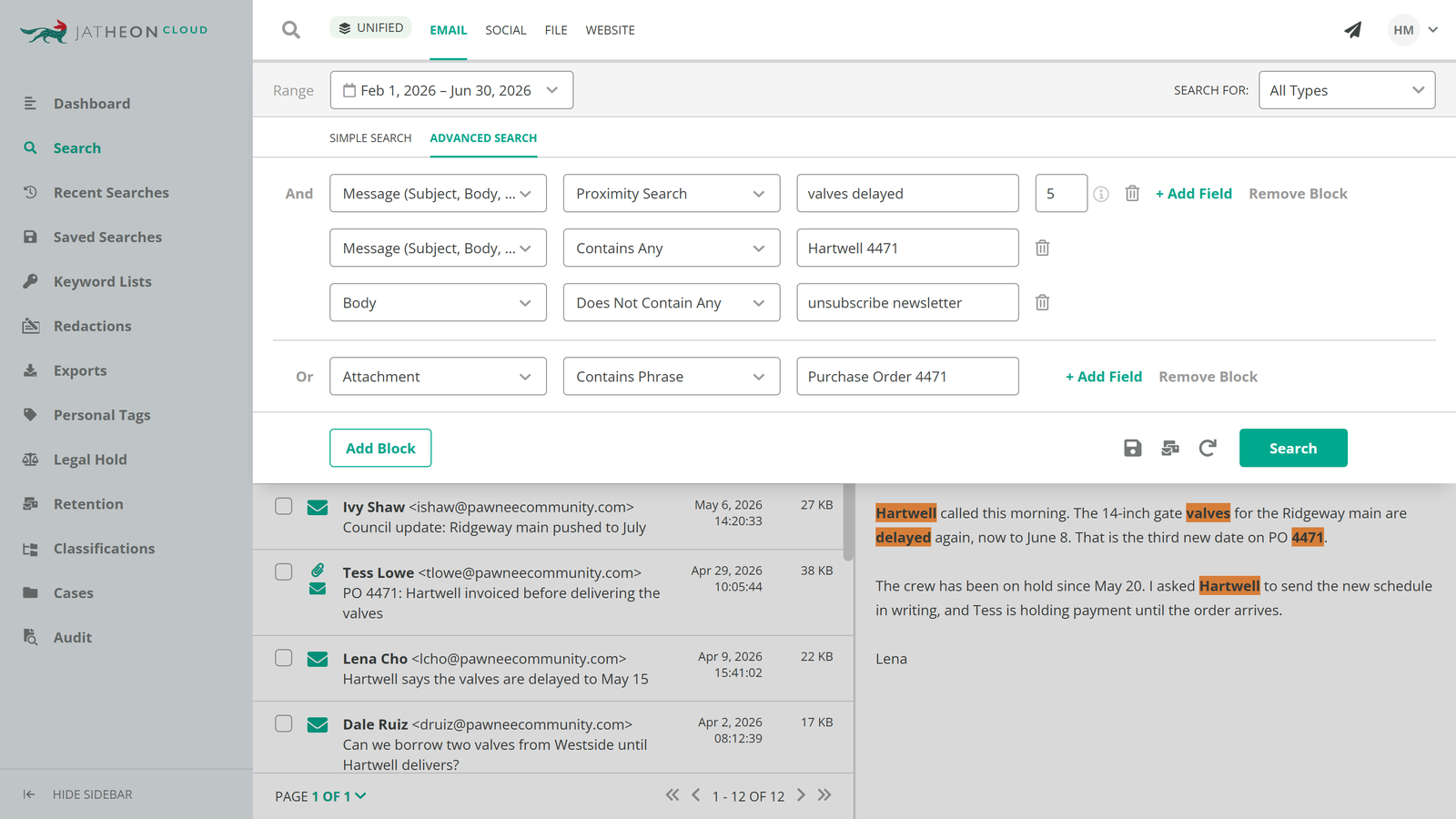
Keyword hunts across separate systems miss items or over-collect. In Jatheon Cloud, advanced multi-criteria search with Boolean, fuzzy and proximity operators narrows results, and AI data classification filters out newsletters, promotions, out-of-office replies and bounced messages. Liya, Jatheon’s conversational AI copilot, generates summaries, so review starts with a smaller, relevant set.
Data deleted mid-case or privileged content released by mistake is a problem no objection can fix. Legal hold and legal hold tags stop deletion, and WORM storage keeps records unaltered. Redaction, case management and role-based access with 60+ permissions control who sees what, leaving a clear record of what you held, withheld and why.
Converting ESI to flat images can strip searchability the 2006 Committee Note says to keep. Jatheon Cloud and Jatheon On-Prem export to PST, EML and PDF, so you can produce in the form you stated under Rule 34(b)(2)(D).
Your Rule 26(g) signature certifies a reasonable inquiry you may need to prove. Audit trails and the AI-driven action log with justification reports record who searched, held and exported what, giving you evidence if opposing counsel or the court asks.
Jatheon has archived more than 21 billion messages across more than 500 global customers.