

Hedge fund compliance is the set of rules an SEC-registered hedge fund adviser must follow under the Investment Advisers Act of 1940. At minimum, Rule 206(4)-7 requires written compliance policies, a review at least annually and a designated chief compliance officer (CCO).
Rule 204A-1 adds a code of ethics with personal trading reports, and Section 204A requires policies against misuse of material nonpublic information (MNPI). You also file Form ADV and Form PF, and Rule 204-2 requires five-year records, including business communications about advice, orders and funds.
What a Hedge Fund Compliance Failure Costs
A $6.5 million penalty is what one adviser paid for missing messages and weak personal trading controls. On April 3, 2024, the SEC announced the settlement with Senvest Management LLC, which it describes as a registered investment adviser. Senvest admitted the facts in the Commission’s order.
According to the SEC, three senior employees in one instance used personal devices set to delete messages automatically after 30 days. The SEC also charged Senvest with failing to enforce its code of ethics, including pre-clearance of personal trades.
For a compliance team, the problem is plain: the business conversation happened, but the firm couldn’t produce it. The controls meant to catch personal trading conflicts failed at the same time.
In April 2026, the SEC said the prior Commission brought 95 off-channel recordkeeping actions and $2.3 billion in penalties since fiscal year 2022. It said those cases, grouped with 13 crypto registration and dealer-definition cases, “identified no direct investor harm.”
Rule 204-2 hasn’t changed, though. In April and June 2025, the SEC refused to modify undertakings in earlier off-channel settlements, so those settlements still stand.
Who Regulates Hedge Funds and Which Rules Apply
Hedge fund regulation depends on what you manage, where you raise capital and what you trade. SEC hedge fund compliance applies to the adviser, not the fund, and registration status decides which rules apply: Rules 206(4)-7, 204-2 and 204A-1 cover advisers “registered or required to be registered,” not exempt reporting advisers (ERAs). Funds that trade futures or swaps add CFTC hedge fund compliance on top.
| Regulator | Who it covers | Key obligations |
| SEC | Registered investment advisers | Advisers Act rules, Form ADV amended within 90 days of fiscal year end (Rule 204-1), Form PF |
| SEC (exempt reporting advisers) | Advisers solely to qualifying private funds with under $150 million in private fund assets (Rule 203(m)-1), or to venture capital funds (203(l)) | Form ADV reports (Rule 204-4) and Section 204A MNPI policies |
| CFTC and NFA | Managers of funds that trade futures, options on futures or swaps (commodity pool operators) | CPO registration and NFA membership unless exempt, e.g. Rule 4.13(a)(3); Form CPO-PQR |
| State securities regulators | Smaller advisers below the SEC registration thresholds | State registration and state adviser rules |
| FCA (UK) and AIFMD (EU) | Hedge fund managers marketing funds in the UK or EU | Local authorization or marketing rules and regulatory reporting |
Core Hedge Fund Compliance Requirements Under the Advisers Act
The core hedge fund compliance obligations for SEC-registered advisers fall into three areas: compliance policies and the CCO, the code of ethics and MNPI controls, and books and records (covered in its own section below). These hedge fund compliance requirements apply whatever your strategy or fund size. SEC-registered hedge fund advisers are registered investment advisers (RIAs), so the general RIA compliance requirements apply in full.
Compliance policies, annual review and the CCO
Rule 206(4)-7 has three elements. You must adopt and implement written policies reasonably designed to prevent violations by you and your supervised persons. You must also review them “no less frequently than annually” and designate a CCO who is a supervised person.
A 2023 amendment that required a written record of the review was vacated in 2024, but documenting it is still standard practice. The FY2026 exam priorities say exams “typically include an analysis of advisers’ annual reviews.”
Code of ethics and MNPI controls
Under Rule 204A-1, access persons file a holdings report within 10 days of becoming an access person, then at least once every 12 months. Quarterly transaction reports are due within 30 days of each calendar quarter end. Access persons also need pre-approval before buying into an initial public offering or a limited offering.
Section 204A separately requires advisers to “establish, maintain, and enforce” written policies to prevent misuse of MNPI.
Hedge Fund Regulatory Compliance Filings and Deadlines for 2026 and 2027
Filing dates have shifted several times since 2024, and many older guides haven’t caught up.
| Filing or rule | Who it applies to | Current deadline or status |
| Form PF | Registered advisers with at least $150 million in private fund assets under management (AUM) | Large hedge fund advisers file quarterly |
| 2024 Form PF amendments | Form PF filers | Compliance date of July 1, 2027 |
| Regulation S-P amendments | Larger and smaller entities | December 3, 2025 (larger) and June 3, 2026 (smaller) |
Form PF reporting and the 2027 compliance date
Form PF applies to registered advisers that “managed private fund assets of at least $150 million” (Form PF instructions). Large hedge fund advisers ($1.5 billion or more in hedge fund AUM) also owe Section 5 current reports within 72 hours of certain events at a qualifying hedge fund (one with at least $500 million in net assets). Those events include extraordinary investment losses and significant margin and default events.
Release IA-6992 moved the compliance date for the 2024 amendments to July 1, 2027. An April 2026 proposal would raise the thresholds to $1 billion for filing and $10 billion for large hedge fund advisers. The SEC hasn’t adopted it, so plan against current thresholds.
Regulation S-P amendments
The Regulation S-P amendments require an incident response program and customer notice “as soon as practicable, but not later than 30 days.” Under the SEC’s compliance guide, larger entities had to comply by December 3, 2025, and smaller entities by June 3, 2026.
Books and Records: Where Hedge Fund Compliance Breaks Down
Rule 204-2(a)(7) requires you to keep written communications sent and received that relate to advice, funds or securities movements, orders and performance. Under Rule 204-2(e)(1), you keep them in an easily accessible place for at least five years. The clock starts at the end of the fiscal year of the last entry, with the first two years in an appropriate office.
The rule is content-based and names no channel. It covers a trade discussion on Bloomberg chat, WhatsApp, iMessage or SMS when that discussion relates to those subjects. Personal devices and auto-delete settings were both factors at Senvest.

Under a five-year clock, a trade chat sent in 2026 may need to stay retrievable into 2031 or later. If those messages sit in separate systems or on employees’ phones, pulling them together for an exam request takes longer. The SEC’s tone shifted in April 2026, but the record obligation and the exam request didn’t.
Hedge Fund Compliance Software: How Jatheon Supports Monitoring
The right hedge fund compliance solutions close the four gaps above: capture, retention, supervision and exam response. Jatheon handles each one, backed by 21B+ archived messages and 500+ global customers.
When you compare hedge fund compliance technology, test each option against those four gaps. Hedge fund compliance tools built for trade surveillance or regulatory filings rarely capture communications, and a hedge fund compliance document management system stores policies and filings, not chat records. Hedge fund compliance monitoring software for communications has to capture every channel, keep records on tamper-proof storage and produce them fast.
Capture business communications on every channel
Trade talk spreads across Bloomberg chat, WhatsApp, iMessage and SMS, often on personal phones. Jatheon Data Connectors capture Bloomberg email and IB chat, WhatsApp, iMessage, SMS, Microsoft Teams and email. Captured messages keep their metadata and threading, including edited and deleted messages.
For bring-your-own-device (BYOD) phones, whitelist and blacklist controls separate business messages from personal ones. The Rule 204-2 record then exists in the archive even if the phone auto-deletes.
Retain records for the full five-year window
Each record carries its own five-year clock, with the first two years in an appropriate office. Jatheon Cloud applies customizable retention policies and retention tags on WORM storage, with automated deletion when a window expires. Records stay as long as your retention policy sets, then delete on schedule. Policies, attestations and filings usually live in a hedge fund compliance document management system; the archive holds the communications those records point to.
Supervise code of ethics and MNPI risk without the noise
Code of ethics and MNPI reviews stall when reviewers wade through newsletters and auto-replies. Supervision runs on keywords and user groups, with automated alerts to supervisors. AI data classification filters newsletters, out-of-office replies and bounced messages, and AI sentiment analysis scores tone across five levels.
The AI Dashboard groups high-priority items, so reviewers start from a prioritized queue. The AI-driven action log records every AI action with justification reports and audit trails. You can then explain each review decision to an examiner.
Answer exam requests from one screen
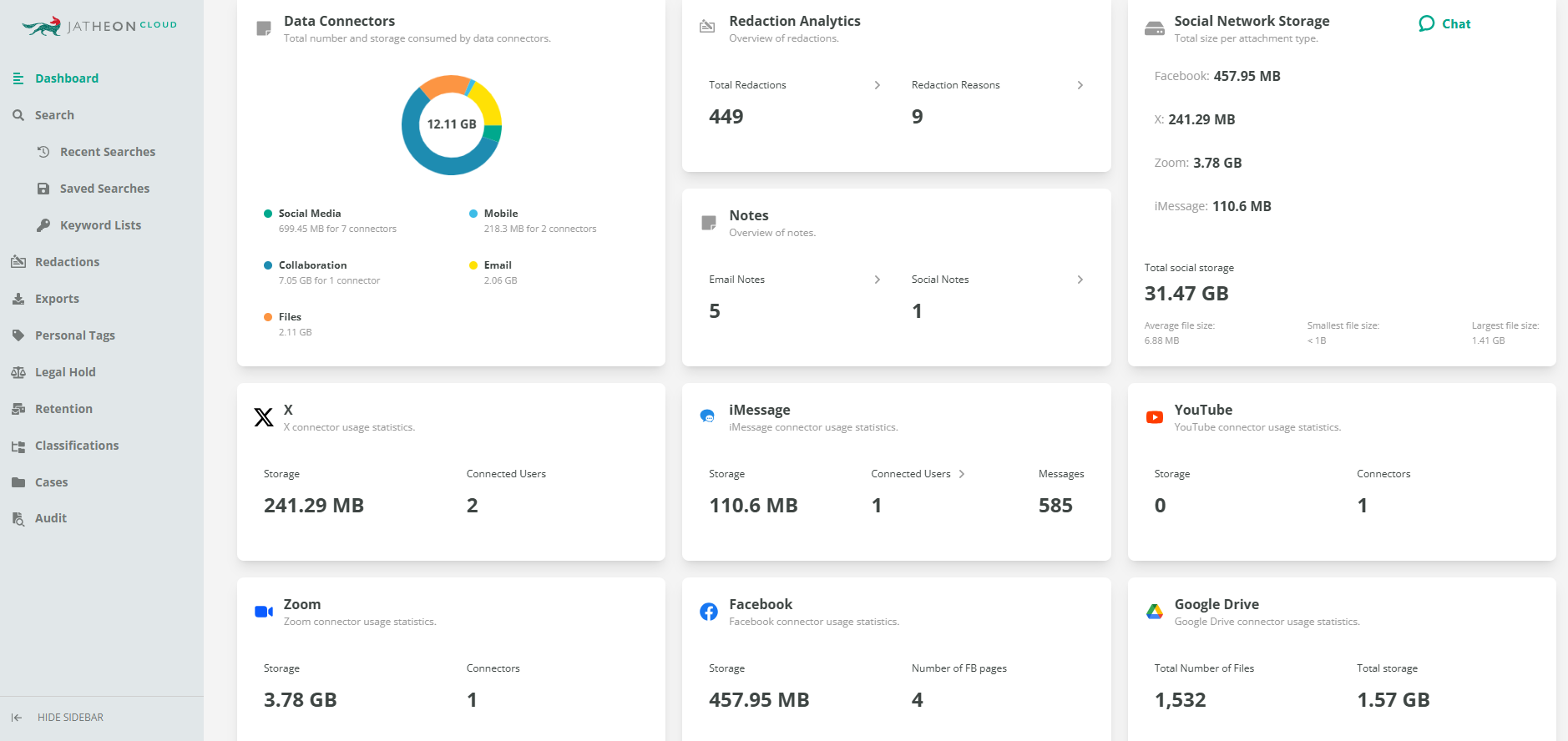
An exam request can span five channels and several custodians. Unified search supports Boolean, fuzzy and proximity operators, legal hold, case tags and export to PST, EML or PDF. Liya, Jatheon’s conversational AI copilot, answers natural-language questions about archived records, so your team builds one production from one screen.
Hedge Fund Compliance Checklist
Use this hedge fund compliance checklist to keep the recurring deadlines in one place. It covers SEC-registered hedge fund managers; add CFTC, state and non-US items if they apply to you.
Annually
- Amend Form ADV within 90 days of fiscal year end (Rule 204-1).
- Review compliance policies and document the review (Rule 206(4)-7).
- Collect holdings reports from every access person (Rule 204A-1).
Quarterly
- Collect transaction reports within 30 days of quarter end (Rule 204A-1).
- File Form PF within 60 days of quarter end if you’re a large hedge fund adviser; other filers file annually within 120 days of fiscal year end.
Ongoing
- Pre-approve access persons’ IPO and limited offering purchases.
- File Form PF current reports within 72 hours of a triggering event at a qualifying hedge fund.
- Notify affected individuals within 30 days of a qualifying data breach (Regulation S-P).
- Capture and retain business communications on every channel staff use, and retest capture after device and OS updates (Rule 204-2).
The rules behind hedge fund compliance are stable, but the channels your team uses keep changing, and the record has to exist either way.