Ediscovery software helps organizations find, preserve, collect, review, and produce electronically stored information (ESI) for litigation, investigations, audits, and records requests. Buyers often compare tools that do very different jobs.
Archives capture and retain communications as they happen and handle preservation, search, and export.
Processing and review platforms take collected data and help attorneys review it, code it, and produce it.
End-to-end suites try to cover the full electronic discovery reference model (EDRM), from legal hold to production. Most organizations need more than one category, and the right ediscovery solution depends on where your data lives and which stage costs you the most today.
What the Wrong Ediscovery Software Costs
The wrong tool usually costs you in three places, which are processing and hosting fees, gaps in what you collected, and court sanctions when data that should have been preserved is gone.
Per-GB fees add up quickly
In the Summer 2025 eDiscovery Pricing Survey from ComplexDiscovery and EDRM, 43% of respondents priced processing at ingestion under $25 per GB, and 44% priced completed processing under $100 per GB.
Hosting is billed again every month, with most respondents charging under $10 per GB per month without analytics. On a 500 GB matter that stays open for a year, those line items alone can reach five figures, before any review hours are billed.
Incomplete collection is harder to see
Many tools collect email well but treat Teams chats, text messages, and WhatsApp threads as an afterthought.
Some flatten them into plain text and lose the threading, reactions, edits, and attachments that give a message its meaning. When opposing counsel or a regulator asks for those conversations, a gap in collection becomes a gap in your production.
Lost data can lead to sanctions
Federal Rule of Civil Procedure 37(e) applies when ESI that should have been preserved is lost because a party failed to take reasonable steps, and it can’t be restored or replaced through additional discovery.
When the loss harms the other side, the court can order measures to cure that harm. If the court finds intent to deprive the other side of the information, it can instruct the jury that it may or must presume the data was unfavorable, dismiss the case, or enter a default judgment.

How to Evaluate Ediscovery Solutions
Five criteria separate ediscovery solutions that hold up in a real matter from tools that only look good in a demo. Use them to compare vendors inside a category and to decide which categories you need at all.
Channel coverage
Start with where your organization actually communicates.
Email is still where most collections begin, but many matters now also involve Microsoft Teams, Slack, Zoom, text messages, and WhatsApp. Ask each vendor for the list of channels it captures natively, and check whether those channels arrive with their context, such as threads, edits, deletions, and attachments.
A tool that needs a separate add-on for every channel will cost more and leave more gaps.
Collection defensibility
A collection is defensible when you can show what you collected, when, from whom, and that nothing changed along the way.
Look for tamper-evident audit trails for ediscovery, hash verification, and a clear chain of custody from capture to export.
The weakest point is usually a manual export from a live system, because nobody can prove what was in the mailbox before someone cleaned it up.
Native-format retention
Records kept in their original format, with full email metadata, are easier to authenticate and harder to challenge.
Ask whether the vendor stores data in a non-proprietary format and whether you can export it in that same format later. If the answer depends on a professional services contract, treat that as a cost and a risk.
Export formats
The export format matters as much as the search, because collected data has to move to outside counsel, a review platform, or a regulator. Check which formats the tool produces, such as PST, EML, and PDF, whether metadata and attachments survive the export, and whether exports carry a per-GB charge.
Your production format is usually agreed during the Rule 26(f) meet and confer conference, so confirm the tool can deliver it before that meeting.
Cost model
Ediscovery pricing ranges from per-GB processing and hosting to per-user subscriptions and per-matter fees.
Ask what you pay to ingest data, to keep it searchable, to export it, and to leave the vendor. Export and egress fees are easy to miss on a quote and expensive to discover in the middle of a deadline, so map every line item of your ediscovery costs before you sign.
Top Ediscovery Software by Category
The top ediscovery software tools fall into three groups, and each group was built for a different stage of the EDRM.
Comparing an archive directly with a review platform tells you little, so the table below sorts vendors by what they were designed to do.
| Vendor | Category | EDRM stages covered | Strongest data types | Best fit |
| Jatheon | Archive with ediscovery | Information governance, preservation, collection, search, export | Email, mobile, collaboration, social, and website data from 25+ channels | Organizations that need communications captured, held, and searchable before a matter starts |
| Smarsh | Archive | Capture, retention, supervision, ediscovery | Broad communications capture | Broker-dealers and other financial firms with supervision requirements |
| Global Relay | Archive | Capture, retention, supervision, ediscovery | Financial messaging and chat | Financial services firms |
| Microsoft Purview ediscovery | Built into Microsoft 365 | Preservation, search, export (review with E5) | Exchange, Teams, OneDrive, SharePoint | Organizations whose data lives almost entirely in Microsoft 365 |
| RelativityOne | Processing and review platform | Processing, review, analysis, production | Any collected data set | Law firms, service providers, and large litigation |
| Everlaw | Processing and review platform | Processing, review, production | Collected documents, audio, and video | Law firms, corporate legal teams, and government agencies |
| Reveal (including Logikcull) | Processing and review platform | Processing, review, production | Document review with AI analytics | Legal teams of all sizes, with Logikcull aimed at smaller self-service matters |
| Exterro | End-to-end suite | Legal hold through review and trial preparation | Corporate legal data | In-house legal departments that want one vendor across the EDRM |
- Archives work upstream, and their value shows up in completeness and speed, because the data is already collected when a request arrives. Their value shows up in completeness and speed, because the data is already collected when a request arrives.
- Processing and review platforms work downstream, which is why the per-GB fees described earlier sit here.
- End-to-end suites suit corporate legal departments with a steady caseload, and they still depend on clean collection from the systems where data lives.
Most organizations pair an archive with a review platform, or use a review platform only for the few matters that reach litigation.
Why Indexing and Search Depth Decide What You Can Find
The five criteria we discussed tell you what a tool collects and how it exports. Search depth decides what you can actually find in between, and it’s the difference that’s hardest to spot in a vendor table.
An ediscovery platform can only produce what its index can see. Two tools can hold the same data and return very different results, because one indexes message bodies, attachments, and metadata in full while the other indexes headers and a handful of fields.
- Full-text indexing at scale. Search engines built on Elasticsearch can index the full text of each item as it arrives, so a query across several years and millions of messages can return in seconds. Archives that weren’t built for that scale tend to slow down as data grows, and searches that time out push teams back to manual exports.
- Text locked inside images and scans. Scanned contracts, faxed forms, and screenshots shared in chat contain text that a standard index never reads. Optical character recognition (OCR) turns that text into searchable content. Without it, a keyword search can miss a responsive document even though it sits in the archive.
- Audio and video. Recorded meetings and voicemails are part of ESI too. Transcription makes spoken content searchable with the same keywords you use for email, which matters when the key conversation happened on a Zoom call.
- Search operators that match real requests. Requests rarely arrive as a single keyword. Boolean logic, proximity, wildcard, and fuzzy search let you build the query a request actually describes, including misspelled names and variations of a project code. Strong email archive search also lets you save, rerun, and document a query, so you can show a court or regulator exactly how you searched.
How Jatheon Handles Ediscovery
Of the three categories in this comparison, Jatheon is an archive with built-in ediscovery that covers preservation, search, and export, the stages before a matter moves to review. It captures data from 25+ channels, keeps it under your retention rules, and lets legal and compliance teams search, hold, redact, and export it without a separate collection project.
- Complete collection across channels. Requests now reach chat and mobile data that email-only tools miss. Jatheon’s native, in-house connectors for core channels such as Microsoft Teams, Slack, and WhatsApp capture messages with their threading, metadata, and attachments, so a conversation arrives in review looking like the conversation it was.
- Search that finds the whole record. A single request can span email, chat, and mobile messages from several custodians. Unified Search runs one query across every archived channel with 20+ search criteria on Elasticsearch indexing, so the whole request is covered in one search. OCR adds scanned files and images to the results. Liya, Jatheon’s AI assistant, can summarize a result set in plain language and shows the source items behind every answer.
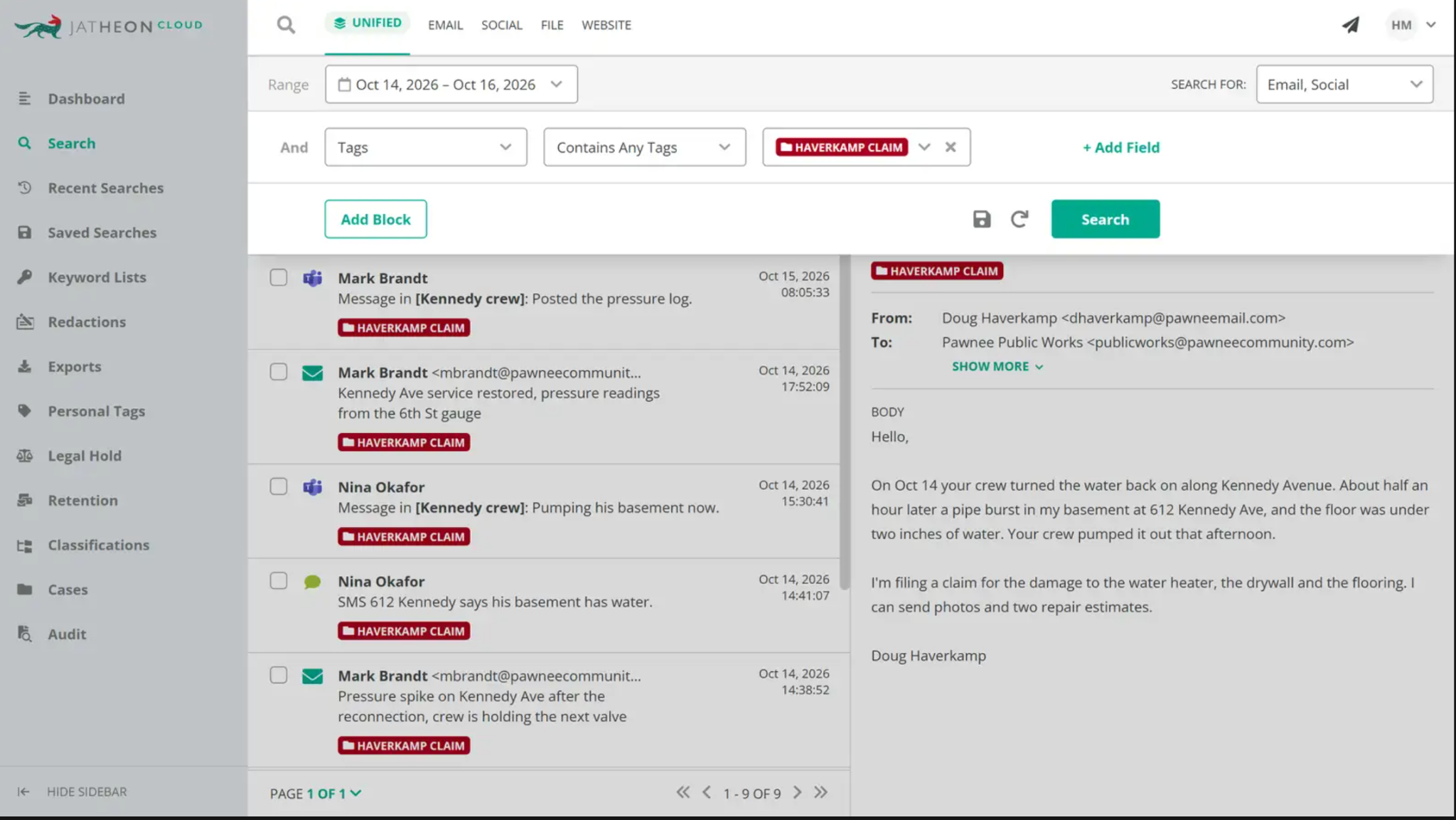
- Preservation and production in one place. Separate tools for holds, redaction, and export create handoffs that break the chain of custody. In Jatheon, Cases group searches, notes, and audit logs for each matter, and Legal Hold overrides retention so held data isn’t deleted while the hold is in place. Redaction works on messages and attachments and adds a PDF legend and log. Exports go out as PST, EML, PDF, CSV, or XLSX, so collected data can move to outside counsel or a review platform.
- Predictable cost at any volume. Search, investigation, and standard export are included in the subscription at any volume, with no ingestion or egress fees, and data stays in its original non-proprietary format. North East Independent School District (NEISD) in Texas has run 4,866 investigations on the platform.
Conclusion
Choosing ediscovery software starts with knowing which stage costs you the most. If collection and preservation are where your matters slow down, an archive with ediscovery built in fixes the problem where the data lives, and a review platform can take over when a case reaches attorneys.