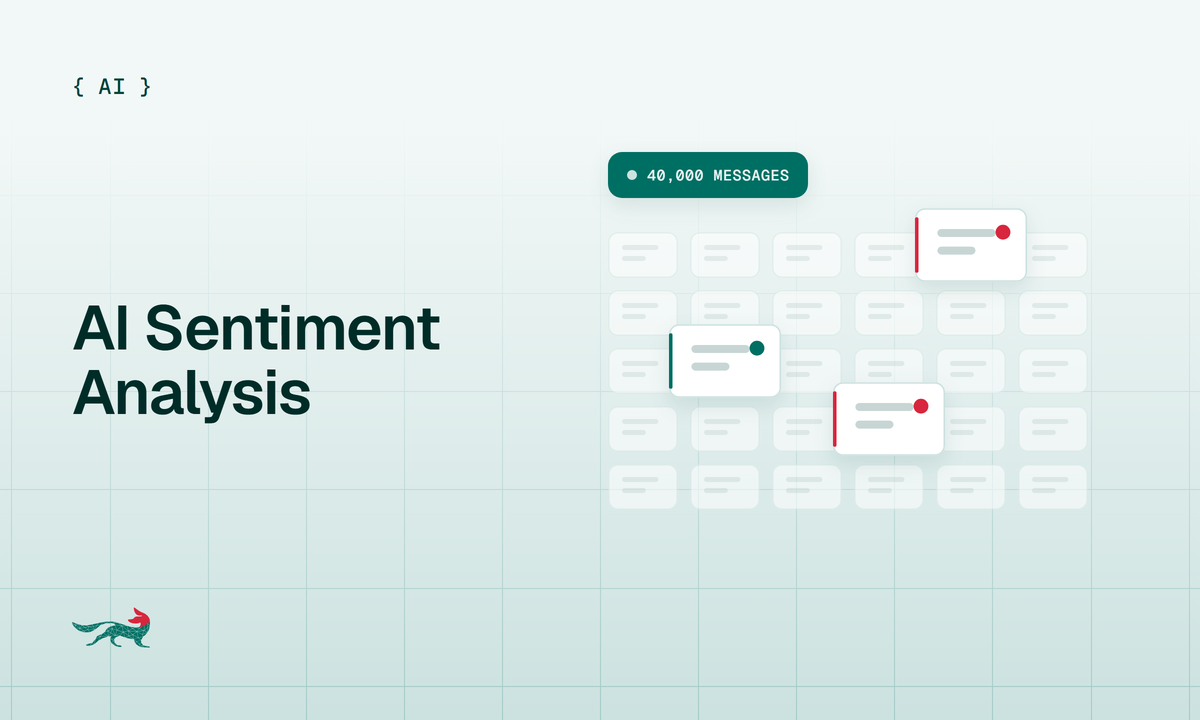
AI sentiment analysis for compliance tags the tone of each archived message as negative, neutral, or positive, so reviewers can start with the messages most likely to matter instead of reading a search result in date order. It gives investigators a second filter next to keywords, senders, and dates, and a person still decides whether a rule was broken.
Most IT and compliance buyers hear “sentiment analysis” and think of marketing dashboards. In an archive, it helps with a review problem. A search for an investigation can return 40,000 messages, and a keyword list flags plenty of harmless ones while missing indirect wording.
Sentiment shows which messages read like pressure, anger, or eagerness to accept something they shouldn’t, so reviewers open those first. This post explains what that looks like in practice, where it helps, where it doesn’t, and what regulators are saying about communications review.
What AI Sentiment Analysis Does in a Compliance Archive
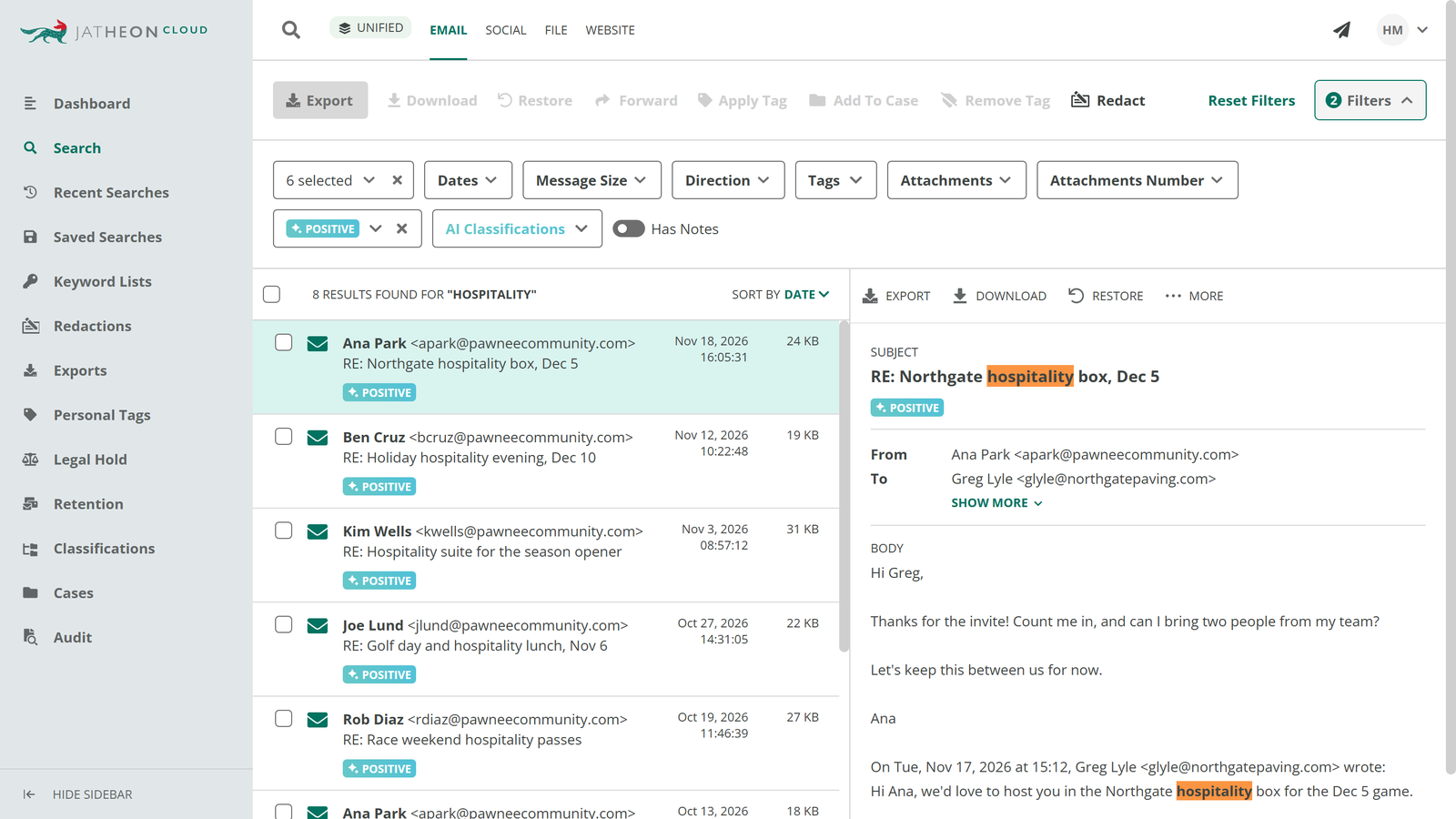
Sentiment analysis reads the wording of a message and assigns it a tone of negative, neutral, or positive. In Jatheon’s email archive, that tone is stored as a tag on the message and can be used as a filter in search, the same way you would filter by sender or date.
Keyword search finds messages that contain words you thought of in advance. Sentiment finds messages by how they read, including ones that use words nobody put on a list. A reply that says “count me in, and can I bring two people from my team?” contains no term a lexicon would flag, but its eager tone is worth a look.
Three things to know before using it:
- It prioritizes: The tag tells a reviewer where to look first. A person still decides what the message means.
- It works at archive scale: Tags are applied automatically to every email as it’s archived, so the filter works across every message that comes in.
- Most business mail is neutral: That’s what makes the filter useful. Neutral messages drop out of view, and a small set of negative or positive messages stands out.
Where Sentiment Helps an Investigation: Four Concrete Use Cases
Sentiment is most useful when you combine it with a second filter. Pair a tone with a topic, a person, or a date range, and a review queue of thousands shrinks to a few dozen messages.
These four scenarios show the pattern.
1. Replies to third-party gift and hospitality offers
A vendor invites an employee to a hospitality box at a sporting event or a racing weekend. The invitation itself is easy to find with a keyword list. The harder question is how the employee answered. An enthusiastic acceptance, especially one that asks for extra guests or suggests keeping it quiet, deserves a closer look than a polite decline.
A global financial services firm evaluating Jatheon in 2026 asked to flag employee replies to third-party gift offers so compliance could check them against the firm’s gifts and entertainment policy. Search for the hospitality terms, filter to positive messages sent by your employees, and the review queue is the acceptances rather than every message that mentions an event.
2. Escalating tone in a thread
Disputes rarely start with the angriest message.
They build over a thread. When tone moves from neutral to negative over several replies between a client and an adviser, or a supplier and a procurement officer at a government agency, that pattern often points to a complaint, a conflict of interest, or a conversation that later becomes evidence.
Filtering a person or a thread by negative tone lets an investigator see where it turned.
3. Pressure language
Messages that push someone to act quickly, skip a step, or avoid putting something in writing tend to read as tense.
A supervisor looking at a sales team near the quarter end, or a finance team at a deadline, can filter that group’s messages by negative tone and review those first. That’s a faster starting point than a keyword list of every phrase pressure could take.
4. Complaints and dissatisfaction from outside parties
Customers, residents, and counterparties put complaints in writing before they escalate to a regulator or a lawsuit.
A negative-tone filter over inbound mail gives a compliance or records team an early view of those messages, and a negative trend over time is visible on Jatheon’s AI compliance dashboard.
Sentiment Analysis vs. Keyword Lexicons
Sentiment analysis works alongside lexicon-based communication surveillance, and each covers gaps the other leaves.
| Keyword lexicon | AI sentiment analysis | |
| Finds | Messages containing words and phrases you listed | Messages whose tone reads negative, neutral, or positive |
| Strength | Precise, explainable, easy to defend in an audit | Catches wording nobody anticipated |
| Weakness | Misses new slang, euphemisms, and indirect phrasing | Doesn’t know your policies or what a gift is |
| Maintenance | Lists need regular revision | No list to maintain |
| Best used for | Named risks: specific terms, tickers, products | Prioritizing review, spotting escalation, narrowing large result sets |
The practical pattern is a keyword search for the topic, then a sentiment filter to narrow the results.
What Regulators Say About Communications Review
Regulators expect firms to review electronic communications and to keep their surveillance current, and they’re paying attention to how AI fits in. Three sources frame the expectation.
- FINRA Rule 3110: Requires member firms to have written procedures for reviewing incoming and outgoing electronic correspondence and internal communications, with the review evidenced in writing. A negative-tone filter helps reviewers find customer complaints, which the rule requires review to identify, and a person still has to read each message, since FINRA states that merely opening a communication isn’t sufficient review.
- FINRA’s 2026 Annual Regulatory Oversight Report: Published Dec. 9, 2025, it includes a chapter on generative AI, a new topic for 2026. The point for buyers is that AI features in a compliance workflow need supervision and governance like any other tool.
- FCA multi-firm review on off-channel communications: The UK regulator’s August 2025 review found firms combining natural language processing with lexicon models and exploring AI to reduce false alerts. It also reminds firms that SYSC 10A responsibilities can’t be handed to a third-party vendor.
Two takeaways follow. First, firms are already combining AI with lexicon-based surveillance. Second, the firm stays accountable for the result, so financial services firms adding sentiment to supervision should treat it as a prioritization aid, keep the human decision, and keep the audit trail.
Limits to Plan For
Sentiment analysis is a statistical read of language, so plan for its limits before you rely on it.
- Sarcasm and dry humor: A joke can read as negative. Reviewers need to open the message.
- Industry shorthand: Words that are negative in everyday speech, such as “short” or “default” in a trading context, can skew a score.
- Opposite-tone errors: The accuracy test that matters is whether a negative message is ever tagged positive, or a positive one negative. Ask any vendor how it measured this, and test it on a sample of your own messages.
- Not a verdict: A tag marks a message for review, and any finding comes from the person who reads it.
- Intent of use: Define in your policy that the filter supports compliance and records review, and who is allowed to use it.
How Jatheon Delivers AI Sentiment Analysis
Jatheon runs sentiment analysis inside the Jatheon cloud archive, so there’s no third-party tool to license, export data to, or keep in sync. The models run within Jatheon’s AWS infrastructure, archived messages are never sent to external AI providers, and customer content isn’t used to train them.
- Tags in search: Sentiment appears as a filter alongside sender, date, and keywords, so one search can say “messages about the event invitation, from these users, in the last quarter, with a positive tone.”
- Dashboard view: The sentiment widget on the AI Dashboard shows how tone is distributed across archived email, next to statistics for Liya, Jatheon’s AI assistant, so a shift stands out.
- Logged AI activity: Every AI-driven action is logged with justification reports and an audit trail.
- One archive for more than email: Jatheon archives and searches content from sources including collaboration tools and Slack.
- Fits ediscovery and audits: Teams using sentiment analysis in ediscovery filter a large collection by tone before ediscovery review, and the same filters support a communication audit.
Sentiment analysis is a paid AI add-on, switched on per customer alongside the other Jatheon AI features, such as the Liya assistant, OCR, and audio transcription. AI is priced per user because it processes every message for every user. Your account team will quote it with the rest of your compliance archiving package, as a full AI bundle or individual features.
Questions to Ask Before You Add Sentiment Analysis
- Which of my messages are scored, and can I see the score on each one?
- Can I filter by tone in the same search as keywords, senders, and dates?
- How has accuracy been tested, and can I run it on a sample of my own data?
- Where does the data go during analysis, and does it leave my archive region?
- Is every AI tag labeled as AI-generated, and is use of the filter logged in the audit trail?
- Is it priced per user, and what happens to cost as headcount changes?