
A WhatsApp content policy in Jatheon can take a non-compliant message off every employee phone in the chat while the original stays in your archive. If a financial advisor pastes a client’s account number into a group chat with colleagues, the message has to leave the chat quickly, and the record of it still has to be there for an audit.
Here, a WhatsApp content policy means your organization’s own rules for what employees can’t share on WhatsApp, enforced through your archive.
Removing a harmful message protects the client, patient, or student, but deleting a business record can look like destroying evidence.
Below you’ll see how to keep removal and retention apart, how to set up enforcement in Jatheon Cloud, and where WhatsApp itself sets limits.
What Is a WhatsApp Content Policy?
A WhatsApp content policy is a set of rules that defines which content employees shouldn’t share in work chats and what happens when a message breaks one of those rules.
There are no built-in policies, so each organization writes its own, naming the content to look for and the reason recorded when a matching message is removed. The table below shows examples of policies you could create.
| Policy | What it looks for | Reason shown to reviewers |
| Sensitive personal information | Social Security numbers, dates of birth, home addresses | Contains sensitive PII |
| Sensitive student information | Grades, disciplinary notes, student ID numbers | Contains FERPA-protected information |
| Inappropriate language | Profanity, harassment, slurs | Inappropriate language |
| Confidential numbers | Client account numbers, internal phone numbers | Contains a confidential account or phone number |
A content policy takes over at the point where a communication surveillance program usually stops. Surveillance flags a risky message for a reviewer, and the message stays visible in the chat until someone acts on it, while a content policy removes it as soon as it matches the rule.
Why Deleting a WhatsApp Message Can Create a Recordkeeping Problem
Work messages on WhatsApp are business records, so deleting one can break the same rules that require you to keep it. Broker-dealers have to preserve business communications under SEC Rule 17a-4, and FINRA Rule 4511 requires member firms to keep FINRA records for at least six years when no other rule sets a retention period, in a format that meets SEC Rule 17a-4. Government agencies have the same duty under FOIA and state public records laws.
When a message disappears without a copy, a regulator or opposing counsel can treat the gap as spoliation, the destruction of evidence a party was required to keep. Courts have sanctioned organizations that let chats vanish after a duty to preserve disappearing messages had already started.
How long each message has to stay in the archive depends on the retention periods for WhatsApp records that apply to your industry.
What a WhatsApp Policy for Employees Should Cover
A WhatsApp policy for employees should tell staff which accounts they can use for work, what they can’t share, and what happens when a message breaks the rules. HR guides already cover tone and conduct, so the checklist below ties each rule to an enforcement action.
- Business use and approved accounts: which phone numbers and WhatsApp accounts are connected to the archive, and which can’t be used for work.
- Prohibited content: each category with examples, such as client account numbers, patient details, student records, and offensive language. For healthcare teams, keeping patient details out of chats is part of WhatsApp HIPAA compliance.
- Consent and BYOD: how employees consent to capture, and how personal contacts on a personal phone stay out of the archive.
- Enforcement: that matching messages are removed from the chat, the sender can be notified by email, and compliance can review the record.
- Ownership: who can create or change a policy, and how those changes are approved.
Treat this document as a WhatsApp compliance policy that sits inside your records management policy, so retention, legal hold, and disposal apply to WhatsApp the same way they apply to email.
Add a WhatsApp message deletion policy clause
Employees should know in advance that a message can be removed, and a signed clause is the simplest way to tell them.
A WhatsApp message deletion policy clause can read like this:
Messages sent from WhatsApp accounts connected to [Company]’s archive may be deleted for all chat participants if they match a company content policy. The sender may be notified by email when a message is removed. The original message is retained as a business record under [Company]’s records retention schedule.
Use this as sample text only and review it with legal counsel, because consent and notice rules differ by state and country.
How to Enforce a WhatsApp Content Policy in Jatheon Cloud
Jatheon Cloud enforces a WhatsApp content policy in five steps, from connecting accounts to reviewing what was removed. Content Policy currently works on WhatsApp, and each step below matches a screen in the app.
1. Connect the WhatsApp accounts you need to cover
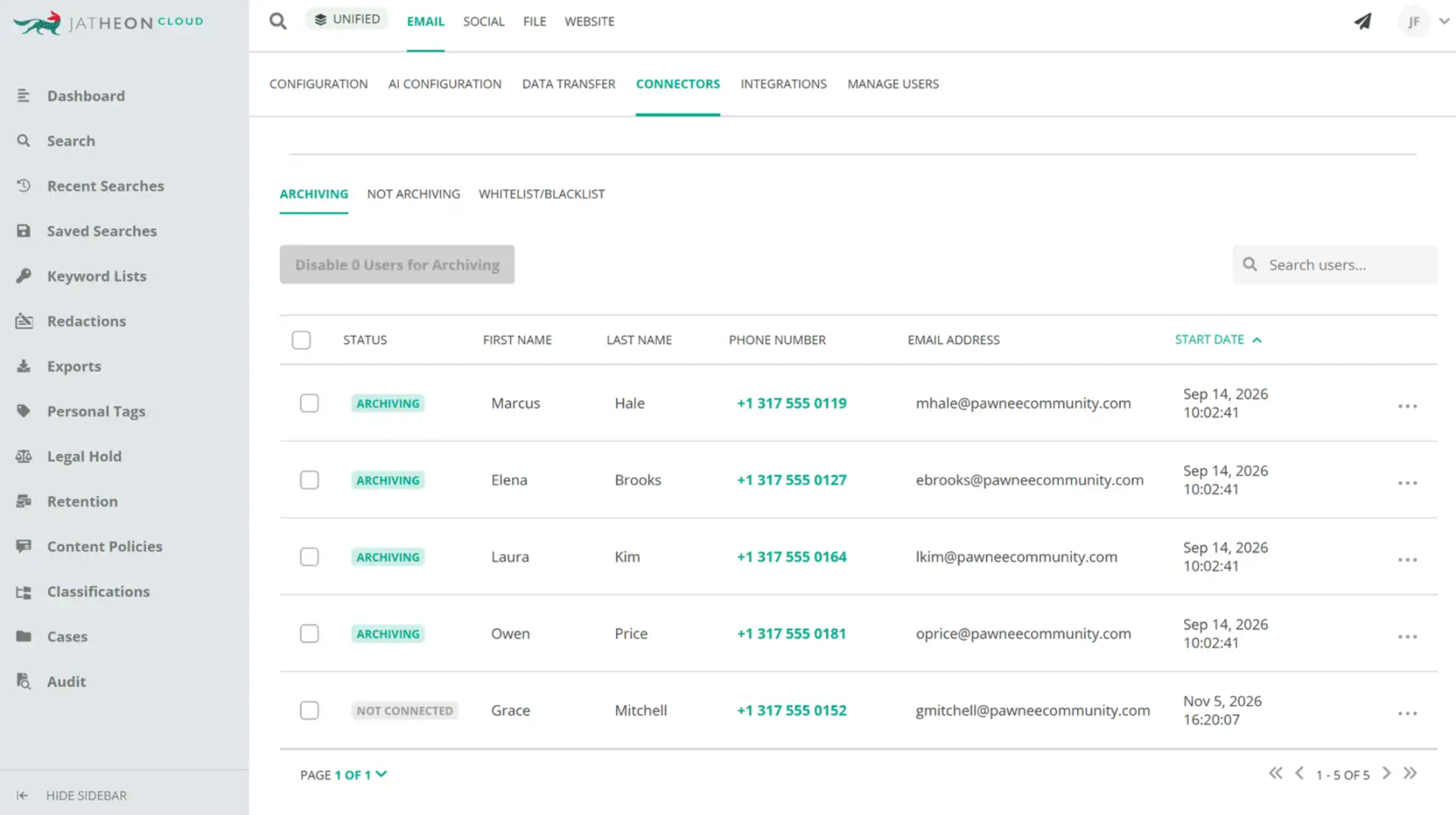
Sync your identity provider, such as Microsoft Entra ID, Google Workspace, Active Directory, or Okta, and choose the employees to include.
Meta requires each user’s consent, and Jatheon tracks those approvals for you. Users link their account by scanning a QR code, with no extra app on the phone, because WhatsApp compliance archiving in Jatheon connects through Meta’s cloud. Whitelists and blacklists keep personal contacts out of capture.
2. Create the policy and define its criteria
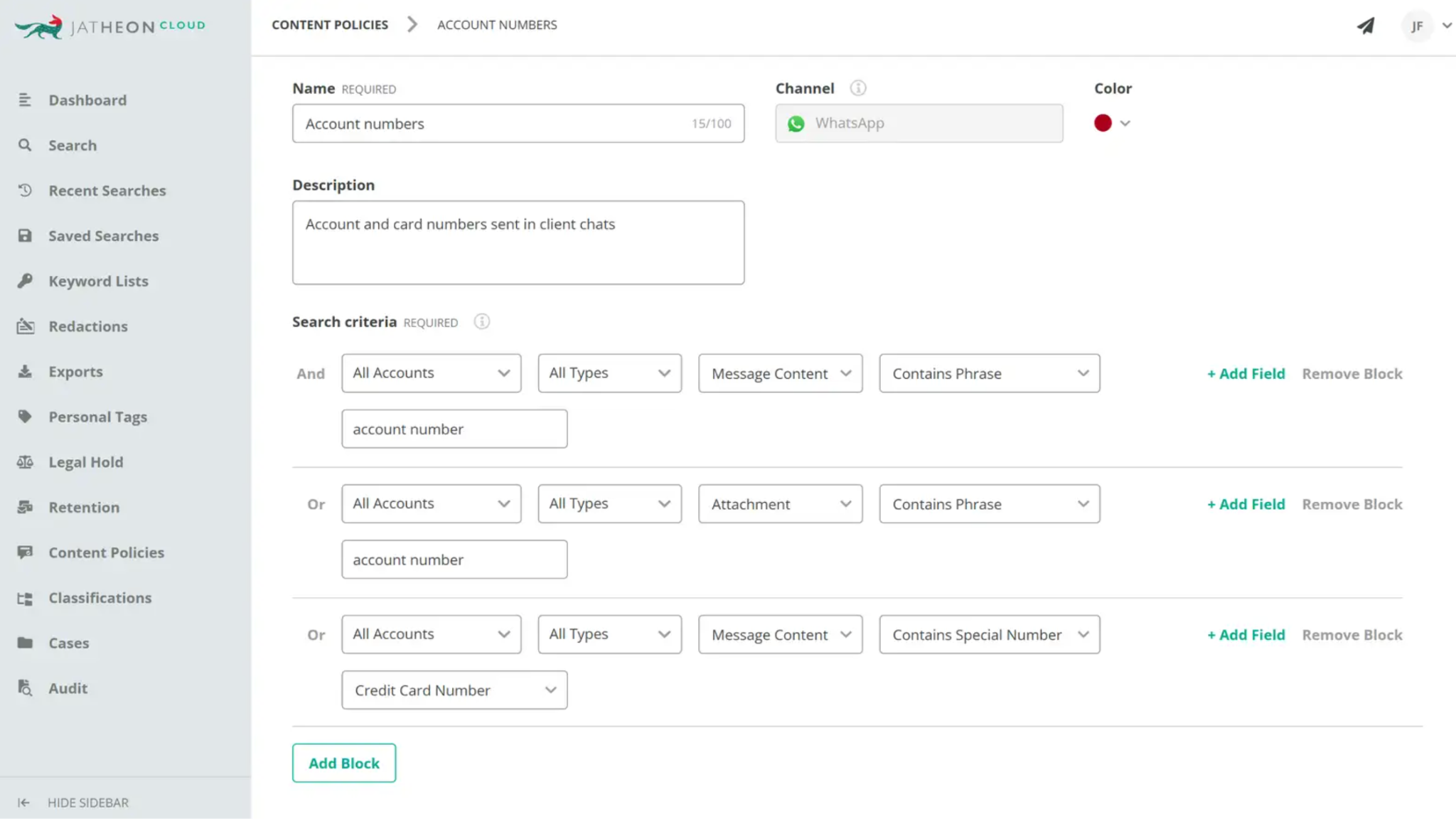
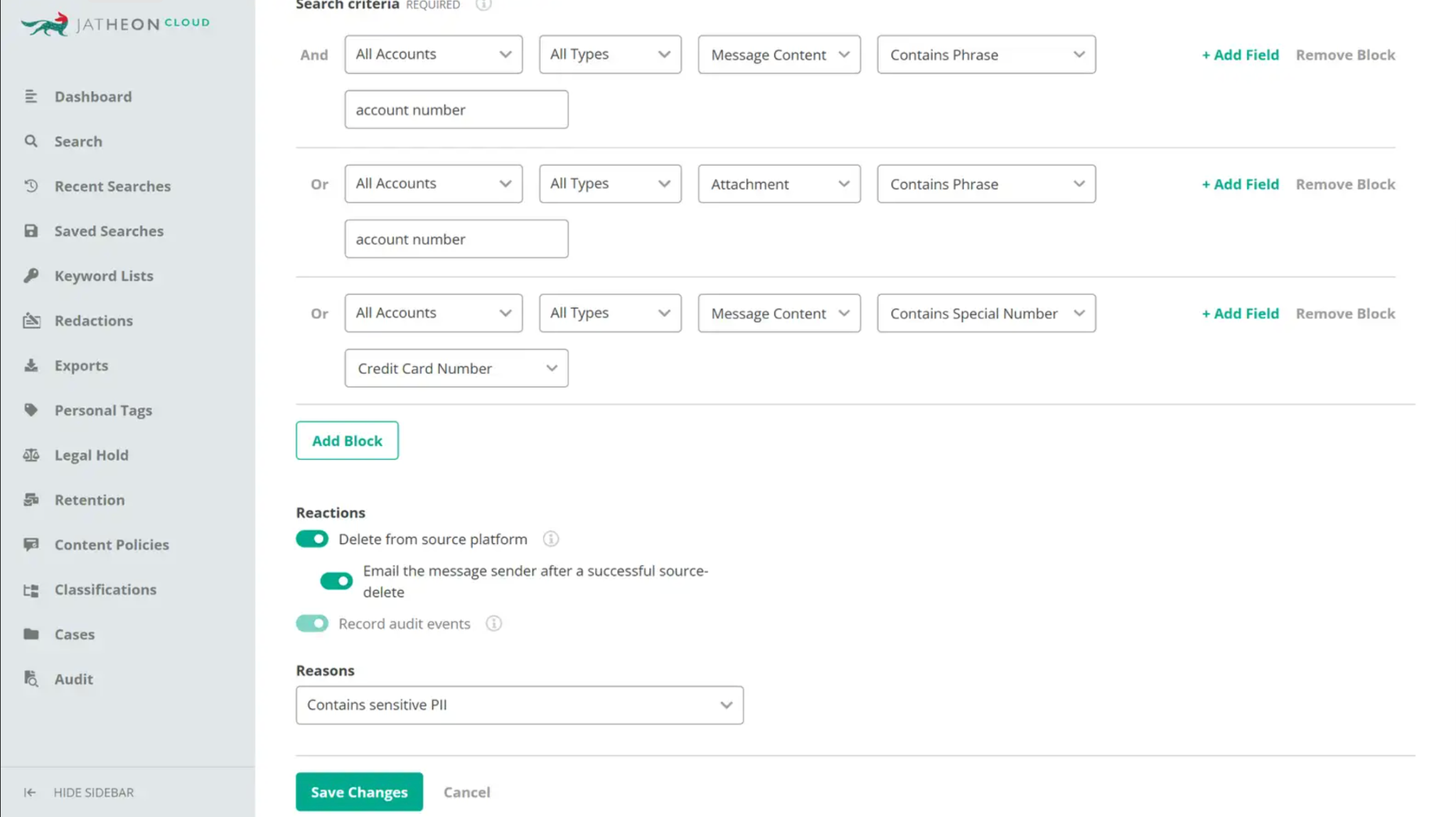
Give the policy a name, select WhatsApp as the channel, pick a color, and add a short description so reviewers know what it’s for. Then build the search criteria from custom fields and blocks, such as keywords, prohibited language, or specific phone and account numbers.
3. Turn on deletion at source and choose a reason
In the policy, turn on Delete from source platform. When a message matches, Jatheon deletes it on WhatsApp for everyone in the conversation and always keeps the archived copy. Then pick the reason reviewers will see, for example, “Contains sensitive PII.”
4. Let the sender know why
Turn on sender email notification, and Jatheon emails the sender to say the message was deleted because it broke a company policy. Hearing about the removal right away helps the rule stick better than a reminder weeks later during a review.
5. Find every removed message in search
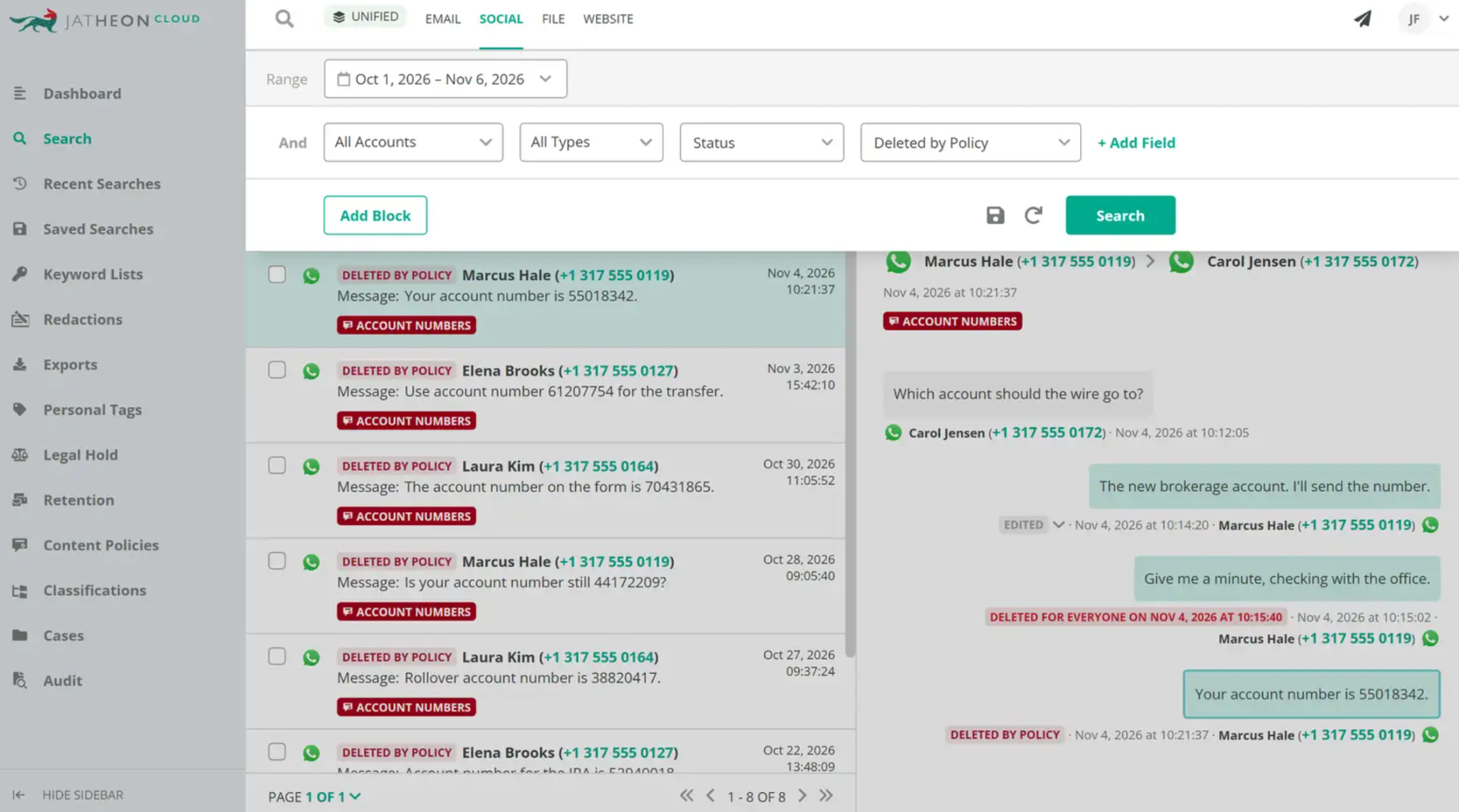
In search, select the WhatsApp accounts you want to review and look for messages with the “Deleted by policy” status. Each result shows the content, the sender, and the timestamp, with the policy’s tag attached.
What Happens to the Record After a Message Is Removed
The archive keeps the original message as it was captured, with its content, sender, timestamp, and metadata. The “Deleted by policy” status sets these messages apart from the ones employees delete or edit on their own, so a reviewer can tell an enforcement action from a user’s choice.

Each deletion is also recorded in the audit log, which is read-only, so nobody can change or delete its entries.
That gives the removal itself a full audit trail you can show an examiner, and policy-removed messages follow your retention schedule like any other record, stay under legal hold while a matter is open, and can be exported for ediscovery or a public records request.
Limits to Plan For Before You Turn On Deletion
WhatsApp’s own behavior sets a few limits on what removal can achieve. The WhatsApp Help Center page on deleting messages warns that recipients might see a message before it’s deleted, or still see it if the deletion doesn’t go through, and that iPhone users may still have its media saved to Photos.
WhatsApp doesn’t send any notice when a deletion for everyone fails, and the deletion only works when everyone in the chat uses the latest version of the app. Employees who delete a message for everyone themselves have to do it within two days of sending it, and after that WhatsApp only lets them delete their own copy.
Jatheon marks any message it couldn’t remove as “Policy delete failed” and records the failure in the audit log. Deletion is also possible only within a limited window after a message is sent, and a match found after that window closes is logged instead of deleted.
Content Policy has scope limits of its own:
- It covers only the WhatsApp accounts connected to Jatheon.
- It doesn’t record real-time WhatsApp calls.
- It skips conversations with personal contacts you’ve excluded from capture.
Conclusion
You can keep WhatsApp as a work channel, enforce your own rules on it, and still produce the full record when a regulator, court, or requester asks for it. A content policy takes the risky message out of the chat, and the archive keeps the original, the reason for its removal, and the audit entry in one place.