
FINRA Rule 8210 gives FINRA staff and adjudicators the authority to require member firms, associated persons, and others subject to FINRA’s jurisdiction to provide information, documents, and sworn testimony, and to inspect and copy books and records for an investigation, complaint, examination, or proceeding.
Because FINRA has no subpoena power, Rule 8210 is its primary investigative tool. Recipients must respond fully, truthfully, and on time, because failing to respond, or responding incompletely or inaccurately, can bring fines, suspension, a bar for individuals, or expulsion for firms.
What It Costs to Get FINRA Rule 8210 Wrong
The price of a slow or incomplete response shows up in real dollars and real careers. On Jan. 8, 2025, FINRA issued a Letter of Acceptance, Waiver, and Consent (AWC) that censured and fined Investments for You, Inc. of Marysville, Ohio $25,000. The AWC included a finding that the firm failed to timely respond to Rule 8210 request letters, according to FINRA’s March 2025 Disciplinary and Other FINRA Actions.
Because of the non-response, FINRA issued a Notice of Suspension under Rule 9552. The firm was suspended and warned it would be expelled unless it acted. It produced the records nearly four months after FINRA first requested them.
Careers end over non-response, too. In the same January 2025 FINRA actions, John Alfred Dow Jr. and Charles Wodrich were barred in all capacities for refusing to produce Rule 8210 documents or testimony.
Fines vary widely. FINRA’s Regulatory Notice 22-20 set a $5,000 minimum for firms and removed the upper limit for mid-size and large firms that fail to respond or respond untruthfully. Individuals usually face a permanent bar, even when the underlying conduct is never proven. According to FINRA, more than a third of the enforcement cases that ended in individual bars over a two-year period involved Rule 8210 violations.
What FINRA Can Demand under Rule 8210
Rule 8210 rests on two core powers. Under Rule 8210(a)(1), FINRA can require a member, associated person, or other person under its jurisdiction to provide information orally, in writing, or electronically. It can also compel testimony at a location FINRA staff specifies.
Under Rule 8210(a)(2), FINRA can inspect and copy the books, records, and accounts in that person’s possession, custody, or control. In practice, an 8210 letter is usually specific. It names custodians, such as a registered representative, a branch manager, or a supervisor, sets a date range, and asks for every email, chat, text message, and call record those people sent or received in that window.
The duty to answer fully and truthfully applies to spoken answers just as it does to documents. A careless or evasive answer carries the same risk as a missing file.
The scope is broad by design. It reaches records tied to compliance with FINRA rules, Municipal Securities Rulemaking Board (MSRB) rules, and federal securities laws.
That reach includes outside business activities and private securities transactions. It also covers possible violations of the just and equitable principles of trade under Rule 2010, according to the FINRA FAQ.
Who Has to Respond and What Catches Firms Off Guard
The obligation reaches member firms, associated persons, and other people subject to FINRA’s jurisdiction, including former registered and associated persons under Article V, Sec. 4 of its By-Laws. Leaving a firm does not close the door on a request, and neither does location. There is no exception based on foreign law, according to Regulatory Notice 25-11 (Sept. 25, 2025).
Service is easier to trigger than many teams expect. A request is deemed received when FINRA sends it through FINRA Gateway or to the last known address, according to the FINRA FAQ. If FINRA knows you have counsel, it serves your attorney instead, and that counts as receipt under Rule 8210(d). Individuals who let their contact details lapse risk a default bar for a letter they never opened.
A few other details catch compliance teams off guard:
- An 8210 request is not a finding of wrongdoing; it signals that FINRA believes you may hold relevant information (FINRA FAQ);
- The Fifth Amendment offers no shield here, because FINRA is a self-regulatory organization, not a government agency (Spodek Law Group); and
- FINRA can compel on-the-record testimony even after a Wells Notice, though the SEC vacated related sanctions in its May 28, 2026 DiPaola opinion.
How Firms Must Respond and the Deadlines That Matter
Every response is judged on three things: completeness, accuracy, and timing. Incomplete or inaccurate answers that you do not promptly correct can trigger the same sanctions as silence, according to the FINRA FAQ. Each request letter sets its own deadline, and those windows are often short.
A written, tested process helps here. Firms that assign a clear owner, log every request, and track deadlines tend to respond on time and in full.
The consequences scale with the failure:
- Non-response: fines, and a bar for individuals or expulsion for firms;
- Partial response: fines and possible suspension; and
- Late response: fines and suspensions.
Timeliness carries independent weight. A complete production that lands after the deadline is still a violation. Meeting the date is as important as getting the content right.
Why Firms Miss Rule 8210 Deadlines
Most missed deadlines don’t come from refusing to cooperate. They come from records that live in too many places. Email sits in one system, Teams and Slack chats in another, and texts and WhatsApp messages in a separate capture tool or on employees’ phones. Without a single search across all of them, compliance teams run separate searches, export each result set, and stitch everything together by hand, checking custodians and dates line by line. Every manual step costs time and adds another chance to miss a record.

The through-line is preservation. A request can demand emails, internal messages, and electronic files at any time. A firm that cannot locate and produce those records quickly is exposed long before FINRA knocks. That’s why 8210 readiness starts with the recordkeeping duties in FINRA Rule 4511.
How Jatheon Helps You Respond to a Rule 8210 Request
A Rule 8210 clock starts the moment a letter arrives, so the real question is whether your archive can produce complete, defensible records fast.
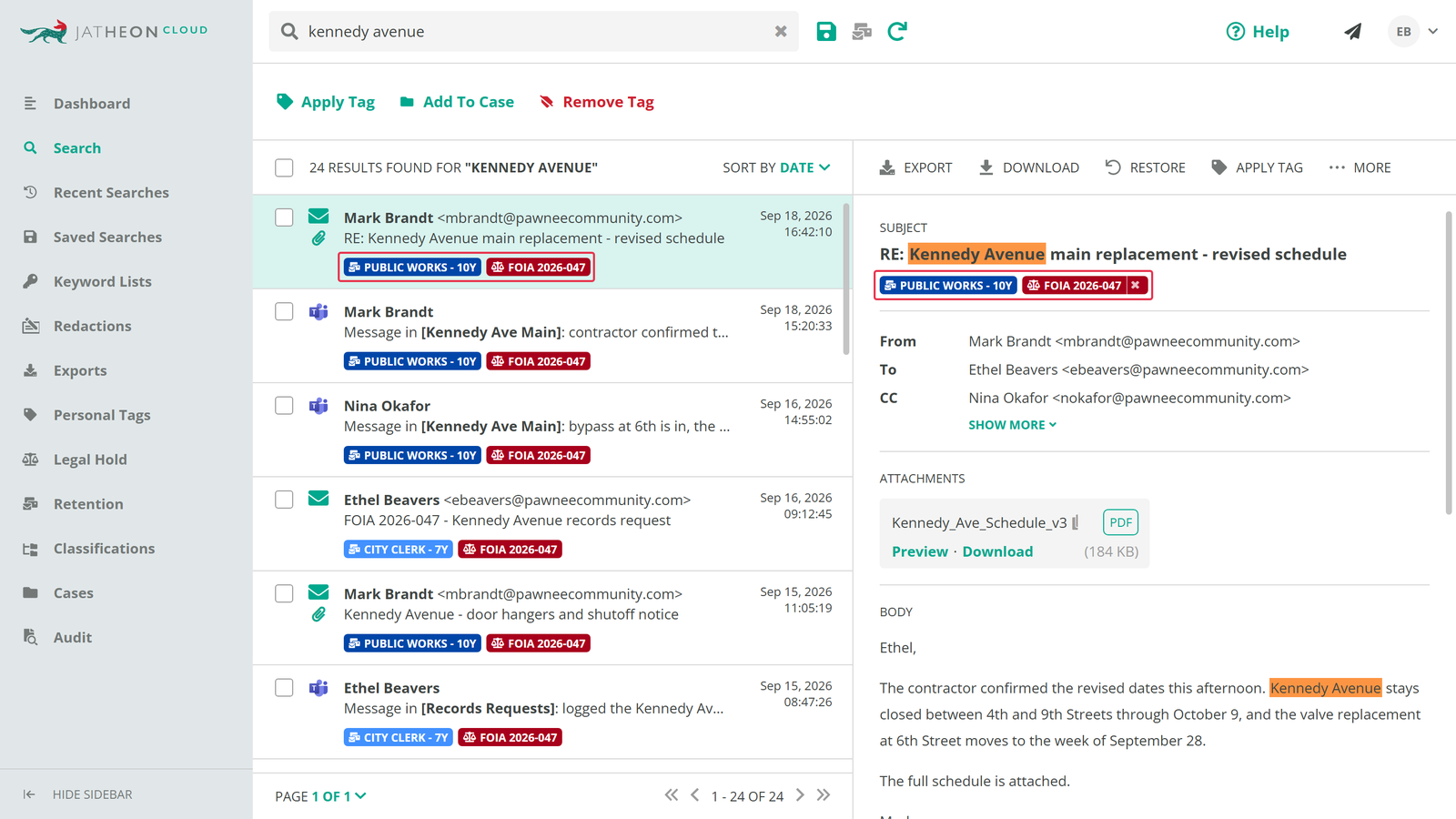
Short deadlines push many firms into a scramble, like the four-month gap that got Investments for You suspended. In Jatheon Cloud, Unified Search runs across a WORM (write once, read many) storage archive, and Elasticsearch-backed indexing returns results in seconds, even across multi-year archives at enterprise scale. You pull responsive email and chat records quickly and produce them with retention and legal hold context intact.
Off-channel messaging drives many incomplete-response findings. Jatheon Data Connectors capture 25+ channels, including SMS, WhatsApp, iMessage, and Microsoft Teams, in evidentiary-quality formats. Your production covers the channels FINRA now expects, with no silent gaps. Each 8210 letter can live in its own Case, so the custodians, searches, holds, and exports for that request stay together, and Redaction lets you mask privileged or out-of-scope content before anything leaves the firm.
Regulators can also challenge whether records were altered. WORM storage, Audit Logs, an AI-driven action log, and role-based access with 60+ permissions work together here. They keep every record tamper-evident and access-controlled during a live investigation.
Liya, Jatheon’s conversational AI copilot, can also summarize a thread to speed up review.
Production is where deadlines are won or lost, and it’s where Jatheon’s ediscovery tools do the heavy lifting. Legal hold locks the responsive set so nothing changes mid-investigation, and export to PST, EML, and PDF hands FINRA the formats it expects. Export at any volume is included at no charge. You keep a clean chain from capture to production.
The scale behind this matters when a regulator is waiting. Jatheon has archived more than 21 billion messages for over 500 organizations, with capture and retrieval proven under real regulatory demand.